
A 30-nanometer gap separates 630 nm from 660 nm. That tiny distance on the spectrum determines how deeply light reaches your tissue, which is why people ask: Is 630 or 660 red light better?
Neither 630nm nor 660nm is universally better for red light therapy. Both are visible red wavelengths used in photobiomodulation research. Their tissue absorption and scattering characteristics differ, with 660nm generally showing somewhat more favorable relative tissue propagation under many conditions. However, neither wavelength has a fixed anatomical penetration depth, and practical performance also depends on irradiance, dose, beam geometry, tissue properties, and the intended application..
Understanding this photochemistry helps you read past marketing claims about LED counts and nominal wavelengths. You will learn how manufacturing tolerances shift the actual output of any panel, and what specifications genuinely determine a device’s clinical value.
Why wavelength matters: the photochemistry behind 630 nm and 660 nm red light

Most consumer health blogs treat “red light” as a single category. The 30-nanometer shift between 630 nm and 660 nm fundamentally changes how photons interact with cellular chromophores. Research published in Photomedicine and Laser Surgery demonstrates that cytochrome c oxidase (CCO), the primary mitochondrial photoreceptor, has distinct absorption peaks across the visible red spectrum. Both wavelengths stimulate CCO, but 660 nm aligns more closely with the optimal peak for driving adenosine triphosphate (ATP) production in deeper tissue layers.
Kevin Zhang, Chief Technology Officer at REDDOT LED, draws on over 15 years of optical engineering experience to explain why medical-grade photobiomodulation requires precise wavelength targeting rather than broad-spectrum approximations. Is 630 nm enough for red light therapy? It is highly effective for superficial targets like epidermal cells. For systemic or subcutaneous applications, 660 nm generally delivers superior results because of its photon absorption depth profile.
The misconception that all red wavelengths behave identically
Users frequently assume any device labeled “red light therapy” delivers identical biological outcomes regardless of the specific nanometer rating. Optical physics contradicts this. Longer wavelengths within the red spectrum scatter less in biological tissue than shorter ones. Photons closer to 700 nm travel further before losing energy compared to those near 600 nm, allowing 660 nm light to reach deeper structures. Anyone evaluating red light wavelength therapy should verify the exact peak wavelength and full width at half maximum (FWHM) of the LEDs used instead of relying on generic marketing terms.
A sports recovery clinic in California, for example, replaced standard panels with high-irradiance multi-wavelength devices and reduced client treatment times by 50%. The outcome hinged entirely on matching the correct wavelength to the required tissue depth. Understanding this photochemical distinction determines whether a device actually reaches its intended target.
The manufacturing reality: why “630 nm” and “660 nm” are rarely what the box claims
Even high-quality LED diodes carry a manufacturing variance of ±5 nm. In poorly manufactured devices, mixing bins can result in a panel marketed as 660 nm actually emitting a scattered range closer to 650–670 nm, diluting therapeutic efficacy. An LED chip rated for 660 nm does not automatically emit exactly 660 nm under real-world operating conditions. Thermal drift during extended use shifts the output wavelength, and poor component identification during assembly compounds the problem.
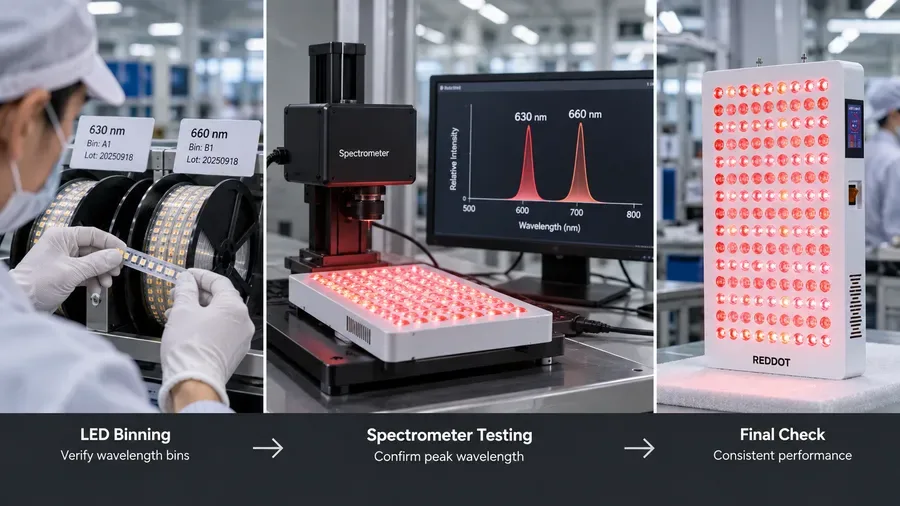
Rigorous manufacturing standards prevent these errors. REDDOT LED operates an ISO 13485-certified quality management system that mandates strict spectrometer testing to ensure wavelength consistency across every batch. Maintaining irradiance stability alongside wavelength accuracy demands serious optical engineering. The company’s 17-member R&D team holds over 70 granted patents focused specifically on solving these photobiomodulation challenges. During the production of one panel model, engineers discovered that the control board’s ribbon cable overlapped with the power supply, creating a safety hazard where wire insulation could be damaged.
They redesigned the mounting position to create clearance and updated the bill of materials to replace 36mm screws with 34mm screws that no longer pressed against the control board. That level of physical precision directly protects the optical integrity of the chosen wavelength.
How slight wavelength shifts change application depth
The Rhinitis Lamp uses 12x3W LEDs specifically tuned to a 650 nm wavelength with a controlled 10mW/cm² irradiance. Engineers deliberately selected 650 nm instead of 630 nm or 660 nm for this localized nasal application because the target tissue sits at a very specific shallow depth where 650 nm offers optimal absorption. The “best” wavelength depends entirely on the target tissue depth and required dosage. Broader panels follow the same logic, confirming that precise wavelength selection is a deliberate engineering choice rather than an arbitrary number. Verifying how manufacturers control these tolerances separates reliable equipment from misleading specifications.
Is 660 nm red light effective compared to 630 nm for clinical outcomes?

Is 660nm red light effective? Yes. It is the most studied red wavelength for deep tissue efficacy, while 630 nm excels strictly at the skin surface. Studies published in Lasers in Medical Science comparing optical penetration depths confirm that 660 nm photons reach subcutaneous structures that 630 nm light cannot effectively access. The World Association for Photobiomodulation Therapy (WALT) widely standardizes 660 nm in therapeutic protocols because it offers the optimal balance between mitochondrial stimulation and tissue penetration. Is 630 nm red light effective?
It holds an established role in surface skin rejuvenation, wound healing, and acne protocols where shallow penetration is the desired outcome. Using a 630 nm device expecting deep muscle recovery results wastes time. Applying a 660 nm device when targeting purely epidermal cosmetic concerns ignores dosimetry implications.
Is 630 nm or 660 nm better for my specific application? Neither is universally superior. If the target is epidermal, such as treating superficial wounds or fine lines, 630 nm delivers concentrated energy exactly where it is needed. If the goal involves joint care, muscle recovery, or deeper cellular stimulation, 660 nm provides the necessary penetration depth.
Why do professional devices combine multiple wavelengths? Because biological tissues exist in layers. Delivering only one wavelength addresses only one depth, leaving adjacent structures untreated.
The error of ignoring near-infrared pairing in wavelength design
Comparing 630 nm and 660 nm in isolation represents a flawed approach. Professional devices almost always pair red light with near-infrared (NIR) wavelengths to address multiple tissue depths simultaneously. The T1 Desktop Panel illustrates this engineering principle: it uses exactly 120pcs x1W LEDs with a precise 660nm:850nm 1:1 wavelength ratio and a 30-degree lens to deliver 35mW/cm² irradiance at 15cm. Adding 810 nm or 850 nm creates a multi-wavelength therapeutic architecture capable of reaching neurological and deep muscular targets that visible red light alone cannot touch. Recognizing this pairing requirement shapes how buyers evaluate clinical readiness.
Irradiance, optics, and the 30-nanometer difference in device engineering
A 660 nm photon passing through a 30-degree lens concentrates differently than one passing through a 60-degree lens, altering the actual dosage delivered to the target tissue. Wavelength alone does not dictate effectiveness. Irradiance (power density) and optical lensing are equally critical factors that change how 630 nm vs 660 nm light behaves in practice. The EST-X2 Therapy Lamp achieves >200mW/cm² irradiance at 6 inches using 60 X5W LEDs with a 660nm:850nm 1:1 ratio, offering both 30-degree and 60-degree lens options to adjust light coverage based on user needs. IEC 60601-1 standards dictate why precise wavelength control, irradiance testing, and thermal management are mandatory for medical electrical equipment. A larger format device like the RDPRO6000 Red Light Panel applies these principles at scale, housing 1200pcs x5W LEDs with a 660nm:850nm 1:1 ratio behind a 30-degree lens to deliver >178mW/cm² irradiance at 15cm, alongside adjustable 1-20 Hz pulsing for NIR LEDs and 0%-100% dimming for personalized dosimetry.
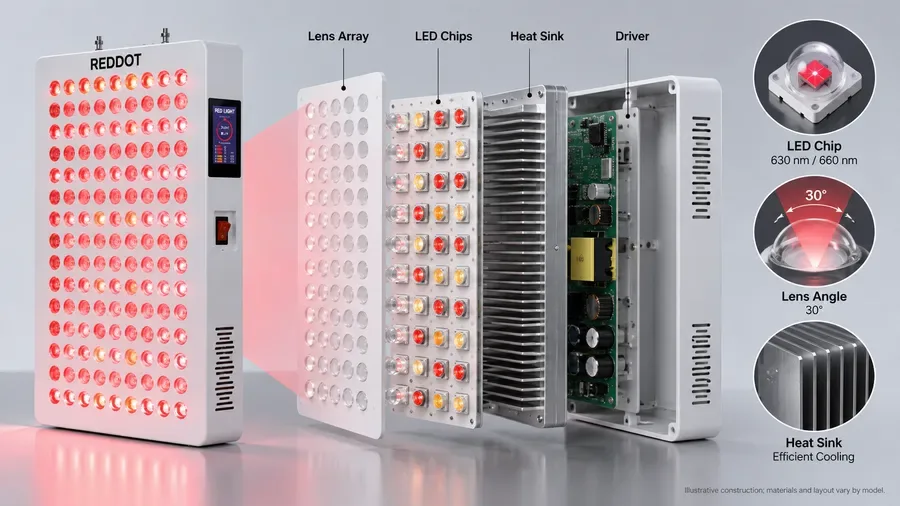
When REDDOT LED upgraded the chassis on its RDPRO series, replacing side rivets with reinforced plates containing screw holes, engineers noticed the existing PCB circuit traces now overlapped with the new metal plates. If the paint coating chipped, a short circuit could occur. The immediate fix involved applying high-temperature insulating tape to the traces, followed by a permanent PCB layout redesign moving the traces away from the overlap zones.
Preventing assembly errors that compromise wavelength purity
Hidden manufacturing challenges frequently emerge during PCB layout and control board integration. Mixing up drive currents or overlapping ribbon cables with power supplies causes thermal spikes that permanently shift an LED’s emission wavelength away from its intended 630 nm or 660 nm target. True medical-grade manufacturing requires designing the physical chassis and circuitry specifically to protect the optical integrity of the chosen wavelength. Evaluating optical engineering prevents purchasing decisions based solely on printed specifications.
Building independent judgment: what to look for beyond the marketing specs
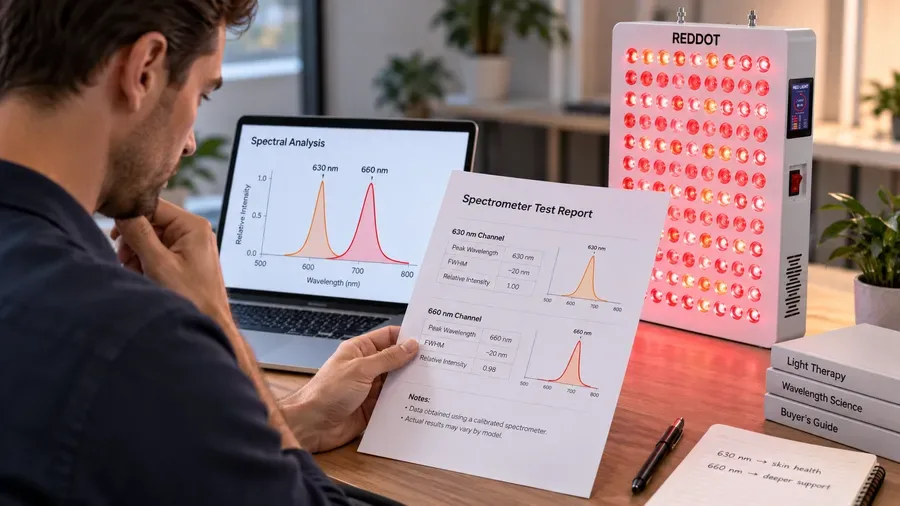
The debate over 630 nm vs 660 nm red light is not about one being universally better. It is about matching the biophysical mechanism of the specific wavelength to the intended therapeutic depth, supported by verified engineering data. B2B buyers, brand owners, and informed consumers evaluating devices should demand spectrometer reports verifying peak wavelength and FWHM. Check for ISO 13485 or MDSAP certifications ensuring manufacturing rigor. Verify alignment with WALT dosimetry guidelines. Understanding how manufacturers engineer around specific wavelengths separates reliable partners from simple assemblers.
REDDOT LED’s capabilities span optics, electronics, firmware, and photobiomodulation technologies exported to over 80 countries, serving as a benchmark for what complete OEM/ODM partnership looks like.
Common belief: Any device advertising “red light therapy” will produce similar results if the wattage matches. What is actually true: Wattage measures electrical consumption, not optical output. A 100W panel with poor thermal management and wide binning tolerances delivers less usable 660 nm light to the tissue than a properly engineered 50W device. Spectrometer verification is the only way to confirm what the LEDs actually emit under operating temperatures.
Independent judgment relies on documented evidence rather than packaging claims.
Key Takeaways
660 nm red light penetrates tissue more effectively than 630 nm because its longer wavelength scatters less, allowing photons to reach deeper targets like muscle and joint tissue where cytochrome c oxidase drives cellular energy production. For superficial skin applications such as wound healing or collagen stimulation, 630 nm delivers sufficient energy to the epidermis, making the choice between these wavelengths dependent entirely on treatment depth rather than one being universally superior. Understanding this distinction helps buyers evaluate whether a device’s optical engineering matches their intended clinical or wellness application.
Frequently Asked Questions
Is 630 nm enough for red light therapy?
Yes, 630 nm is sufficient for red light therapy targeting the outermost layers of the skin. Photobiomodulation research shows that shorter visible red wavelengths are absorbed heavily within the first few millimeters of tissue, making 630 nm effective for epidermal concerns like superficial wound healing and acne management. Devices operating at this wavelength must still deliver adequate irradiance, typically measured in mW/cm², to ensure enough photons reach the target chromophores.
Is 660nm red light effective?
660 nm red light is highly effective for reaching tissues slightly below the skin surface. According to optical penetration models referenced by the IEC, longer red wavelengths experience less scattering in biological tissue compared to 630 nm. This allows 660 nm photons to reach deeper into the dermis and subcutaneous layers, stimulating cytochrome c oxidase in fibroblasts and muscle cells to support ATP production.
Is 630 nm red light effective?
630 nm red light is effective specifically for superficial dermatological applications. Studies indexed in PubMed demonstrate that this wavelength is readily absorbed by hemoglobin and melanin in the upper skin layers, which limits its depth but concentrates its energy exactly where epidermal repair is needed. Manufacturers producing medical-grade devices under ISO 13485 quality systems validate these specific output parameters to ensure consistent therapeutic dosing at the skin surface.
What is the difference between 630 nm and 660 nm red light?
The primary difference between 630 nm and 660 nm red light is their depth of tissue penetration due to varying rates of optical scattering. A 30-nanometer shift changes how photons interact with water, hemoglobin, and cellular structures; 630 nm absorbs rapidly in the epidermis, while 660 nm travels further into the dermis. This physical distinction dictates which wavelength an engineer selects when designing panels for specific clinical outcomes.
Which red light wavelength penetrates deeper?
660 nm penetrates deeper into human tissue than 630 nm. Because scattering in biological tissue decreases as visible red wavelengths lengthen toward the near-infrared spectrum, 660 nm photons maintain their trajectory further before being fully absorbed. Optical physics standards published by organizations like the CIE (International Commission on Illumination) confirm that longer wavelengths within the red spectrum achieve greater maximum penetration depths.
Does the wavelength of red light therapy matter?
Wavelength directly determines which cellular chromophores absorb the light energy and how deep that energy travels. Cytochrome c oxidase, the primary photoacceptor in mitochondria, has distinct absorption peaks across the red and near-infrared spectrum, meaning a mismatch between wavelength and target tissue yields poor results. Regulatory bodies like the FDA require manufacturers to specify and validate the exact wavelengths used in cleared phototherapy devices to ensure predictable biological responses.
Is 660 nm better than 630 nm for skin?
Neither wavelength is universally better for skin; the optimal choice depends on the specific skin layer targeted. 630 nm concentrates its energy in the epidermis, making it preferable for surface-level issues like minor abrasions or superficial inflammation. 660 nm reaches the deeper dermal layer where fibroblasts produce collagen, making it the standard choice for anti-aging protocols and deeper tissue repair.
Can you combine 630 nm and 660 nm red light?
Combining 630 nm and 660 nm red light is a standard engineering practice in multi-wavelength phototherapy devices. By integrating both wavelengths into a single panel, manufacturers allow photons to address both superficial epidermal conditions and deeper dermal targets simultaneously during one session. REDDOT LED and similar OEM/ODM manufacturers frequently design custom wavelength ratios, verified through spectrometer testing, to meet specific clinical requirements for global brands.
References & Sources
- National Institutes of Health (NIH). “Photobiomodulation and Red Light Therapy Research.”
- U.S. Food and Drug Administration (FDA). “Medical Device Regulation and Guidance for Light Therapy Products.”
- International Electrotechnical Commission (IEC). “IEC 60601-1: Medical Electrical Equipment Safety Standards.”
- International Organization for Standardization (ISO). “ISO 13485: Medical Devices Quality Management Systems.”
- Wikipedia. “Low-Level Laser Therapy.”
- Hamblin, M.R. “Mechanisms and applications of the anti-inflammatory effects of photobiomodulation.” Photomedicine and Laser Surgery.
Related Guides
This distinction shapes how manufacturers engineer medical-grade photobiomodulation devices. A panel designed for deep muscle recovery needs different optical architecture than one built for superficial skin treatments. Some advanced systems address this by combining multiple wavelengths. For example, the PRO300-FS7 Single chip integrates seven distinct wavelengths — including both 630 nm and 660 nm — with independent 0–100% adjustability, allowing users to isolate specific spectral outputs based on their treatment goals. This level of control reflects a broader industry shift away from fixed-ratio LED boards toward programmable dosimetry.