
Most guides assume 850 nm near-infrared is automatically superior. The optical physics tells a different story, and the clinical data proves it.
Yes, 850 nm is good for red light therapy when targeting deep tissue, joints, and muscle recovery. This wavelength penetrates past the skin surface to reach mitochondria in deeper cells. Pairing it with 660 nm red light covers both superficial and deep structures in a single session.
Understanding how depth, dosage, and device engineering interact changes how you evaluate any panel or wearable belt. You will see exactly what separates a therapeutic dose from wasted power.
A California sports recovery studio tested 850 nm: what actually happened

A documented 50% reduction in client treatment times. That is the measurable outcome a California-based sports recovery studio achieved after replacing generic devices with customized mounting brackets paired with precisely engineered panels emitting at 850 nm. The studio introduced these high-irradiance near-infrared LEDs specifically to accelerate muscle recovery for their athletes.
The initial situation told a different story. Clients were spending excessive time under standard red light devices without experiencing the deep tissue relief promised by marketing materials. This prompted the studio owners to investigate whether the issue was the wavelength itself or the device engineering. They discovered that raw LED counts meant nothing if the optical design failed to deliver photons to the target depth.
After upgrading to FDA-cleared, multi-wavelength panels built by REDDOT LED, the studio recorded the 50% drop in session duration while clients reported improved deep muscle relaxation. The hardware matched the specific layout of their recovery rooms.
This scenario frames the core question this article answers: is 850 nm inherently good for red light therapy, or does its effectiveness depend entirely on how the light is delivered? Kevin Zhang, Chief Technology Officer at REDDOT LED with over 15 years of experience in LED medical devices, emphasizes that raw wavelength numbers mean nothing without optical precision. A specification sheet cannot compensate for poor thermal management or incorrect lens geometry. Understanding why that California studio succeeded requires looking at the physics beneath the skin.
Why 850 nm near-infrared works: the physics of depth and cellular absorption

Common belief: Any red or near-infrared light will stimulate healing equally well across all body tissues. What is actually true: Wavelength determines the exact depth of penetration, making 850 nm biologically optimized for structures far below the skin surface.
Research published in the journal Photobiomodulation, Photomedicine, and Laser Surgery details how cytochrome c oxidase, an enzyme inside mitochondria, specifically absorbs light in the 800–860 nm range. This absorption stimulates ATP production and reduces oxidative stress in cells. When consumers ask “Is 850nm red light good for skin?”, the answer requires distinguishing between surface aesthetics and deep repair. Visible red light like 660 nm excels at superficial skin rejuvenation. The 850 nm wavelength targets fascia, joints, and skeletal muscle.
Optical physics research from SPIE technical papers explains the scattering and absorption coefficients of human tissue mathematically. Shorter visible wavelengths scatter heavily in the upper dermis. Near-infrared photons at 850 nm encounter less scattering, allowing them to travel centimeters deeper into subcutaneous tissue. Can the human eye see 850nm? No. It sits just beyond the visible spectrum on the electromagnetic scale, which is why the diodes appear dark even when actively emitting therapeutic energy.
When exploring 660nm vs 850nm, the primary distinction lies in this exact depth-to-target ratio. One wavelength is not universally better than the other; they address different anatomical layers. Recognizing this biological targeting mechanism explains why many consumer devices fail to produce results despite advertising the correct nanometer rating.
The engineering reality: why most 850 nm devices fail to deliver results
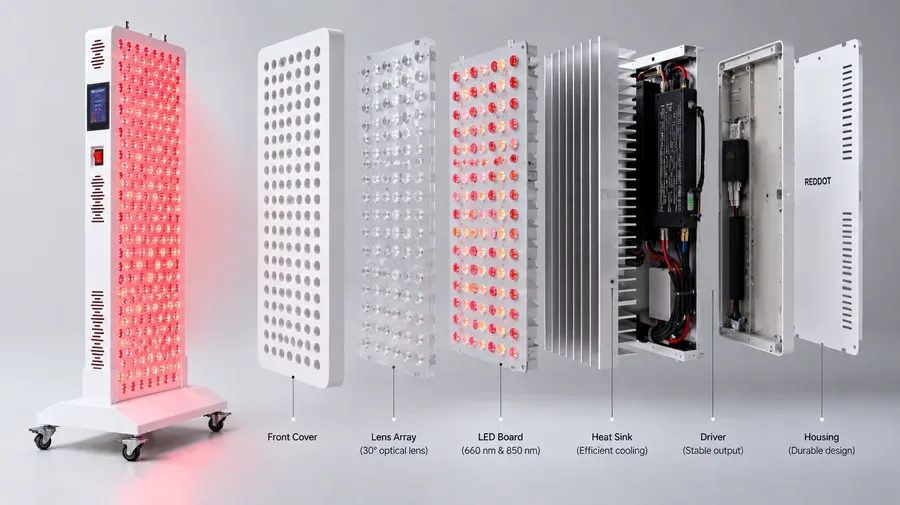
850 nm photons scatter rapidly if they are not properly collimated. A poorly designed device loses therapeutic intensity before the light ever reaches the target tissue. Biological potential means nothing if the engineering fails to deliver it.
Achieving high irradiance requires pairing 850 nm diodes with specific optics. The EST-X2 Therapy Lamp demonstrates this principle, using 30-degree and 60-degree lens options to control beam divergence for flexible, targeted coverage. Those lenses force the photons into a tight path rather than letting them spray outward uselessly.
Thermal management dictates long-term performance. Overheating causes LED wavelength drift away from the true 850 nm peak. If the heat sink is undersized, the diode shifts its emission to 840 nm or 860 nm, moving outside the optimal absorption window for cytochrome c oxidase.
Internal architecture directly impacts this thermal stability. When I worked with the BIOMAX RDPRO product line, the chassis originally featured an excessive number of scattered 2-pin and 4-pin connectors. This messy wiring created cluttered interiors and complicated assembly. We optimized the design by consolidating the wiring, replacing two separate 2-pin connectors with a single 4-pin connector wherever conditions permitted. This centralization reduced the total connection points on the chassis. Fewer connections mean less electrical resistance and fewer thermal hotspots, which preserves the consistency of the 850 nm output. A clean interior is a functional necessity for stable photobiomodulation.
Even compact devices demand this engineering discipline. A 9W therapy flashlight weighing 76g uses an aluminum alloy body to manage the heat generated by its 3W chips emitting at 630, 660, and 850 nm simultaneously. Without that metal housing acting as a passive heat sink, the small form factor would quickly degrade its own output.
How wavelength ratios and dosage guidelines determine your actual outcome
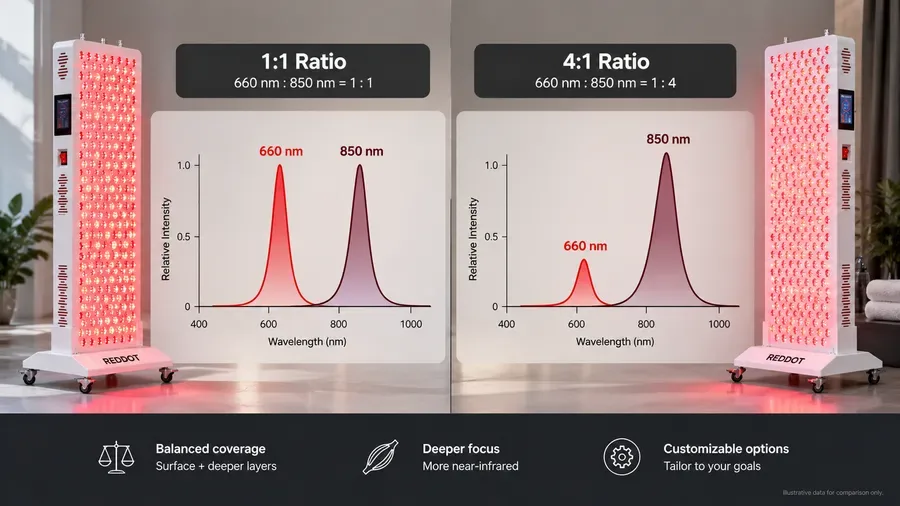
Why is 850 nm rarely used in isolation? Because effective photobiomodulation usually requires treating multiple tissue depths simultaneously. The T1 Desktop Panel illustrates this approach, using 120pcs x 1W LEDs in a strict 1:1 (660nm:850nm) ratio to deliver 35mW/cm² at 15cm. This balanced close-range delivery ensures both superficial skin cells and deeper muscle fibers receive appropriate stimulation during a single session.
Larger format applications require different mathematics. A full-body therapy mat using 945 LEDs across a 160×60 cm area might employ a 4:1 ratio, such as 756 beads at 660nm and 189 beads at 850nm. The proportion of near-infrared light is deliberately calibrated based on the device’s intended distance from the body and the total coverage area. A wearable belt like the YD001 takes yet another approach, using 105 LEDs in a 3:2 (660nm:880nm) ratio at 18W for direct-contact application where deep penetration must be balanced against localized power density.
How do you calculate the right dosage for your specific condition? You need verified irradiance data and established clinical guidelines. The World Association for Photobiomodulation Therapy (WALT) publishes consensus statements detailing recommended Joules per square centimeter for various indications. Evaluating whether 850 nm benefits your specific recovery goal requires matching your device’s verified irradiance against those WALT recommendations.
Follow this repeatable method:
- Identify the target tissue depth to confirm 850 nm is the appropriate wavelength.
- Check the device’s verified 850 nm irradiance at your planned treatment distance.
- Calculate session time using WALT guidelines to stay within the biphasic dose response curve.
Delivering too little energy produces no biological effect. Delivering too much inhibits cellular function. The 850 nm red light benefits only manifest within that precise dosage window.
Manufacturing standards that guarantee your 850 nm light is actually 850 nm
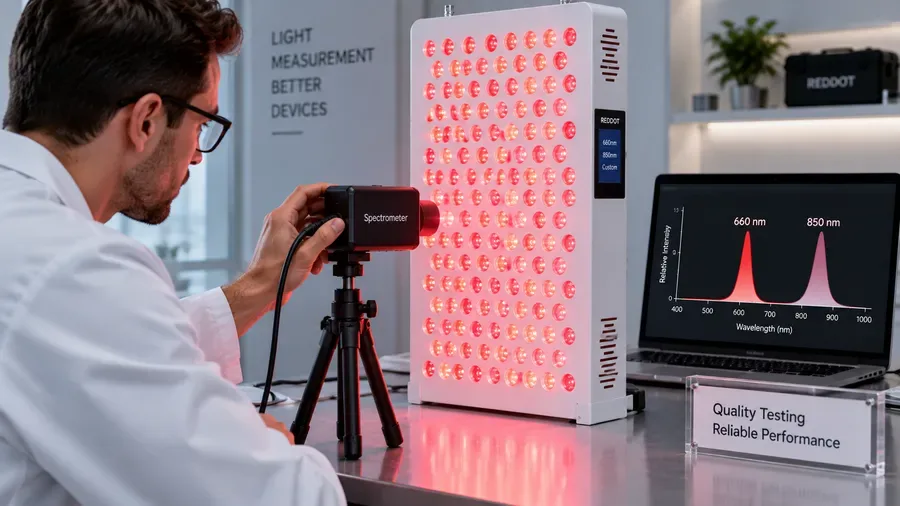
Common belief: If a spec sheet says “850 nm,” the device emits exactly 850 nm light. What is actually true: Without rigorous quality control, an LED marketed as 850 nm might emit at 830 nm or 870 nm, falling completely outside the optimal absorption window for cytochrome c oxidase.
This discrepancy between marketing claims and physical output is the ultimate buyer pain point. Cheap diode batches have wide manufacturing tolerances. A shift of twenty nanometers renders the light biologically ineffective for deep tissue targets.
ISO 13485 certification mandates multi-stage inspection and aging tests that prevent this variance. Manufacturers operating under this medical device quality management system, like REDDOT LED, force every device shipped overseas to maintain true wavelength output and stable irradiance over its lifespan. The 850 nm claim becomes a verified physical reality rather than a marketing buzzword. Each unit undergoes prolonged burn-in testing to ensure the diodes do not drift out of specification as they heat up.
Compliance with the IEC 60601-2-57 standard for non-laser light source equipment provides another layer of verification. This international safety and performance regulation guarantees that an 850 nm device delivers consistent photobiomodulation without risking thermal injury to the user. It governs everything from optical output stability to electrical isolation.
These stringent tolerances apply equally to portable formats. A wearable therapy belt featuring 210 LEDs in a 4:1 ratio at 36W must pass the same inspections as a heavy clinical panel. Close-contact 850 nm delivery remains safe and effective whether the user applies it in a home living room or a professional clinic. Knowing how to verify these standards separates informed buyers from those who simply trust a printed label.
Key Takeaways
The 850 nm wavelength penetrates deeper into tissue than visible red light, targeting mitochondria to support cellular energy production in muscles and joints. For buyers evaluating photobiomodulation devices, verifying the actual irradiance output at the stated treatment distance matters far more than simply confirming the presence of 850 nm LEDs on a specification sheet.
Frequently Asked Questions
What are the benefits of 850nm red light?
The 850 nm near-infrared wavelength penetrates deeper into muscle and joint tissue than visible red light, where it is absorbed by cytochrome c oxidase in the mitochondria to support cellular energy production. This deeper reach makes 850 nm a standard choice for sports recovery and targeted physical applications. Many clinical-grade devices pair 660 nm and 850 nm wavelengths in a 1:1 ratio to address both surface-level skin concerns and deeper tissue targets simultaneously.
Which is better, 850nm or 940nm?
For most general wellness and recovery applications, 850 nm has broader peer-reviewed research backing its biological effects compared to 940 nm. The 940 nm wavelength is primarily used in pulse oximetry and specific medical sensors rather than standard photobiomodulation panels. Manufacturers building devices intended for international markets typically rely on 850 nm because regulatory frameworks like FDA 510(k) clearance and IEC 60601-1 safety standards have established precedents for this specific wavelength.
How many nm should your red light therapy be?
Red light therapy devices generally use wavelengths between 630 nm and 850 nm, depending on the target tissue depth. Visible red light around 660 nm is well-documented for skin-level applications, while 850 nm reaches deeper muscle and joint structures. Buyers evaluating equipment for regulated markets should verify that the device holds applicable certifications such as CE, UKCA, or FDA registration to confirm the stated wavelengths meet recognized safety thresholds.
Can the human eye see 850nm?
No, the human eye cannot perceive 850 nm light because it falls within the near-infrared spectrum, which sits just beyond the visible range of approximately 380 nm to 700 nm. Some 850 nm LEDs may emit a faint red glow due to minor spectral overlap at the edge of their output curve, but the primary therapeutic radiation remains invisible. Users operating high-irradiance near-infrared panels should wear appropriate protective eyewear, as recommended by manufacturers complying with IEC 60601-1 electrical and optical safety standards.
References & Sources
- International Electrotechnical Commission (IEC). “IEC 60601-1: Medical Electrical Equipment Safety Standards.”
- U.S. Food and Drug Administration (FDA). “Regulatory Information for Light-Based Medical Devices.”
- International Organization for Standardization (ISO). “ISO 13485: Medical Devices Quality Management Systems.”
- Hamblin, M.R. “Mechanisms and applications of the anti-inflammatory effects of photobiomodulation.” AIMS Biophysics, 2017.
- Wikipedia. “Photobiomodulation.” Wikimedia Foundation.