
You turn on your therapy panel and the red LEDs glow brightly, but half the diodes emit no visible light at all.
The main difference between 660nm and 850nm red light therapy is their position in the spectrum and their wavelength-dependent interaction with tissue. 660nm is visible red light, while 850nm is near-infrared. In many tissues, 850nm generally experiences lower scattering and can provide greater relative optical penetration, but neither wavelength has a fixed anatomical stopping depth.
Understanding this distinction helps you match a wavelength to a specific outcome, whether targeting surface skin or deep tissue. The sections ahead break down the photobiology, compare clinical applications, and explain why manufacturing precision dictates actual efficacy.
Red light therapy in plain language: where 660 nm and 850 nm sit on the spectrum
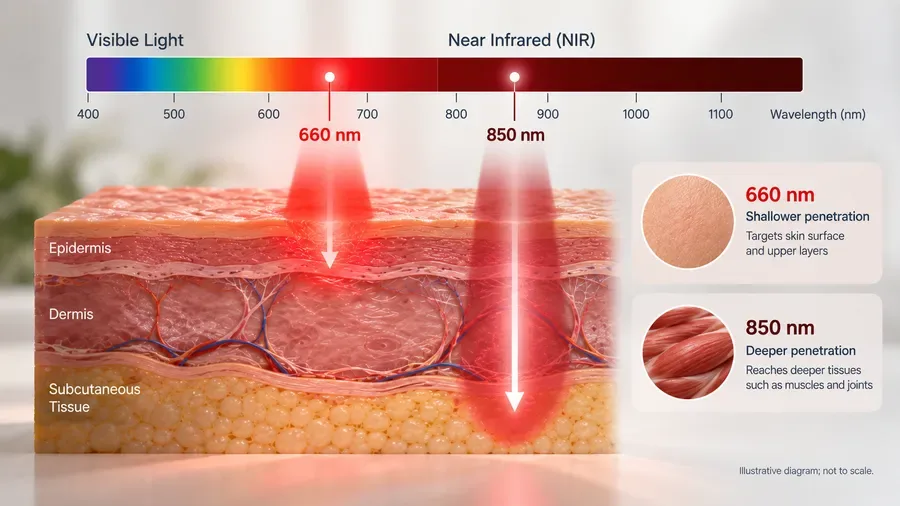
Photobiomodulation (PBM) uses specific wavelengths of light as a biological signal. These photons trigger cellular repair mechanisms rather than simply heating tissue. The two most common wavelengths in this field are 660 nm and 850 nm. The 660 nm wavelength sits in the visible red portion of the electromagnetic spectrum, which is why these devices glow red during operation. The 850 nm wavelength falls into the near-infrared range. It is completely invisible to the human eye but remains biologically active.
When evaluating 660nm vs 850nm what is the difference wavelength-wise, the choice depends on penetration depth. Matching the photon’s absorption profile to the target tissue matters more than declaring one light superior. Kevin Zhang has spent over 15 years leading optical engineering and PBM research and development at REDDOT LED, contributing to over 70 patented technologies and tuning LED arrays to meet IEC 60601 safety standards for therapeutic devices.
| Parameter | 660 nm Red Light | 850 nm Near-Infrared |
|---|---|---|
| Spectrum Band | Visible red | Invisible near-infrared |
| Primary Target | Epidermis and dermis | Muscle, fascia, and joints |
| Visual Output | Glows bright red | No visible light |
The table above shows that these two wavelengths operate in different physical domains while serving complementary biological roles. A device emitting only visible red light addresses surface concerns, while an invisible near-infrared source targets deeper structures. Understanding this spectrum placement is the first step in selecting the right equipment.
The photobiological mechanism: how each wavelength interacts with your cells

A widespread assumption suggests that red light therapy works primarily through heat. What is actually true is that both 660 nm red light and 850 nm near-infrared light act as photochemical triggers. Foundational research published in Photobiomodulation, Photomedicine, and Laser Surgery identifies mitochondrial cytochrome c oxidase (CCO) as the primary chromophore absorbing these photons. CCO is the enzyme responsible for cellular respiration. When it absorbs light energy, it accelerates adenosine triphosphate (ATP) production.
The biochemical response differs by depth. Melanin and hemoglobin in the epidermis and dermis heavily absorb 660 nm photons, making them highly efficient for surface-level cellular signaling. In contrast, 850 nm photons bypass superficial scattering to reach deeper fascia, muscle, and bone structures. This distinction defines the practical boundary between 660nm red light vs 850nm applications.
More light does not equal better results. Research referenced in Lasers in Medical Science describes the biphasic dose response, often called the Arndt-Schulz curve. Both wavelengths have an optimal therapeutic window where ATP production peaks before inhibitory effects begin if the dose goes too high.
Engineering balanced dual-wavelength delivery requires precision. The T1 Desktop Panel uses 120pcs x 1W LEDs configured in an exact 660nm:850nm = 1:1 wavelength ratio, delivering a measured 35 mW/cm² irradiance at 15 cm. This balanced approach ensures simultaneous surface and deep-tissue photon delivery without exceeding the biphasic threshold. Recognizing how cells process these photons explains why clinical outcomes vary so widely across different device configurations.
Five criteria for comparing 660 nm red light vs 850 nm near-infrared configurations

Medical device manufacturers, clinic operators, and wellness brands must evaluate five specific criteria when specifying OEM/ODM product builds. The debate around 660nm vs 850nm what is the difference reddit users and professionals frequently discuss ultimately comes down to matching hardware specifications to intended clinical outcomes.
Before selecting a configuration, buyers should verify these parameters against their target application:
- Confirm the required tissue penetration depth for the intended treatment area.
- Match the primary clinical application to the dominant wavelength.
- Calculate the necessary irradiance based on WALT clinical dosing guidelines.
- Specify beam angle optics to control light distribution.
- Verify manufacturing certifications such as ISO 13485 and IEC 60601-2-57.
| Criterion | 660 nm Red Light | 850 nm Near-Infrared |
|---|---|---|
| Penetration Depth | 2–5 mm (epidermis/dermis) | 20–50+ mm (muscle/joints) |
| Primary Applications | Wound healing, collagen synthesis, anti-aging | Muscle recovery, joint inflammation, deep tissue repair |
| Irradiance Requirements | Lower mW/cm² per WALT guidelines | Higher mW/cm² per WALT guidelines |
| Optical Engineering | Wider beam angles for broad surface coverage | Narrower lenses for deep targeting |
| Certifications | Consumer or medical-grade compliance | Often requires medical-grade compliance |
Controlling beam angle is just as critical as wavelength selection. The EST-X2 Therapy Lamp uses 60 x 5W LEDs in a 1:1 ratio with interchangeable 30-degree and 60-degree lenses, producing >200 mW/cm² irradiance at 6 inches to optimize targeted joint recovery. There is no universal winner here. Pure 660 nm wins for dermatology-focused devices. Pure 850 nm wins for deep physiotherapy tools. Combined ratios win for versatile full-body panels. Product designers also skew wavelength balances for specific needs; for example, a wearable therapy belt using 105 LEDs might apply a 3:2 ratio of 660 nm to 880 nm to prioritize surface-level benefits for daily waist and abdomen care. These five criteria separate marketing claims from functional engineering reality.
Evidence-based applications: matching the right wavelength to real-world outcomes

Dermatological and aesthetic clinics rely heavily on 660 nm red light. Its high absorption rate in superficial tissues drives fibroblast proliferation and improves collagen density. Because the photons deposit their energy within the first few millimeters of skin, treatments targeting fine lines, wound healing, and general skin rejuvenation depend almost entirely on this visible red wavelength.
Sports medicine and rehabilitation scenarios demand a different approach. 850 nm near-infrared light penetrates past the skin to reduce oxidative stress in muscle fibers post-exercise. Athletes recovering from intense training or joint strain require this deeper photon delivery to accelerate tissue repair where topical treatments cannot reach.
Properly engineered combinations deliver measurable physiological outcomes. A California sports recovery studio used REDDOT’s multi-wavelength panels to reduce client treatment times by 50%. This real-world validation demonstrates that combining 660 nm and 850 nm safely accelerates protocols without compromising patient comfort.
Form factor dictates application success just as much as wavelength. Compact, multi-wavelength designs allow for localized spot therapy in home or travel settings where large panels are impractical. A specialized therapy flashlight weighing 76g with an aluminum alloy body can house 3W chips combining 630 nm, 660 nm, and 850 nm for precise, targeted use. Similarly, wearable formats like a 120-LED therapy belt operating at 25W with a 1:2 ratio of 660 nm to 850 nm provide hands-free deep tissue access for post-workout muscle recovery in a gym rest area or home bedroom.
Matching the right wavelength to the right scenario prevents wasted energy and poor clinical results. Selecting the correct application profile determines whether a device succeeds in practice or fails despite impressive specifications.
Why manufacturing precision determines true wavelength efficacy

The 660nm vs 850nm what is the difference red light therapy debate means nothing if the manufactured device suffers from spectral drift, poor thermal management, or inconsistent irradiance output. Biological theory relies entirely on physical engineering execution. REDDOT transitioned into phototherapy in 2018 and achieved both ISO 13485 and MDSAP certifications by 2024. Precise wavelength output and consistent irradiance are enforced through these medical-grade quality management systems rather than basic component sourcing alone.
Thermal dynamics dictate LED performance. As diodes heat up, their peak emission wavelength shifts. A cheaply built “660 nm” device might actually emit at 670 nm during sustained operation, falling outside the optimal CCO absorption peak. Maintaining stable temperatures keeps the emitted light exactly where it needs to be on the spectrum.
Physical engineering safeguards maintain device integrity over thousands of hours of use. Early LED panel jumpers had insulation only on the front and back sides, leaving metal parts exposed. Under high voltage, this easily punctured the insulating varnish on the circuit board, causing short circuits that burned out LED chips. Upgrading to fully insulated jumper models, where everything except the necessary soldered parts is encased, fundamentally eliminates this hazard. Although the cost per unit increases slightly, it prevents severe after-sales losses.
Loose ribbon cables present another failure point. Applying glue to all ribbon cable terminals during production, and requiring suppliers to secure subsequent purchases the same way before shipment, stops detached terminals from causing field failures. Even packaging demands engineering attention. Modifying EPE foam inserts to include specific cutouts for power switches prevents transit pressure from damaging controls before the device reaches the customer. Manufacturing precision is the actual guarantee behind any wavelength specification.
Key Takeaways
The 660 nm wavelength delivers visible red light that absorbs primarily in the epidermis and upper dermis, while the 850 nm near-infrared wavelength penetrates several centimeters deeper to reach muscle tissue, joints, and bone. Selecting the correct wavelength for your specific application determines whether the photobiomodulation energy reaches the intended cellular targets or dissipates before triggering a biological response. Understanding this depth distinction is why medical-grade manufacturers engineer devices with precise optical control rather than relying on generic LED arrays.
Frequently Asked Questions
Is 660nm and 850nm good for red light therapy?
Yes, 660 nm and 850 nm are the two most extensively studied wavelengths in photobiomodulation research. The 660 nm band targets superficial skin layers for wound healing and collagen production, while 850 nm reaches deeper tissues like muscle and joints. Many professional devices use a 1:1 ratio of 660nm to 850nm LEDs to cover both depth ranges simultaneously.
How many nm for red light therapy to be effective?
Red light therapy requires wavelengths within the therapeutic window of approximately 600 nm to 900 nm to trigger mitochondrial cytochrome c oxidase activity. Outside this range, photons either lack the energy to stimulate cellular repair or are absorbed too heavily by water in the tissue. The 660 nm and 850 nm wavelengths fall squarely within this peak absorption spectrum.
Which red light wavelength is best for anti-aging?
The 660 nm wavelength is generally preferred for anti-aging applications because its penetration depth aligns with the dermal layer where fibroblasts produce collagen and elastin. Peer-reviewed dermatology research consistently identifies the 630–670 nm range as optimal for stimulating these skin-repair cells. Deeper wavelengths like 850 nm pass through the dermis too quickly to deliver maximum energy to these superficial targets.
Is 850 nm infrared light good?
Yes, 850 nm near-infrared light is highly effective for targeting deep structures such as skeletal muscle, tendons, and joint capsules. Because it sits just beyond the visible spectrum, 850 nm LEDs emit no visible glow but deliver photons that penetrate several centimeters into human tissue. Sports recovery clinics frequently rely on this deeper penetration profile to address muscle fatigue and joint stiffness.
What is the best nm for red light therapy?
There is no single best wavelength; the ideal nanometer value depends entirely on the target tissue depth. For skin conditions and surface wounds, 660 nm provides concentrated energy in the first few millimeters. For musculoskeletal issues, 850 nm delivers photons to deeper anatomical structures. This is why understanding the difference between 660nm vs 850nm matters when selecting a device for a specific clinical goal.
How many nm is good for red light therapy?
Wavelengths between 630 nm and 850 nm represent the primary therapeutic bands recognized in photobiomodulation science. These specific nanometer values correspond to the absorption peaks of chromophores inside mitochondria. Devices operating outside this 630–850 nm window typically fail to initiate the photochemical reactions required for measurable cellular benefits.
Is 660nm red light effective?
Yes, 660 nm red light is effective for superficial tissue applications including wound closure, scar reduction, and skin rejuvenation. Photons at 660 nm are readily absorbed by hemoglobin and cytochrome c oxidase in the upper tissue layers. Published studies on low-level laser and LED therapy confirm that this specific wavelength accelerates cellular ATP production in targeted skin zones.
How often should you use 660 nm red light therapy on your face?
Most clinical protocols recommend applying 660 nm red light to the face three to five times per week during an initial treatment phase. Overexposure can lead to a biphasic dose response, where excessive light energy actually inhibits cellular function rather than stimulating it. Consistent, moderate sessions allow dermal fibroblasts time to process the photonic signal and synthesize new collagen between treatments.
References & Sources
- International Organization for Standardization (ISO). “ISO Standards for Medical Devices and Optical Safety.”
- U.S. Food and Drug Administration (FDA). “Laser Products and Devices Guidance.”
- International Electrotechnical Commission (IEC). “IEC 60601 Series: Medical Electrical Equipment Safety Standards.”
- Wikipedia. “Photobiomodulation.” Wikimedia Foundation. https://en.wikipedia.org/wiki/Photobiomodulation
- National Institutes of Health (NIH). “Mechanisms of Low Level Light Therapy.” PubMed Central database.
Related Guides
Understanding why 660nm vs 850nm what is the difference red light therapy matters requires looking beyond basic marketing claims. The biological response depends on dosimetry, which combines irradiance, wavelength, and exposure time into a measurable energy dose. Optical engineering principles determine how efficiently a device delivers that dose to the target tissue without excessive heat generation. Readers exploring community discussions about 660nm red light vs 850nm often encounter conflicting advice because users compare devices with entirely different lens designs, power outputs, and LED binning tolerances.