
Most guides claim 850nm outperforms 660nm because it penetrates deeper. The physics proves that assumption wrong. Here is the evidence behind what is the difference between 660nm and 850nm.
The difference between 660nm and 850nm is their target tissue: 660nm red light absorbs in the epidermis to drive surface repair, while 850nm near-infrared passes through skin to reach muscle and joint tissue. This happens because distinct cellular chromophores respond to specific wavelengths. Neither replaces the other.
Understanding this distinction changes how you evaluate photobiomodulation devices for clinical or home use. You will learn why isolating a single wavelength limits efficacy, how inaccurate specifications mislead B2B buyers, and what data actually supports device selection.
Where 660nm and 850nm actually sit on the light spectrum
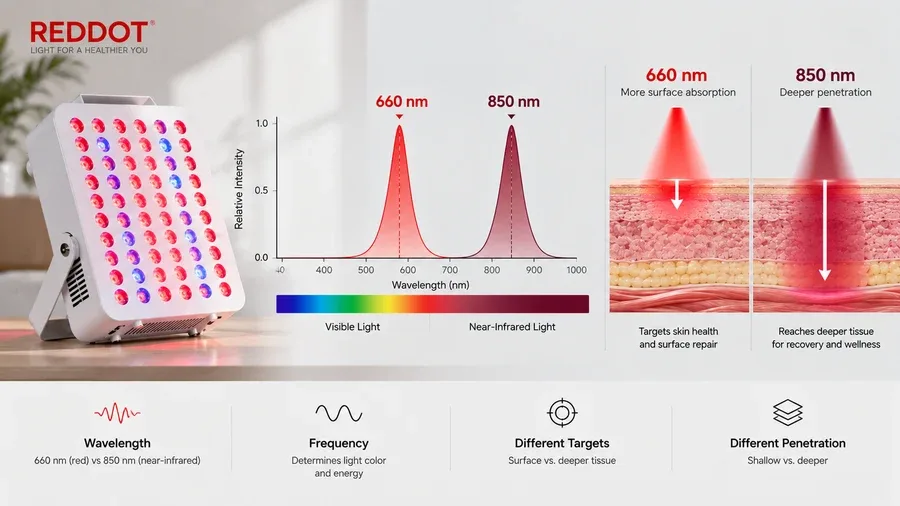
A nanometer measures wavelength. On the electromagnetic spectrum, 660nm sits inside the visible red band, producing a bright crimson light you can see. The 850nm wavelength falls into the near-infrared range, which is entirely invisible to the human eye. Consumers frequently group both under the label “red light therapy” and assume they behave identically. Optical engineers treat them as fundamentally different tools with distinct physical properties.
Research by Tunér and Hode maps out how biological chromophores absorb these wavelengths differently. Hemoglobin and melanin absorb 660nm readily, making it highly active in superficial tissue layers. Water absorption remains low at 660nm but rises noticeably at 850nm, altering how deeply photons travel before scattering or converting to heat. This divergence in absorption profiles forms the physical basis for their differing biological effects.
Kevin Zhang, Chief Technology Officer at REDDOT LED, brings over 15 years of experience developing medical-grade LED devices compliant with IEC 60601 safety standards. His perspective highlights why precise wavelength selection at the manufacturing level dictates both device safety and clinical reliability. A deviation of even a few nanometers changes the absorption dynamics entirely. When large products require palletized shipping to reach clinics safely, standardized logistics matter just as much as optical precision. REDDOT LED adopted specific American standard pallet sizes measuring 120x100x12cm for all palletized shipments, wrapping units in multiple stretch film layers with cardboard edge protectors to prevent strap damage during transit.
To evaluate where 660nm and 850nm fit your application, check these physical parameters:
- Confirm whether your target tissue is superficial (favoring 660nm) or deep (favoring 850nm).
- Verify the actual spectral peak of the LEDs using independent testing data.
- Check the manufacturer’s compliance with IEC 60601-1 electrical safety standards.
- Assess how water absorption at 850nm affects thermal management in the device housing.
Understanding these spectral positions prevents fundamental errors in protocol design.
The penetration depth myth: why assuming deeper is always better fails

The assumption that 850nm is universally superior because it penetrates deeper into tissue than 660nm is one of the most persistent mistakes in photobiomodulation. Depth alone does not determine efficacy. Target matching does.
Michael Hamblin’s research on photobiomodulation mechanisms explains this clearly. The 660nm wavelength primarily targets cytochrome c oxidase located in the epidermis and dermis. It drives cellular energy production efficiently at the surface without wasting photons on deeper tissues that do not need stimulation. Pushing 850nm into a shallow target forces energy past the intended cells, often resulting in thermal waste rather than enhanced outcomes.
REDDOT LED applies this principle directly in its Rhinitis Lamp. The device deliberately uses a dedicated 650nm wavelength adjacent to 660nm, delivering 10mW/cm2 irradiance via 12x3W LEDs specifically for targeted, localized nasal application. Shallow-penetrating visible red light is intentionally chosen over 850nm for surface-level mucosal care. The engineering decision prioritizes absorption efficiency over raw depth.
Determining what constitutes a good irradiance for red light therapy requires understanding this depth relationship first. Applying high-intensity 850nm to a superficial target can trigger biphasic dose inhibition, where excess energy actively suppresses the cellular response instead of stimulating it. More power does not equal better results when the wavelength overshoots the target.
The difference between 660nm and 850nm becomes a practical liability when users apply deep-tissue protocols to surface conditions. Match the wavelength to the anatomy before adjusting the dial.
Misunderstanding chromophores: why 660nm and 850nm trigger different biological responses
Common belief: 660nm and 850nm perform the exact same function inside the body, with the only variation being how far they travel.
What is actually true: They interact with entirely different primary chromophores and secondary photoacceptors, triggering distinct biochemical cascades.
Research by Chung et al. on the mechanics of low-level light therapy details the biphasic dose response governing these interactions. Red wavelengths between 600nm and 700nm and near-infrared wavelengths between 800nm and 900nm possess distinct optimal dosing curves. The cellular interaction pathways diverge significantly depending on which chromophore absorbs the photon.
The 660nm wavelength excels at wound healing, collagen synthesis, and skin rejuvenation because its energy deposits precisely where fibroblasts operate. The 850nm wavelength dominates in joint recovery, deep muscle repair, and neurological applications where photons must survive scattering through dense tissue to reach target cells. What is the difference between 660nm and 850nm? It is a difference in biochemistry, not merely geography.
Pulsing frequencies complicate this further. When practitioners ask if 10hz or 40hz is better for red light therapy, the ideal frequency often depends on whether the target tissue is superficial, favoring 660nm interactions, or deep, favoring 850nm neural and muscular entrainment. Frequency modulates how the tissue processes the delivered wavelength.
Ignoring chromophore specificity turns a targeted therapy into a guessing game. Select the wavelength based on the molecular target, then tune the pulse rate to match the tissue depth.
The single-wavelength trap: why isolating 660nm or 850nm limits device efficacy
Entry-level manufacturers frequently build devices using only 660nm or only 850nm LEDs to cut costs, mistakenly believing one wavelength covers all therapeutic needs. This approach leaves half the target tissue unaddressed.
Guidelines from the World Association for Photobiomodulation Therapy suggest that treatment protocols require specific dose adjustments based on target tissue depth. Full-spectrum efficacy naturally necessitates a combination of both wavelengths working simultaneously. Professional manufacturers engineer balanced ratios to serve superficial and deep targets at once.
Wavelength efficacy ties directly to optical engineering and beam angle control. The table below illustrates how single-wavelength designs compare against engineered dual-wavelength systems.
| Design Approach | Superficial Target (660nm) | Deep Target (850nm) | Beam Control |
|---|---|---|---|
| Single 660nm Only | High absorption | Missed entirely | Limited scope |
| Single 850nm Only | Bypassed / Thermal waste | Good penetration | Limited scope |
| Dual 1:1 Ratio | Simultaneous stimulation | Simultaneous stimulation | Adjustable via optics |
REDDOT LED’s T1 Desktop Panel demonstrates this dual approach. It houses 120pcs x1W LEDs engineered with a strict 660nm:850nm=1:1 wavelength ratio, delivering 35mW/cm2 irradiance at 15cm in a compact desktop form factor. For larger treatment areas requiring precise light distribution, the EST-X2 Therapy Lamp uses 60 X5W LEDs with the same 1:1 ratio and interchangeable 30-degree and 60-degree lens options to adjust light coverage accurately.
A single wavelength restricts the biological conversation the device can have with the body. Engineering both into one system allows the hardware to address layered tissue structures simultaneously.
The counterfeit wavelength problem: how B2B buyers get misled by inaccurate specs
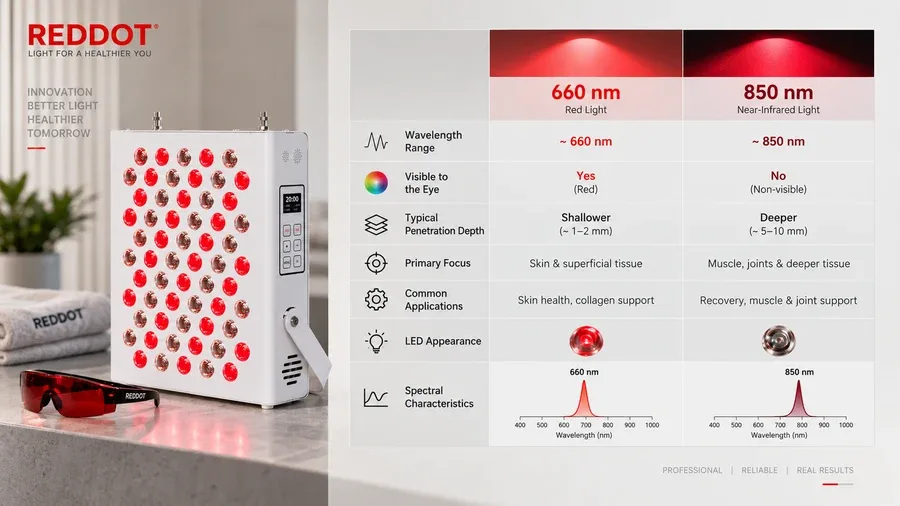
Wellness brands and medical device companies face a critical supply chain risk. Suppliers routinely claim 660nm or 850nm output while shipping broad-spectrum LEDs that peak inaccurately, sometimes landing at 630nm or 830nm. This silent substitution drastically reduces clinical efficacy.
Buyers frequently debate if 810 or 830 red light therapy is better than 850nm. While those wavelengths have valid use cases, substituting them silently for 850nm without adjusting power density or protocol violates IEC 60601-2-57:2011 standards for spectral output validation. Undocumented wavelength shifts compromise both safety and regulatory standing.
Verifying genuine LED bead output demands rigorous testing infrastructure. REDDOT LED relies on a 17-member R&D team and 70+ granted patents in photobiomodulation technologies to maintain spectral accuracy. Multi-stage inspection and aging tests guarantee every shipped device maintains exact wavelength specifications without degradation over time. Under ISO 13485-certified quality management systems, wavelength precision is a documented, testable manufacturing parameter.
| Verification Parameter | Generic Private-Label Vendor | ISO 13485-Certified OEM/ODM Partner |
|---|---|---|
| Spectral Peak Accuracy | Unverified / Broad tolerance | Documented per batch |
| Aging Tests Before Shipment | Rarely performed | Mandatory multi-stage process |
| Regulatory Alignment | Marketing claims only | IEC 60601 / ISO 13485 traceable |
This distinction separates reliable OEM/ODM partners from generic private-label vendors who treat specifications as suggestions. The difference between 660nm and 850nm means nothing if the diodes fail to emit the stated wavelengths in the first place. Demand spectrometer data before committing to a manufacturing partner.
Key Takeaways
The 660nm wavelength produces visible red light absorbed primarily by the skin, while the 850nm near-infrared wavelength penetrates deeper into muscle and joint tissue. Selecting the correct wavelength ratio determines whether a photobiomodulation device addresses surface-level concerns or targets deeper physiological structures. Understanding this optical distinction helps buyers evaluate product specifications against their actual treatment goals.
Frequently Asked Questions
Is 850 nm good for red light therapy?
Yes, 850 nm is highly effective for targeting deep tissues such as muscles and joints. Because it falls within the near-infrared spectrum, photons at 850 nm pass through the epidermis with less scattering than visible red light, reaching deeper anatomical structures. Manufacturers of clinical-grade devices frequently pair 850 nm LEDs with visible wavelengths to cover both superficial and deep targets in a single session.
Is 660 nm enough for red light therapy?
A 660 nm wavelength alone is sufficient for applications focused strictly on the skin’s surface. Peer-reviewed research on photobiomodulation shows that 660 nm light is readily absorbed by chromophores in the epidermis and upper dermis, making it a standard choice for dermatological and cosmetic devices. However, for muscle recovery or joint care, a device relying solely on 660 nm will lack the penetration depth required to reach those tissues effectively.
Can the human eye see 850nm?
No, the human eye cannot detect 850 nm light. The visible spectrum ends around 700 nm to 750 nm, placing 850 nm firmly in the near-infrared range defined by the International Commission on Illumination (CIE). When an 850 nm LED appears to emit a faint glow, that visibility comes from a small amount of energy bleeding into the visible red band, not from the 850 nm wavelength itself.
What is 660nm red light good for?
The 660 nm wavelength is primarily used for skin-level treatments, including wound healing support and general dermatological care. Light at 660 nm is absorbed by cytochrome c oxidase in cellular mitochondria, a mechanism documented extensively in photobiomodulation literature. Device manufacturers often use 660 nm LEDs in facial masks and localized panels designed specifically for aesthetic and surface-tissue applications.
What is the difference between 660nm and 850nm?
The primary difference between 660 nm and 850 nm lies in their position on the electromagnetic spectrum and their resulting tissue penetration depth. The 660 nm wavelength is visible red light absorbed mostly in the first few millimeters of skin, whereas 850 nm is invisible near-infrared light capable of reaching deeper muscle and joint structures. Many professional devices combine these two wavelengths in specific ratios, such as a 1:1 configuration, to deliver energy across multiple tissue layers simultaneously.
What are the 850 nm red light benefits for OEM products?
For OEM manufacturers, integrating 850 nm near-infrared LEDs allows brands to develop devices targeted at sports recovery, physiotherapy, and veterinary rehabilitation markets. Producing medical-grade equipment that combines 660 nm and 850 nm wavelengths requires strict adherence to international safety standards like IEC 60601-1 and quality management systems such as ISO 13485. Companies specializing in photobiomodulation engineering, like REDDOT LED, build custom OEM and ODM solutions that align specific wavelength outputs with the regulatory requirements of over 80 countries.
References & Sources
- International Organization for Standardization (ISO). “ISO 13485: Medical devices — Quality management systems.”
- International Electrotechnical Commission (IEC). “IEC 60601-1: Medical electrical equipment safety standards.”
- U.S. Food and Drug Administration (FDA). “Regulation of Light-Based Medical Devices.”
- Wikipedia. “Photobiomodulation.”
- National Institute of Standards and Technology (NIST). “Optical Radiation and Wavelength Standards.”