
You sit at your desk, a compact panel glowing red six inches from your face, counting down fifteen minutes on the timer.
LED light therapy at home works when the device delivers sufficient irradiance at the wavelengths proven to reach target tissue. Red and near-infrared light, typically 660 nm and 850 nm, stimulate mitochondrial activity. Output drops sharply as you move away from the LEDs, so distance dictates everything.
Irradiance decay over distance is the single most misunderstood metric in consumer photobiomodulation. The sections ahead explain how optics, electrical safety standards, and wavelength selection determine whether your daily sessions actually deliver a clinical dose.
Why irradiance and optics dictate at-home treatment times
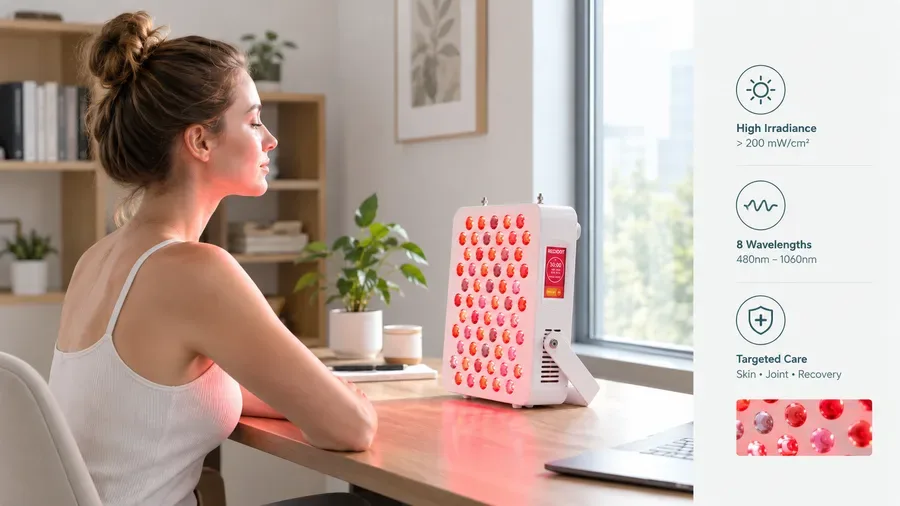
Irradiance decay over distance is the single most misunderstood metric for anyone exploring LED light therapy at home. The Illuminating Engineering Society (IES) publishes standards for optical measurement that define exactly how light output must be tested.Some products may publish output figures without clearly stating the measurement distance or test conditions. This can make meaningful comparison difficult.
Engineering data clarifies what marketing obscures. The EST-X2 Therapy Lamp delivers >200mW/cm² irradiance at 6 inches using 60 X5W LEDs with interchangeable 30-degree and 60-degree lens options, allowing flexible light coverage adjustment for local or larger areas without moving the device closer or further away. This hardware reality connects directly to biology. Peer-reviewed research published in Photobiomodulation, Photomedicine, and Laser Surgery documents the biphasic dose response, known as the Arndt-Schulz curve. Too little irradiance results in under-dosing, while excessive exposure inhibits cellular response. Understanding how photobiomodulation works requires accepting this narrow therapeutic window.
To calculate your required session time, divide your target dose in Joules per square centimeter by the device’s verified mW/cm² rating at your specific sitting distance. Ignore generic ten-minute instructions printed on consumer boxes. Your actual distance determines your actual dose.
The hidden problem of irradiance decay in living rooms
The inverse square law governs every photon leaving an LED array. Double the distance from the panel, and the irradiance drops to one-quarter of its original value. Home environments rarely match laboratory conditions. Users sit on beds, lean back on sofas, or place panels on desks where maintaining a precise clinical distance is difficult.
A high-output engineered device compensates for this reality. Low-power decorative lamps fail to deliver therapeutic photons past the first few millimeters of skin. If a product cannot state its output at a defined distance, it likely lacks the optical engineering to reach deeper tissue targets.
A simple mental model helps evaluate any setup. Check the manufacturer’s stated irradiance at six inches. If you plan to sit twelve inches away during your daily routine, assume the effective power drops significantly. Devices designed for real-world domestic use account for this decay through higher initial output or focused optics.
How lens angles change your daily routine
Optics determine where the energy lands. Narrow 30-degree lenses concentrate energy into a tight beam suitable for targeted joint recovery. Wide 60-degree lenses spread the same total energy across broader facial areas safely. Fixed-lens budget devices force users into awkward positions to achieve adequate coverage. You end up contorting your body to fit the light, which reduces long-term compliance.
Adjustable optics represent a fundamental engineering choice. They indicate a device designed around photobiomodulation science rather than aesthetic appeal alone. When you can swap a lens to match the treatment area, you control the dosage geometry. This flexibility transforms a rigid piece of hardware into a practical daily tool. Knowing how light behaves in your room sets the stage for understanding the wavelengths inside the device.
Translating clinical wavelengths to compact home form factors

Packing clinical-grade wavelengths into lightweight, aesthetically acceptable form factors creates a core tension in home device design. Sacrificing thermal management or optical accuracy ruins the therapeutic value. REDDOT LED’s 17-member R&D team applies in-house expertise in optics, electronics, firmware, and industrial design, backed by over 70 granted patents, to solve this exact engineering challenge.
The T1 Desktop Panel demonstrates successful translation. It houses 120pcs x1W LEDs with a precise 660nm:850nm 1:1 wavelength ratio delivering 35mW/cm² irradiance at 15cm, all within a remarkably compact 30x20x1.5cm, 0.44kg lightweight design ideal for desktop placement. Multi-wavelength masks present a different hurdle. Cramming multiple colors into a small surface area requires careful circuit design to prevent electrical interference. The E49 7 Color LED Facial Mask uses 193pcs LED lights across 7 wavelengths operating at a safe 5V/1A voltage specifically engineered for home use.
Beware the marketing trap claiming more colors equal better results. Each wavelength requires specific diode quality and binning to ensure the emitted nanometer matches the claimed specification. A poorly binned red diode might drift into orange, missing the mitochondrial absorption peak entirely. Form factor means nothing if the spectrum is inaccurate.
The thermal bottleneck in wearable devices
Heat dissipation limits what wearable masks and handhelds can achieve. Excess heat damages both the diodes and the user’s skin barrier. Medical-grade manufacturers use advanced substrate materials and structural design to keep junction temperatures low. Cheap alternatives rely on thin plastics that trap heat against the face.
Proper thermal management directly correlates with device lifespan. A mask that runs hot will experience wavelength drift over months of daily use. The diodes degrade faster, shifting their output away from the therapeutic peaks documented in clinical literature. Thermal engineering is invisible until it fails.
Evaluating mask designs for comfort and compliance
Structural rigidity affects how evenly LEDs sit against facial contours. Hard masks maintain consistent spacing but feel heavy. Some flexible LED masks offer adjustable fits, while rigid designs can provide more consistent spacing between LEDs and the treatment surface.Both approaches prioritize wearability because an uncomfortable device stays in the drawer.
High-density engineering pushes these boundaries. The SD-008 Shaping Mask incorporates 690 light beads (230 per color across 660nm-665nm Red, 450nm-480nm Blue, and 405-410nm Pink) within a 25.4×20.32×11.9 cm size designed for comfortable facial fitting during bedside routines. The best form factor is one the user will actually wear consistently. Weight distribution, strap mechanics, and operating temperature matter just as much as the light itself. Comfort drives consistency, and consistency drives results, provided the device meets basic safety thresholds.
Understanding safety standards for home environments
IEC 60601-1 dictates strict limits on leakage current, dielectric strength, and mechanical stability to prevent electrical shock when medical technology enters unregulated domestic spaces. When clinical equipment moves into bedrooms and living rooms, performance metrics take a backseat to protection. Kevin Zhang brings 15+ years of experience developing products compliant with IEC 60601 safety standards and ISO 13485 quality management requirements, translating dense regulatory acronyms into practical realities for everyday consumers.
The IEC 60601-1 standard documentation published by the International Electrotechnical Commission (IEC) establishes non-negotiable electrical boundaries. These limits exist because a therapy panel plugged into a standard bedroom wall outlet interacts with the same wiring as household appliances. ISO 13485, published by the International Organization for Standardization, functions differently. It is a manufacturing framework rather than a product feature. This standard ensures every batch of devices undergoes identical quality checks. The unit arriving at a consumer’s door performs exactly like the prototype tested in the lab.
Engineering rigor extends beyond the circuit board to physical logistics. Early production runs of high-power panels used EPE foam packaging without a cutout for the power switch. The foam pressed directly against the switch during shipping, leading to customer complaints about damaged controls upon arrival. Modifying the foam design to include a specific cutout eliminated the pressure on the switch during transit. This packaging improvement addressed a major source of returns without adding material costs. A device that passes electrical tests can still fail if its packaging compromises sensitive components before the box is even opened.
What IEC 60601-1 actually means for your bedroom wall
Proper grounding and insulation spacing prevent shocks when devices operate near beds, carpets, or humid bathroom environments. Certified manufacturing processes enforce tight component tolerances. Unverified overseas assembly lines allow those tolerances to drift dangerously out of spec without rigorous oversight.
Certifications like CE, RoHS, FCC, and ETL function as baseline market entry requirements. True therapeutic safety relies on the underlying medical-device frameworks. A CE mark confirms a product can be sold in Europe. An IEC 60601-1 test report confirms it will not harm you if a wire frays.
The overlooked risk of optical safety and eye protection
Dosage guidelines published by the World Association for Photobiomodulation Therapy (WALT) provide evidence-based benchmarks that responsible manufacturers use to cap maximum exposure limits in consumer devices. Certain high-intensity wavelengths require integrated eye protection or specific usage protocols. Lifestyle-focused wellness blogs frequently omit this detail.
Look for manufacturers who explicitly state their optical safety testing methodologies. Vague “FDA cleared” marketing language often refers only to administrative registration rather than rigorous safety evaluation. Protecting your eyes is as important as treating your skin.
Evaluating power output and electrical safety for international consumers
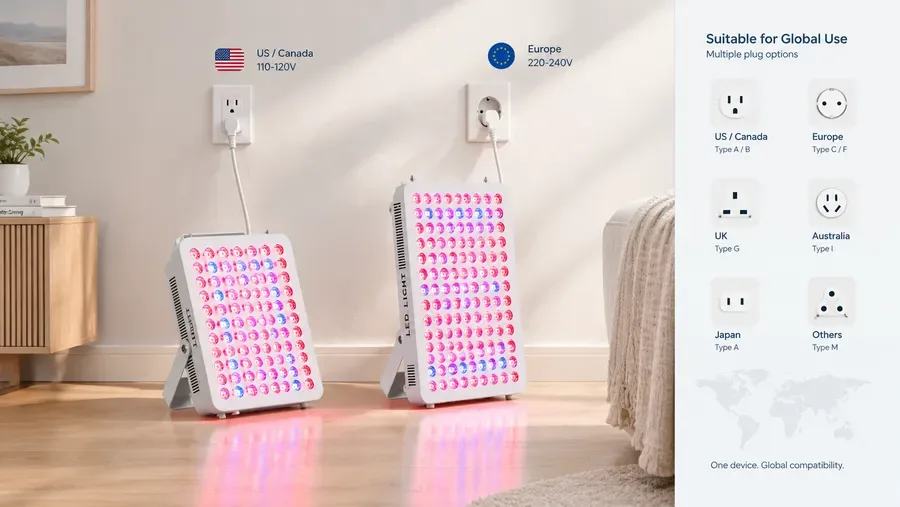
Working through varying electrical grids without damaging expensive phototherapy equipment remains a highly specific pain point for global consumers. The RDS1500 Red Light Panel addresses this directly. It operates 300x5W LEDs with a 660nm:850nm 1:1 wavelength ratio producing 161mW/cm² irradiance at 6 inches, supported by AC100-240V wide voltage compatibility for global home use.
Devices with active Power Factor Correction (PFC) and universal switching power supplies handle grid variations gracefully. Cheaper models rely on fragile step-down transformers prone to overheating in regions with unstable grid frequencies. Wide-voltage architecture impacts the consistency of irradiance output. A poorly designed power supply causes LED flickering or dimming when local voltage fluctuates, silently reducing the therapeutic dose delivered to the user. Always verify a device’s electrical specifications on the manufacturer’s label. Products listing a narrow input range like “110V only” pose a fire hazard or immediate failure risk outside compatible regions.
Why wide-voltage architecture matters for device longevity
Constant-current LED drivers protect diode arrays from voltage spikes common in residential wiring. This protection extends the operational lifespan of the therapy device significantly. High-wattage systems generate substantial thermal loads on the power supply itself. This necessitates internal heatsinking that budget brands routinely skip to save weight and cost.
Electrical stability connects directly back to the Arndt-Schulz curve discussed earlier. Inconsistent power delivery means inconsistent dosing. If your panel dims every time the refrigerator compressor kicks on, your entire therapy protocol becomes unreliable over time. Stable current equals stable light.
Navigating global plug types without compromising safety
Changing a physical plug adapter does not alter the internal electronics’ ability to handle a destination country’s electrical frequency. A 50Hz versus 60Hz mismatch can destroy a transformer not rated for both. International buyers should prioritize devices explicitly rated for AC100-240V 50/60Hz to eliminate any risk of transformer failure or degraded optical performance.
Check for region-specific safety marks. Marks such as UKCA for the UK or MDSAP for applicable medical markets indicate the manufacturer has genuinely engineered the product for international deployment. Slapping a travel adapter onto a domestic-only device is a shortcut that compromises both safety and light output. Reliable home phototherapy depends on matching the right engineering to your local infrastructure.
Key Takeaways
Effective LED light therapy at home depends on delivering specific wavelengths, typically 660 nm and 850 nm, at a verified irradiance measured at your actual treatment distance rather than against the diode surface. Checking for independent safety testing like IEC 60601-1 or FDA registration helps separate devices built with proper optical engineering from those relying on inflated specification sheets.
Frequently Asked Questions
Does home LED light therapy actually work?
Home LED light therapy produces measurable biological effects when the device delivers adequate irradiance at the correct wavelengths. Photobiomodulation research establishes that red and near-infrared light stimulate mitochondrial activity, but clinical outcomes depend entirely on the dose reaching the tissue. A panel delivering 35 mW/cm² at 15 cm will produce different results than one dropping to single digits at the same distance. Buyers should look for devices where manufacturers publish third-party tested irradiance maps rather than unverified marketing claims.
What is the best at-home LED light therapy device?
The most reliable at-home LED light therapy devices are those manufactured under recognized quality management systems like ISO 13485 and tested to electrical safety standards such as IEC 60601-1. Specifications matter more than brand names: look for a defined wavelength ratio (commonly 660 nm to 850 nm), verified irradiance at your intended treatment distance, and documented component sourcing. Devices holding certifications like CE, FCC, or ETL have passed independent laboratory testing for electromagnetic compatibility and electrical safety. Choosing a manufacturer with an established OEM/ODM track record often indicates stricter production consistency than generic private-label alternatives.
Can I do my own red light therapy at home?
You can perform red light therapy at home safely by following the dosage parameters and distance guidelines provided by the device manufacturer. Treatment protocols vary based on the target area and the device’s power output; higher irradiance panels require shorter exposure times to deliver the same energy dose in Joules per square centimeter. Consistency matters more than session length. Regular, shorter sessions using a device with stable thermal management will outperform occasional use of an overheating unit that dims its LEDs to protect the circuitry.
Which light therapy is best for inflammation?
Near-infrared light at 850 nm penetrates deeper into muscle and joint tissue than visible red light, making it the preferred wavelength for addressing localized inflammation. Peer-reviewed photobiomodulation studies consistently point to combined 660 nm and 850 nm wavelengths for targeting both superficial skin recovery and deeper tissue repair. The therapeutic effect relies on delivering sufficient energy density to the inflamed area, which requires knowing the exact irradiance at your working distance. Devices offering adjustable lenses or multiple distance settings allow users to modify the light coverage for specific body regions.
References & Sources
- International Electrotechnical Commission (IEC). “IEC 60601-1 Medical Electrical Equipment Safety Standards.”
- U.S. Food and Drug Administration (FDA). “Medical Device Registration and Listing.”
- International Organization for Standardization (ISO). “ISO 13485 Medical Device Quality Management Systems.”
- Illuminating Engineering Society (IES). “Optical Measurement Standards for Light Output Testing.”
- Wikipedia. “Photobiomodulation.” https://en.wikipedia.org