
Assuming any panel emitting 660 nm light qualifies as professional gear quietly costs wellness operators client trust when devices overheat or fail to deliver measurable doses.
The best red light therapy equipment for wellness centers">best red light therapy equipment for wellness centers pairs verified irradiance with medical-grade electrical safety. Devices combining 660 nm and 850 nm wavelengths at a 1:1 ratio, backed by IEC 60601-1 testing and ISO 13485 manufacturing, deliver the consistent photobiomodulation required for clinical environments.
Evaluating this hardware means looking past spec sheets into optical lens design, thermal management, and regulatory documentation. The sections ahead break down how engineering choices affect treatment times, what compliance actually requires, and how to distinguish a manufacturing partner from a simple logo printer.
A real-world scenario: how a California recovery studio halved treatment times

A boutique sports recovery studio in California faced a scheduling bottleneck. Their standard consumer-grade panels required sessions exceeding 30 minutes to deliver a meaningful therapeutic dose, which limited daily client throughput and frustrated athletes seeking quick post-workout relief. The intervention involved replacing that equipment with FDA-cleared, multi-wavelength panels equipped with customized mounting brackets engineered for the studio’s specific spatial layout. Treatment times dropped by 50%, bringing sessions down to 15 minutes without compromising safety or clinical efficacy. Client feedback highlighted superb build quality and deep, effective heat penetration. This outcome did not come from simply adding more devices to the wall. It came from optimized irradiance delivery and precise optical engineering. Selecting the best red light therapy equipment for wellness centers requires an engineering-first evaluation rather than relying on marketing claims.
Why standard consumer panels failed the commercial test
Common belief: More LEDs automatically mean better results. What is actually true: High LED counts are meaningless if the thermal management causes diode degradation or if the driver cannot maintain stable current.
The original equipment at the California studio suffered from inadequate thermal dissipation. When internal temperatures rise, LED output degrades, leading to inconsistent irradiance across the treatment field. Operators often mistake high component counts for high performance, missing the role of lens optics and driver stability in delivering actual therapeutic doses. Professional photobiomodulation demands medical-grade tolerances. Consumer electronics prioritize cost reduction over production consistency, resulting in batch-to-batch variations in wavelength accuracy and assembly quality.
When evaluating internal testing equipment for voltage regulators, exposed copper strands connected directly to terminals without proper connectors create significant safety hazards and risk inaccurate test results. Upgrading to professional, insulated fork terminals eliminates these electrical risks and ensures reliable contact, which is critical for obtaining consistent test data during quality assurance. A device built with this level of internal discipline will survive continuous daily operation in a busy clinic.
Understanding why hardware fails under commercial load sets the stage for examining the optical mechanics that define clinical performance.
Optical engineering: wavelengths, irradiance, and lens mechanics
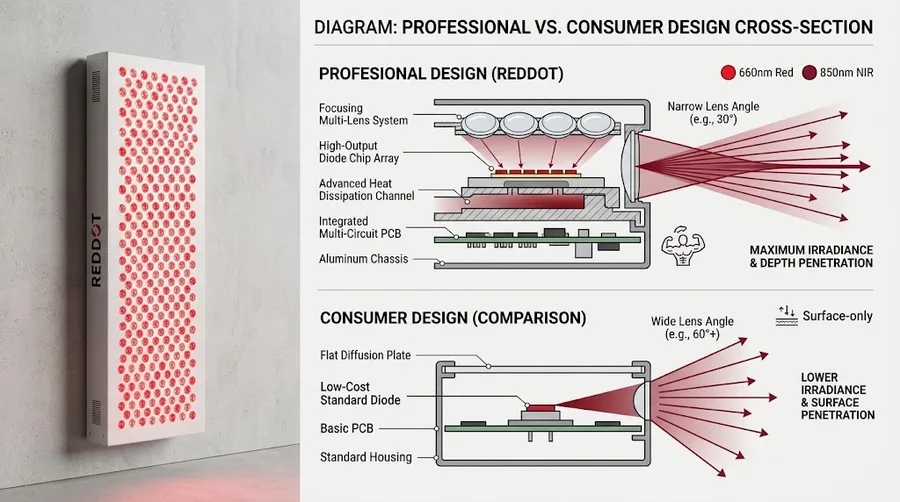
Red light therapy operates on biophotonic principles where specific wavelengths interact with cellular mitochondria. According to research published in the Journal of Biophotonics, visible red light at 660 nm and near-infrared light at 850 nm stimulate cytochrome c oxidase to drive tissue repair and reduce inflammation. But producing those wavelengths is only half the equation. Irradiance, measured in mW/cm², dictates how much energy reaches the target tissue per second. It remains the most misunderstood metric in the industry. Manufacturers frequently advertise peak irradiance measured directly against the glass, ignoring World Association for Photobiomodulation Therapy (WALT) dosimetry guidelines that emphasize effective treatment dose at practical distances.
The EST-X2 Therapy Lamp demonstrates what professional optical design looks like. It delivers >200mW/cm² irradiance at 6 inches using 60 x 5W LEDs with a precise 660nm:850nm 1:1 wavelength ratio. Mechanical flexibility matters just as much as raw power. Interchangeable lens options, such as 30-degree and 60-degree lenses, allow practitioners to adjust light coverage from highly targeted joint care to broader full-body exposure without changing the device. A narrow beam concentrates energy for deep muscle penetration, while a wider dispersion covers larger surface areas efficiently.
The hidden variables in device specifications
Anyone asking “what is the most reputable red light therapy device?” must look beyond basic spec sheets. Pulse width modulation, driver efficiency, and optical uniformity determine whether a panel delivers a consistent dose or fluctuates wildly during a session. Wavelength ratios dictate treatment focus. Devices like the YD004 Red Light Therapy Belt use a 660:850 4:1 ratio optimized for surface-level skin and localized care, while other configurations prioritize deeper muscle penetration. Too many competitor pages leave buyers staring at “your cart is empty” messages instead of educating them on how to interpret these optical parameters for clinical decision-making.
Evaluating these optical variables prevents clinics from purchasing equipment that looks impressive on paper but underperforms in practice.
Understanding medical-grade compliance and safety standards
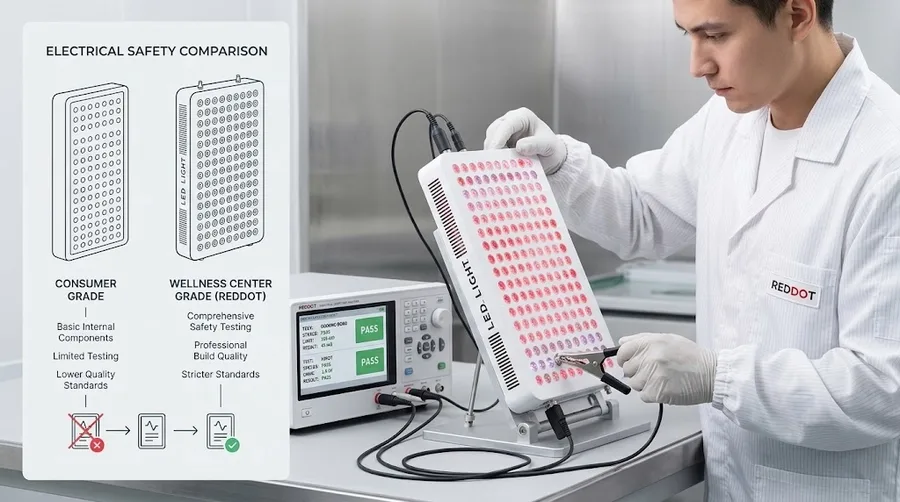
IEC 60601-1 standards govern basic safety and essential performance for medical electrical equipment. For a commercial wellness environment, these regulations protect both clients and practitioners from electrical faults, excessive leakage currents, and mechanical failures. Consumer electronics manufacturing operates under entirely different rules than ISO 13485:2016 certified quality management systems. Multi-stage inspection and rigorous performance testing prevent the premature device malfunctions that plague wellness centers using uncertified gear. A factory operating under ISO 13485 treats every solder joint and wire routing as a potential failure point requiring documentation.
The Medical Device Single Audit Program (MDSAP) streamlines global regulatory compliance by unifying auditing frameworks across multiple jurisdictions. This program helps wellness center operators understand how equipment legally and safely enters international markets like the US, Canada, and Australia without facing customs seizures or liability lawsuits.
In my own testing of internal equipment, I found that our voltage regulators used substandard wiring methods where wires connected directly to terminals without proper connectors, creating poor contact and exposed copper strands. This created a significant safety hazard for technicians and risked inaccurate test results. We initiated a project to procure professional, insulated fork terminals and rewired all voltage regulators to use these proper connectors. This upgrade eliminated the electrical hazard and ensured reliable electrical contact, which is critical for obtaining accurate and consistent test data. True safety engineering involves thermal dissipation design and electrical isolation that remain invisible to the end-user but dictate whether a device survives continuous daily operation.
How certifications translate to clinical reliability
Kevin Zhang’s 15+ years of experience in IEC 60601 safety standards translates into practical procurement advice: proper voltage regulation and wiring methods directly impact device lifespan and patient safety. Operators should verify manufacturer claims by requesting specific certification documentation rather than accepting generic logos without understanding their scope.
| Certification | Scope | What it verifies |
|---|---|---|
| IEC 60601-1 | Medical electrical equipment | Basic safety, electrical isolation, thermal limits |
| ISO 13485:2016 | Quality management system | Consistent manufacturing processes, traceability |
| MDSAP | Global regulatory audit | Unified compliance for US, Canada, Australia, Japan, Brazil |
Generic CE or FCC marks confirm electromagnetic compatibility, but they do not guarantee a device can withstand the thermal stress of back-to-back clinical appointments. Safety is engineered into the chassis before the first prototype is ever powered on.
Verifying these standards protects your business from liability and ensures the best red light therapy equipment for wellness centers performs reliably year after year.
Specialized equipment form factors for aesthetics and dermatology
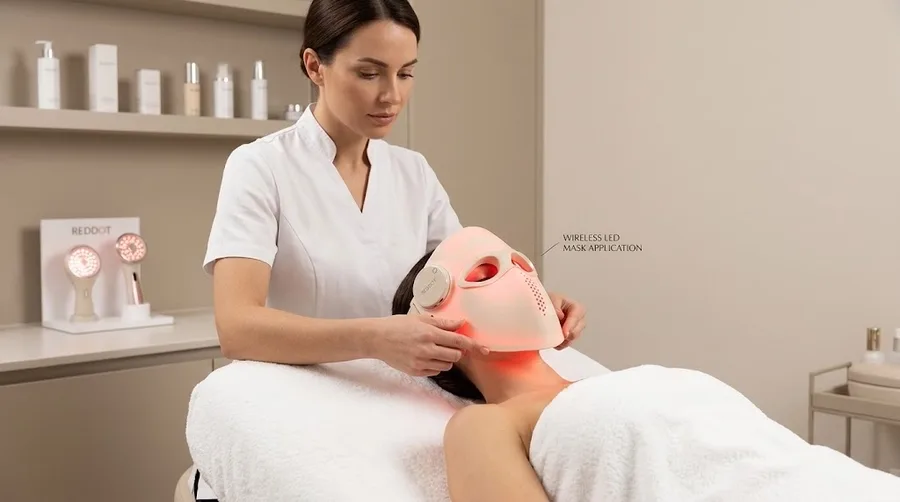
Precision aesthetics demand different hardware than sports recovery. A premium skincare clinic in London replaced cumbersome wired masks with ISO 13485-certified Wireless LED Facial Masks. The operational impact was immediate. Facial treatment bookings increased by 40%. Practitioners praised the devices for being easy to use with visible results. Improved client comfort, faster sanitation turnaround between sessions, and enhanced practitioner mobility drove this growth. Emerging sub-niches within wellness centers now include targeted wands for hair growth and intraoral devices for oral health. These specialized form factors require distinct optical and thermal engineering compared to full-body panels. Evaluating the best commercial red light therapy devices versus wearable or localized tools depends entirely on the clinic’s service menu. A one-size-fits-all approach compromises both treatment efficacy and business ROI.
Matching hardware design to the treatment protocol
Common belief: Smaller devices are inherently weaker than large panels. What is actually true: Miniaturized devices concentrate optical power over smaller areas, often achieving comparable or higher localized irradiance when engineered correctly.
Flexible, lightweight designs are increasingly favored in aesthetic rooms where space efficiency and client comfort are important. A compact therapy flashlight weighing 76g with a 9W output and an aluminum alloy body allows practitioners to perform targeted spot treatments without disrupting the spa environment. Similarly, wearable formats like the YD001 Red Light Therapy Belt pack 105 LEDs into a 1.1 kg frame, consuming only 18W while maintaining a 660:880 3:2 wavelength ratio for localized body care. Engineering challenges arise when miniaturizing high-irradiance outputs into wearable formats without triggering thermal safety limits defined by IEC standards. Heat must dissipate rapidly through materials like aluminum alloy rather than accumulating against the skin. Buyers assessing specialized aesthetic PBM equipment must evaluate battery life, wireless interference, and ergonomic fit alongside optical output.
Matching the physical form factor to the treatment protocol determines whether a device enhances the client experience or disrupts it.
Evaluating manufacturing partnerships vs. private labeling
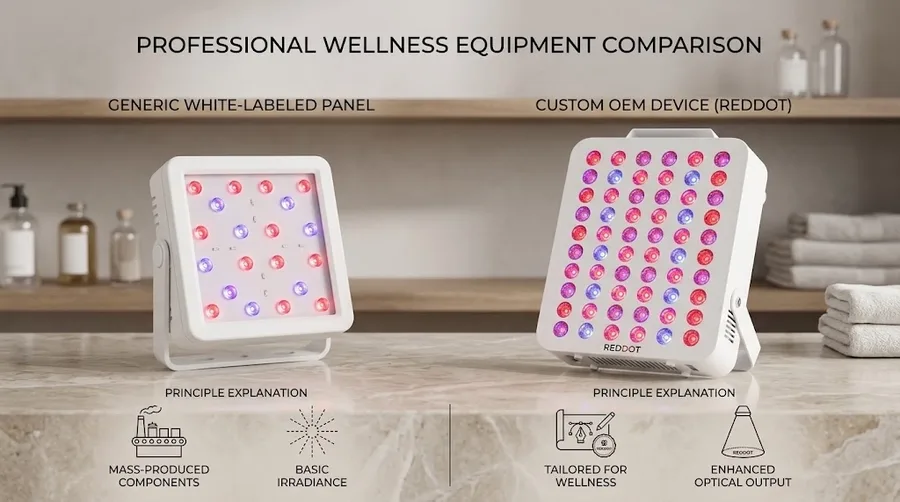
Searching for commercial phototherapy suppliers often leads to e-commerce pages dominated by shopping cart widgets rather than substantive education. Wellness center owners looking to scale or brand their own equipment need a B2B procurement framework. Simple private labeling means slapping a logo on a generic chassis. OEM/ODM partnerships can involve product development, engineering, customization, and technical support. REDDOT LED supports this level of partnership with a 17-member R&D team and 70+ granted patents covering optics, electronics, firmware, and photobiomodulation technologies. When buying a red light therapy device from a manufacturing partner, evaluate their capacity for concept design, prototype engineering, certification assistance, and ongoing technical support rather than focusing solely on unit price. Infrastructure matters. REDDOT LED’s expansion, including a 5,000 m² production facility and a Thailand manufacturing base, illustrates the physical capacity required to reliably supply global wellness brands across Europe, North America, and Asia.
Building a long-term technology roadmap
A manufacturer’s patent portfolio indicates genuine R&D capability versus mere assembly-line reproduction. If a factory holds zero patents related to optical lens design or thermal management, they are assembling commodity parts rather than engineering differentiated products. Firmware development and app integration capabilities matter for clinics wanting to offer connected, data-driven wellness experiences. A panel that allows practitioners to adjust pulsing frequencies via a mobile application creates a distinct competitive advantage over static, button-operated alternatives. Choosing the right manufacturing partner mitigates development risks and accelerates time-to-market for centers looking to differentiate themselves in a saturated wellness industry.
Engineering capability has become just as important as manufacturing capacity when selecting the best red light therapy equipment for wellness centers.
Key Takeaways
The best red light therapy equipment for wellness centers combines verified irradiance output, such as panels delivering over 100 mW/cm² at close range, with medical-grade safety standards like IEC 60601-1 to ensure consistent client dosing. Selecting devices backed by ISO 13485 quality management and recognized regulatory clearances protects facilities from compliance risks while reducing treatment times enough to increase daily client throughput.
Frequently Asked Questions
What is the most reputable red light therapy device?
A reputable red light therapy device for commercial use holds recognized safety certifications such as FDA clearance, CE marking, or IEC 60601-1 electrical safety approval. Devices manufactured under an ISO 13485 quality management system generally demonstrate higher production consistency than those without medical-grade oversight. Buyers evaluating equipment should verify that the manufacturer provides third-party irradiance data rather than relying solely on marketing claims about LED counts.
Do the inexpensive red light therapy devices work?
Inexpensive red light therapy devices often emit the correct wavelengths, typically 660 nm and 850 nm, but frequently lack the optical engineering required to deliver a therapeutic dose efficiently. Lower-cost units may suffer from poor thermal management, which causes LED performance to degrade faster than the claimed 50,000-hour lifespan. For a wellness center where clients expect measurable results, insufficient irradiance means longer session times and lower daily capacity.
What kind of red light therapy is used at Planet Fitness?
Planet Fitness locations primarily use full-body red light therapy booths equipped with high-density LED arrays targeting both the visible red and near-infrared spectrums. These systems typically combine 660 nm red light for skin-level benefits with 850 nm near-infrared light for deeper tissue penetration. Commercial gym installations require strict adherence to electrical safety standards like ETL or FCC certification to operate safely in public fitness environments.
How to pick a good red light therapy device?
Selecting a professional red light therapy device requires verifying the actual irradiance measured in mW/cm² at a specific distance, rather than comparing total wattage alone. A panel delivering 135 mW/cm² at 6 inches will treat a targeted area much faster than a larger unit producing only 30 mW/cm² at the same distance. Buyers should also confirm that the equipment meets the regulatory requirements of their specific market, such as TGA registration in Australia or UKCA marking in the United Kingdom.
References & Sources
- U.S. Food and Drug Administration (FDA). “Medical Devices.”
- International Electrotechnical Commission (IEC). “IEC 60601-1 Medical Electrical Equipment Safety Standards.”
- International Organization for Standardization (ISO). “ISO 13485 Medical Device Quality Management Systems.”
- Wikipedia. “Photobiomodulation.”
- Therapeutic Goods Administration (TGA). “Australian Register of Therapeutic Goods (ARTG).”
About the Author
Kevin Zhang is the Chief Technology Officer at REDDOT LED, bringing over 15 years of experience in LED technology and photobiomodulation engineering. He oversees product development and manufacturing processes governed by international quality frameworks including ISO 13485, MDSAP, and IEC 60601-1. His technical focus remains on translating optical engineering and thermal management research into reliable, compliant light therapy equipment for global B2B partners.
Related Guides
Selecting the best red light therapy equipment for wellness centers requires understanding how wavelengths, safety standards, and hardware formats interact. Operators who skip this groundwork often end up buying devices that look identical on paper but perform differently under daily clinical use. A 76g aluminum alloy therapy flashlight running three 3W LED chips at 630nm, 660nm, and 850nm solves a completely different problem than a full-body panel, yet both appear in the same product catalogs. Knowing which format fits your treatment menu prevents wasted capital.