
You open the box, plug in the panel, and the LEDs glow a familiar red. The listing promised 660nm and 850nm wavelengths, a certain irradiance, and a lifespan of 50,000 hours. But standing there, you realize you have no way to verify any of it. The spec sheet looks convincing, yet the only thing you can confirm is that it turns on.
“How do I know if it’s a good red light therapy device?” The honest answer is that a good device is defined by measurable, verifiable output, not marketing claims. A quality device must deliver a specific wavelength, typically 660nm for skin-level effects and 850nm for deeper tissue, at a sufficient power density—measured in mW/cm²—to trigger a cellular response. A panel that emits light but lacks the irradiance to penetrate the skin effectively is just a lamp.
The gold standard is a device that pairs genuine 660nm and 850nm LEDs with a documented irradiance of at least 30–100 mW/cm² at a stated distance, backed by certifications like CE, FCC, or ideally ISO 13485 for medical-grade manufacturing. Without those numbers and that documentation, you are buying a colored light, not a therapy device.
This guide will walk you through the science behind those specs, the exact markers that separate a clinical-grade tool from a decorative one, and the red flags that signal a device will underperform or fail. By the end, you’ll have a practical checklist to evaluate any device on the market with confidence, so you can make a decision based on evidence rather than marketing.
What actually makes a red light therapy device “good”?
A “good” red light therapy device isn’t about brand prestige or a sleek housing. It’s about whether the device delivers the right wavelengths at the right power to the target tissue, consistently and safely, over years of use. That’s the whole definition.
Most buyers evaluate devices by marketing claims. Engineers evaluate them by measurable specs: wavelength accuracy, irradiance, beam uniformity, thermal stability, and certification validity. These five markers determine whether a device actually works, how long it lasts, and whether it’s safe to put against your skin.
With 15+ years in LED manufacturing and 70+ patents in photobiomodulation, I’ve seen how devices are actually built, tested, and sometimes cut corners. The gap between what a spec sheet claims and what a device delivers can be enormous, especially at the low end of the market.
So how can a first-time buyer verify quality without a lab? The answer is a “trust but verify” approach. Learn the measurable markers of quality, then apply them to any device you’re considering. You don’t need expensive testing equipment, just the right questions and a willingness to dig past the marketing.
The same evaluation principles apply whether you’re choosing a device for home use or evaluating manufacturers for a business. The question of how to find a reliable red light therapy OEM supplier starts with understanding what reliability looks like in the hardware itself. Get that right, and everything else follows.
The science primer: how red light therapy works and why specs matter
Red and near-infrared light penetrate the skin and are absorbed by mitochondria, stimulating cellular energy production (ATP) and triggering repair processes. This is photobiomodulation (PBM), and it’s the mechanism behind every legitimate red light therapy claim.
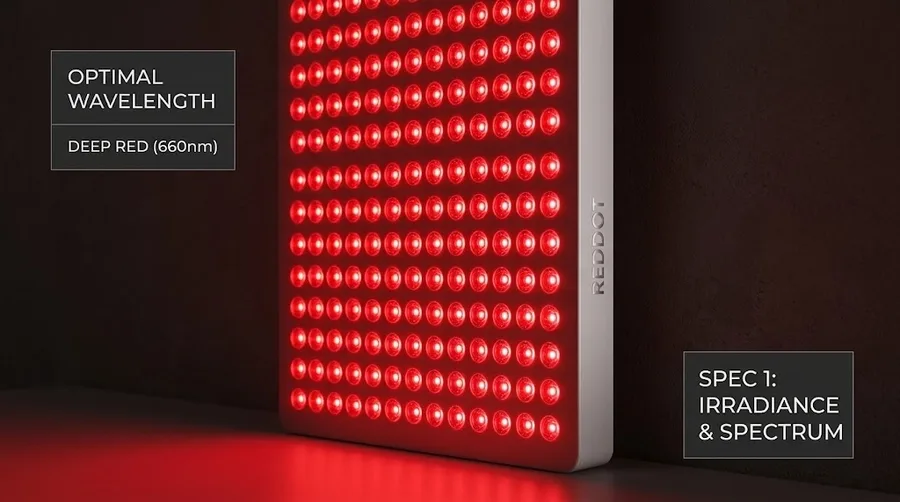
Two wavelengths do most of the work. 660nm red light targets the skin surface for collagen production and inflammation reduction. 850nm near-infrared penetrates deeper for muscle, joint, and tissue recovery. A device’s ratio of these wavelengths determines its versatility, which is why most quality panels use a 1:1 mix.
Here’s the practical checklist for evaluating whether a device can actually trigger the biological response:
- Check wavelength accuracy. The device should state exact wavelengths like 660nm ±5nm, not a vague “600–700nm” range.
- Verify irradiance at a stated distance. “100mW/cm²” means nothing without “at 6 inches” attached to it.
- Confirm the treatment area. A small device can’t treat a large body area effectively, regardless of power.
- Look for the therapeutic window. Most clinical studies use irradiance between 10–100 mW/cm² at the skin surface.
- Demand published specs. A well-specified device publishes these numbers clearly, not hides them.
A device that emits “red light” at the wrong wavelength or too low power simply won’t trigger the biological response, no matter how convincing the marketing is. For context, a desktop panel with 120 1W LEDs and a 660nm:850nm = 1:1 ratio delivers 35mW/cm² at 15cm distance, which sits comfortably within clinically studied parameters. That’s the kind of transparency you want to see.

The measurable markers of a quality device
Wavelength accuracy: the difference between “red light” and the right light
LEDs are manufactured with a wavelength tolerance band. Cheap LEDs can drift 20–30nm from spec, which pushes the device outside the therapeutic window entirely. A device claiming 660nm might actually deliver 630nm, which has different biological effects and reduced efficacy.
Reputable manufacturers bin their LEDs, sorting them by exact wavelength, and test each batch. This is invisible to the consumer but determines whether a device actually delivers what it claims. A quality device’s spec sheet will state exact wavelengths, like 660nm ±5nm, not vague ranges. If you see “600–700nm” on a spec sheet, that’s a confession of poor quality control.

Irradiance: the power behind the light
Irradiance is power density, measured in mW/cm² at a specific distance. It determines how long a treatment session needs to be and whether the light penetrates deeply enough to reach target tissue.
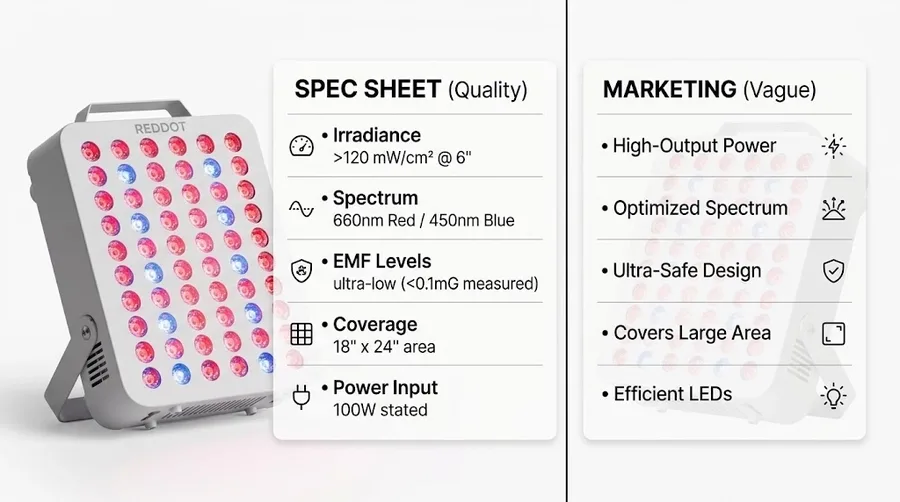
Here’s the catch: irradiance claims must always be tied to a distance. A device that claims “100mW/cm²” without specifying distance is hiding something, because irradiance drops dramatically as distance increases. Double the distance, and you can lose three-quarters of the power.
“Good” is relative to the intended use case. A tri-fold panel with 222 LEDs provides full-body coverage. A targeted device like a rhinitis lamp with 12×3W LEDs at 650nm delivers 10mW/cm² over a small 8×2cm treatment area. Both can be good devices, but they solve different problems. The answer to “how do I know if it’s a good red light therapy device?” depends entirely on what you need it to do.
Thermal management: the hidden determinant of lifespan and safety
LEDs generate significant heat. Without proper heat sinks or cooling, output degrades rapidly, and the device can become a safety hazard. This is one of the most overlooked aspects of device quality.
Quality thermal design uses aluminum heat sinks, thermal interface materials, and fan or passive cooling designed for continuous operation. A well-cooled device can maintain consistent output for 50,000 hours. A poorly designed one may dim significantly within months.
I’ve seen this play out in our own engineering. When we redesigned the chassis of our RDPRO series, replacing rivets with welded reinforcement plates, we discovered the existing PCBs had circuit traces overlapping the new metal plates. That created a short-circuit risk if the paint chipped. We applied high-temperature insulation tape to existing stock immediately, then redesigned the PCB entirely to eliminate the overlap at the design level. This is the kind of proactive hazard elimination that separates quality manufacturing from assembly-line shortcuts.
Certification validity: what the logos actually prove
Many cheap devices print “CE” without ever undergoing proper testing. Self-declared compliance is not the same as third-party certified testing.
The meaningful certifications are: ISO 13485 (medical-grade quality management), MDSAP (medical device regulatory compliance for multiple markets), IEC 60601 (electrical safety for medical devices), FCC (electromagnetic compatibility for the US), and ETL (safety certification for North America).
Certifications are not a one-time checkbox. Maintaining them requires ongoing audits and consistent manufacturing quality. A manufacturer with ISO 13485 and MDSAP certification demonstrates a systematic commitment to medical-grade production standards, not just a marketing badge.
Red flags vs. green flags: what to look for when evaluating a device
Common belief: “If the device is FDA-registered and has a CE mark, it’s safe and effective.”
What’s actually true: FDA registration is an administrative fee, not a safety evaluation. And a CE mark printed on a box without third-party testing is just ink. Neither tells you whether the device delivers therapeutic doses of light.
The real markers are more specific. Here’s what to check:
Green flags:
- Published irradiance with a stated distance
- Exact wavelength specs (660nm ±5nm, not “600–700nm”)
- Third-party test reports you can actually review
- Clear certification documentation with certificate numbers
- A company that openly discusses its manufacturing processes
Red flags:
- Vague “therapeutic grade” language without numbers
- Irradiance claims without distance
- Wavelength ranges instead of exact values
- Unwillingness to share test data or answer technical questions
- No information about who actually manufactures the device
The same scrutiny applies at the brand level. If a company can’t explain who manufactures its devices or what quality systems are in place, that’s a significant red flag regardless of how polished the marketing looks. This is directly relevant to the question of what is the most reputable red light therapy company: reputation is built on transparent specifications and verifiable quality systems, not on branding spend.
Real-world performance: what good devices actually deliver
Specs aren’t abstract numbers. They translate directly into tangible outcomes: shorter treatment times, consistent performance, and measurable results.
Consider a California sports recovery studio that needed high-irradiance panels for client treatments. By upgrading to properly engineered devices, they reduced treatment times by 50%. That’s not a marketing claim, it’s the practical consequence of adequate irradiance. A device delivering 35mW/cm² at the skin surface requires longer sessions than one delivering 135mW/cm², all else being equal.
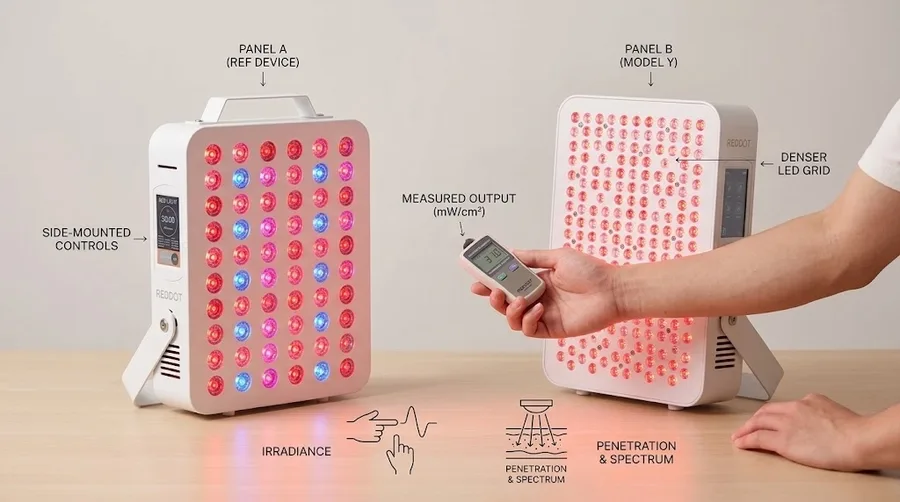
A good device also delivers uniform light distribution across its entire treatment area, not just a bright center with weak edges. This is why LED count and arrangement matter as much as raw power. A panel with evenly spaced LEDs treats the whole target area consistently, while a poorly arranged device leaves hot spots and dead zones.
Device design should match the intended use. A portable flashlight with 3 3W LEDs at 630/660/850nm in a 76g aluminum body is ideal for targeted spot treatment on hands, arms, or small areas. A larger panel suits full-body sessions. “Good” means fit-for-purpose, not universally “the most powerful.”
| Use Case | Recommended Form Factor | Key Specs to Check |
|---|---|---|
| Targeted spot treatment (hands, face, small joints) | Handheld flashlight | 3–9W power, 630–850nm wavelengths, compact size |
| Localized area (back, knees, shoulders) | Desktop panel | 30–50mW/cm² at 15cm, 1:1 red:NIR ratio |
| Full-body sessions | Large panel or tri-fold panel | 100+ mW/cm² at 6 inches, uniform coverage |
The pattern is consistent: the answer to how do I know if it’s a good red light therapy device is always the same. Check the measurable specs, verify the certifications, and match the device to your intended use. A device that delivers the right wavelengths at therapeutic power, with proper thermal management and verifiable compliance, will perform consistently for years. One that doesn’t will disappoint within months, regardless of how convincing the marketing was.
The boundaries: when a “good” device won’t help
Can a red light therapy device replace medical treatment?
No. Even a technically excellent device has limits, and being honest about them is the first step to using the technology well. Red light therapy is a supportive tool, not a cure. For serious conditions, injuries, or persistent symptoms, medical diagnosis and treatment come first. A device that promises otherwise is overstating its case.
The evidence base for photobiomodulation is real but specific. According to the National Institutes of Health’s National Center for Complementary and Integrative Health (NCCIH), light-based therapies show promise for applications like skin health, inflammation, and muscle recovery, but results vary by individual and condition. The placebo effect is significant in this space, which is why anecdotal reviews — however enthusiastic — should carry less weight than consistent clinical findings.
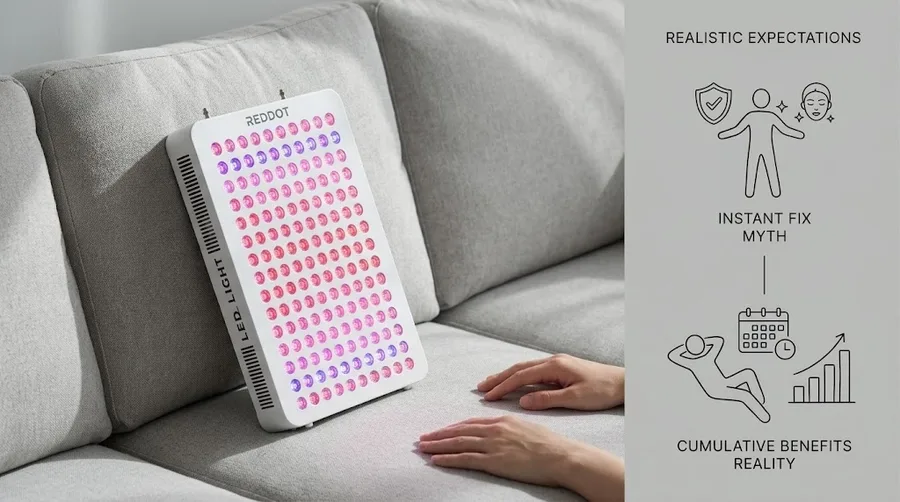
Consistency beats intensity. A moderately powered device used daily for several weeks generally outperforms a powerful device used once a month. The research literature is built on repeated sessions over time, not single high-dose exposures. If you cannot commit to a regular routine, even the best hardware won’t deliver results.
What if the device has the right wavelength but low power?
Fundamental biology sets the floor. If irradiance falls below therapeutic thresholds, or the wavelength misses the target range, extending session time will not compensate. More time with insufficient power is still insufficient. This is why spec sheets matter — and why vague marketing language like “advanced light technology” tells you nothing about whether the device can actually reach the tissue depths required for a given application.
The practical takeaway: match the device to the evidence, use it consistently, and keep expectations proportionate. A good device is one that fits into a sustainable routine, not one that promises miracles.
How to evaluate any device in five practical steps
The gap between marketing claims and engineering reality is where most buying mistakes happen. These five checks take about fifteen minutes and will separate a legitimate device from an overpriced novelty.
Step 1: Demand exact specs with a stated distance. A proper spec sheet lists wavelength (in nanometers) and irradiance (in mW/cm²) measured at a specific distance — for example, “at 6 inches.” If the manufacturer only says “high power” or omits the measurement distance, treat it as a red flag. You cannot evaluate what is not disclosed.
Step 2: Verify certifications, don’t just trust logos. Look for third-party marks like ISO 13485 (medical device quality management), MDSAP, IEC 60601 (electrical safety), FCC, or ETL. These are issued by independent bodies, not self-declared. A reputable manufacturer will share documentation on request. If a supplier hesitates or deflects, that is informative in itself.
Step 3: Assess physical build quality. Weight, materials, heat dissipation design, and construction tell you about engineering integrity. A device that runs hot to the touch or feels hollow is likely cutting corners on thermal management — which directly affects LED lifespan and consistent output. This is where a product like a compact aluminum-bodied therapy flashlight demonstrates the difference between deliberate design and cheap assembly.
Step 4: Compare against clinically studied parameters. The therapeutic window for red and near-infrared light is well-documented in peer-reviewed literature. Any device claiming to work far outside established wavelength and dosage ranges deserves skepticism, regardless of how compelling the marketing is.
Step 5: Match the device to your actual use case. A targeted device for facial care and a full-body panel for sports recovery serve completely different needs. The “best” device is the one aligned with your specific goals, not the one with the highest LED count. This is also where the question of what is the most reputable red light therapy company? comes into play — reputation follows from consistent quality across a range of applications, not from a single flagship product.
A final note on sourcing: when you ask how do I know if it’s a good red light therapy device, the answer is rarely found in a single spec. It lives in the combination of disclosed data, verified certifications, honest build quality, and a realistic match to your needs.
Key Takeaways
A good red light therapy device is defined by measurable engineering specs — wavelength accuracy (660 nm and 850 nm are the clinical workhorses), irradiance at a stated distance, beam uniformity, thermal stability, and valid certifications like IEC 60601-1 for electrical safety — not by marketing claims or LED counts. Before you buy, ask for the irradiance measured at a specific distance (for example, “135 mW/cm² at 6 inches”), confirm the certification is real by checking the issuing body’s database, and verify the device has active cooling rather than passive heat sinks.
These five checks separate devices that deliver consistent, safe treatment for years from those that fade, overheat, or fail within months.
Frequently Asked Questions
How to tell if your red light therapy device is legit?
Check three things: the irradiance spec is stated at a specific distance, the certification is verifiable, and the manufacturer can produce optical test reports. A legit device will state something like “135 mW/cm² at 6 inches” — if the irradiance has no distance attached, the number is meaningless. For certification, look for IEC 60601-1 (electrical safety) or FDA 510(k) clearance, then verify the certificate number on the issuing body’s public database rather than trusting the marketing page.
How to know which red light therapy device is best?
Match the device to the treatment target. For deep tissue or joint work, you want a meaningful 850 nm near-infrared component and higher irradiance — typically above 100 mW/cm² at the treatment distance. For skin-level concerns like wrinkles or wound healing, 660 nm red light is the primary wavelength, and lower irradiance around 30–60 mW/cm² is sufficient. The “best” device also depends on the treatment area: a small panel covers a knee, a full-body panel covers a torso, and a wearable belt wraps around a limb.
Do the cheaper red light therapy devices work?
Some do, but the failure rate is higher, and the reasons are predictable. Cheap devices typically cut corners on LED binning (using mismatched or off-spec LEDs), thermal management (passive cooling that lets the device overheat and shift wavelength), and driver electronics (which cause flicker and inconsistent power delivery). A $100 panel that delivers a genuine 30 mW/cm² at 660 nm will produce some biological effect, but it may not sustain that output after 15 minutes of use, and the wavelength can drift as the LEDs heat up.
The question isn’t whether it “works” at all — it’s whether it works consistently and safely for the full session, every session.
How do you know if your red light therapy is good?
You evaluate the measurable markers: wavelength accuracy (within ±10 nm of the stated value), irradiance consistency across the treatment surface, thermal stability (does the device maintain output after 20 minutes?), and certification validity. A good device also comes with a clear treatment protocol — recommended distance, session duration, and frequency — based on published dosimetry guidelines. If a manufacturer cannot provide optical test reports or third-party certification documents, that absence of evidence is itself the answer.
In 2024 alone, regulatory bodies in multiple markets increased scrutiny of unverified light therapy devices, making documentation a practical safety requirement, not a paperwork formality.
References & Sources
- U.S. Food and Drug Administration (FDA). “Red Light Therapy Devices: Regulatory Information.”
- International Electrotechnical Commission (IEC). “IEC 60601-1: Medical Electrical Equipment Safety Standard.”
- International Organization for Standardization (ISO). “ISO 13485: Medical Device Quality Management Systems.”
- Wikipedia. “Photobiomodulation.”
- U.S. Food and Drug Administration (FDA). “FDA 510(k) Premarket Notification Database.”
About the Author
Kevin Zhang is the Chief Technology Officer at REDDOT LED, a medical-grade LED light therapy manufacturer he has helped build since its founding in 2010. With over 15 years in LED engineering and photobiomodulation technology, Kevin leads a 17-member R&D team holding 70+ patents and oversees compliance across FDA, TGA, ISO 13485, MDSAP, and IEC 60601-1 standards. His work focuses on optical engineering, thermal management, and helping global brands bring certified light therapy devices to market.