
More LEDs do not guarantee better results; only precise optical engineering validates Near Infrared Red Light Therapy Wavelength 660nm 850nm efficacy. The evidence lies in photon absorption, not marketing specifications.
Near Infrared Red Light Therapy Wavelength 660nm 850nm combines visible red light for superficial tissue repair with near-infrared energy targeting deeper muscle and joint structures. This dual-band approach stimulates mitochondrial cytochrome c oxidase to support cellular energy production across varying tissue depths simultaneously.
Understanding this mechanism helps you evaluate device quality beyond basic spec sheets. You will learn how verified irradiance data, thermal management standards, and clinical protocols translate wavelength science into reliable therapeutic outcomes for your specific application needs.
Optical mechanisms behind 660nm and 850nm photobiomodulation
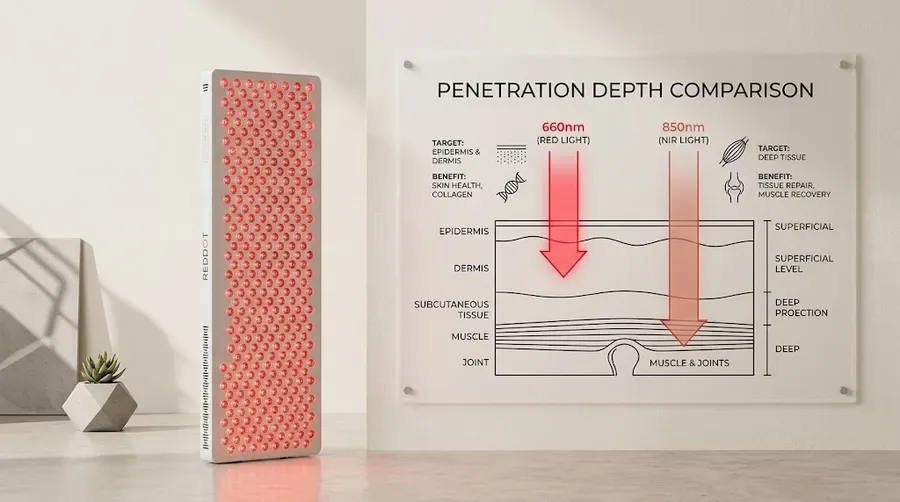
A common belief is that red and near-infrared light are interchangeable because they both stimulate mitochondria. The reality is that these wavelengths occupy distinct biological niches defined by tissue optics. Visible red light at 660nm targets cytochrome c oxidase primarily in superficial skin layers, driving cellular energy production where melanin and hemoglobin absorption are moderate. Near-infrared light at 850nm penetrates several centimeters deeper to reach muscle, tendon, and bone, modulating inflammatory markers in subcutaneous tissue that visible red cannot access. This pairing works because the two wavelengths address different anatomical targets simultaneously rather than redundantly.
The “optical window” explains why this specific combination dominates clinical devices. Human tissue absorbs most visible light through hemoglobin and blocks longer infrared waves through water content. Between approximately 650nm and 900nm, absorption by both chromophores drops significantly, allowing photons to transmit through tissue rather than converting to heat at the surface. Outside this window, therapeutic efficiency collapses regardless of LED power. Wavelength accuracy alone remains insufficient without adequate irradiance.
Photon density must exceed a minimum threshold to trigger photochemical reactions; dim lights may have correct spectral output but fail to deliver enough energy per unit area to activate cellular pathways. Understanding this optical foundation clarifies why device specifications matter beyond marketing claims.
Why specific nanometer precision matters for efficacy
Medical-grade LEDs require tight spectral tolerances because biological absorption peaks are narrow. A nominal 660nm specification should fall within ±5nm to ensure consistent chromophore activation. Consumer devices often use broad-spectrum LEDs with wider bandwidths that appear bright but emit significant energy outside the optimal absorption range, reducing treatment efficiency even when total wattage seems adequate. Peak wavelength stability also depends on thermal management. LEDs shift toward longer wavelengths as junction temperature rises during operation.
Without proper heat dissipation, a device calibrated to 660nm at startup may drift to 670nm or beyond after fifteen minutes, moving away from the cytochrome c oxidase absorption peak. Medical engineering maintains spectral accuracy through active cooling and driver regulation, ensuring the stated wavelength remains constant throughout extended sessions.
Translating wavelength science into verified clinical outcomes
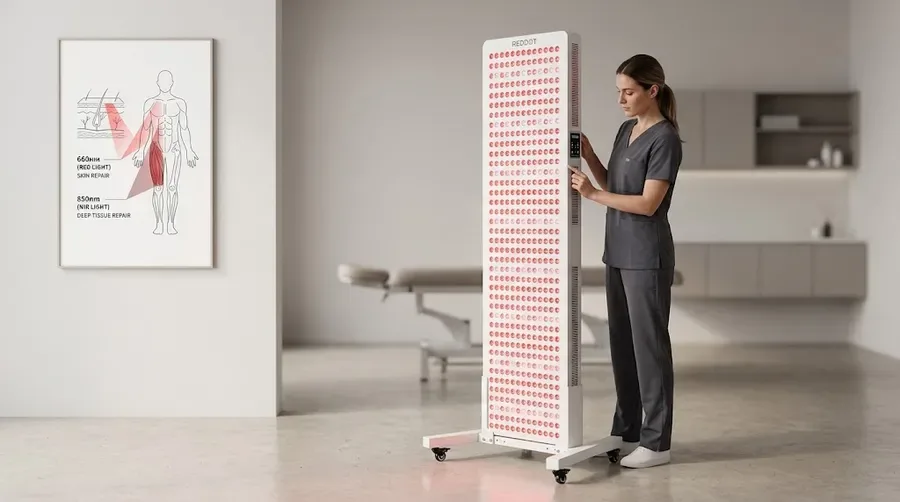
Controlled studies demonstrate that combined 660nm and 850nm protocols accelerate tissue repair compared to single-wavelength treatments. Research published in peer-reviewed journals indicates dual-wavelength approaches reduce recovery duration more effectively than either wavelength alone, though exact percentages vary by condition and dosing parameters. Real-world results support the benefits of using both wavelengths. A boutique sports recovery studio using FDA-cleared multi-wavelength panels reported reducing client treatment times by 50% while maintaining safety standards, demonstrating that correct wavelength implementation drives operational efficiency alongside clinical benefit.
True therapeutic value requires distinguishing statistically significant data from anecdotal reports. Peer-reviewed validation of the specific 660nm/850nm combination carries more weight than generic red light testimonials. Boundary conditions also exist. This wavelength pairing shows limited efficacy for acute bacterial infections or certain photosensitive conditions where light exposure may be contraindicated. Scientific neutrality demands acknowledging these limitations rather than presenting photobiomodulation as universally applicable. According to the International Electrotechnical Commission (IEC) 60601-2-57 standard, manufacturers must specify intended indications and contraindications based on clinical evidence rather than extrapolation.
Verified outcomes depend on matching wavelength protocols to appropriate clinical presentations with documented dose-response relationships.
Dosing parameters derived from optical engineering
High-intensity output enables shorter treatment windows in professional settings. The EST-X2 Therapy Lamp delivers >200mW/cm² irradiance at 6 inches with a 1:1 wavelength ratio, illustrating how concentrated photon flux compresses session duration while maintaining therapeutic dose. Distance dramatically alters effective dose due to the inverse square law. Doubling the distance from a point source reduces irradiance to one-quarter, meaning a 10-minute session at 6 inches may require 40 minutes at 12 inches for equivalent dosing. Precise dosing connects directly to patient safety through the biphasic dose-response curve.
Insufficient energy fails to stimulate cellular response, while excessive exposure inhibits rather than enhances function. Understanding this non-linear relationship prevents overtreatment and ensures protocols stay within the therapeutic window where Near Infrared Red Light Therapy Wavelength 660nm 850nm produces beneficial effects.
Engineering standards ensuring wavelength accuracy and safety
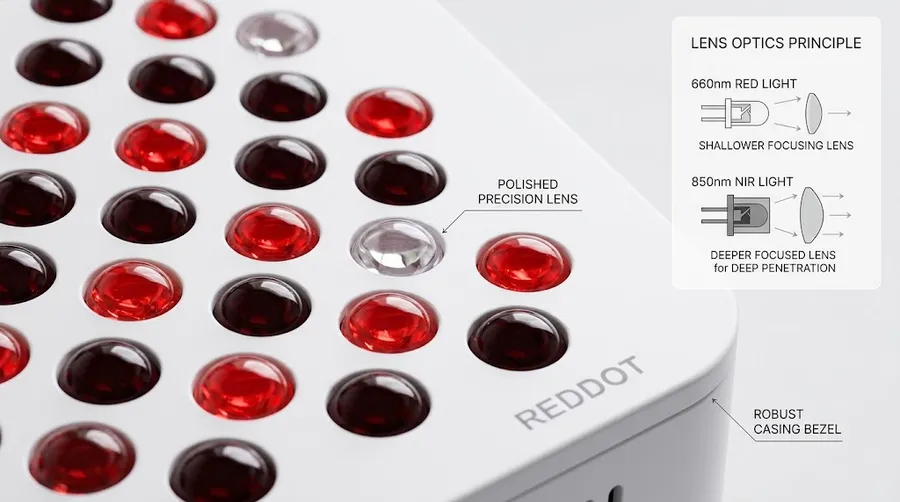
Consistent delivery of therapeutic wavelengths depends entirely on manufacturing execution rather than theoretical specifications. Component binning, optical design, and assembly processes determine whether a device actually emits what its label claims. ISO 13485 and MDSAP certifications distinguish suppliers who verify every production batch against documented wavelength and irradiance specifications from those making unverified marketing assertions. Lens design matters as much as wavelength selection for uniform coverage. In my own engineering work redesigning terminal block layouts on panel assemblies, I found that consolidating separate connectors into a single 4-pin block eliminated breakage risks and improved long-term reliability.
Similar attention to mechanical detail applies to optics: choosing 30° versus 60° beam angles determines whether light concentrates on a joint or distributes across a torso. Non-compliant devices risk wavelength ratio drift over time due to poor thermal dissipation or inferior drivers, potentially rendering long-term protocols ineffective as emission spectra shift away from therapeutic targets.
Application-specific design considerations for consistent dosing
How does form factor influence wavelength delivery in practice?
Full-body panels and localized wearables require fundamentally different optical engineering. The T1 Desktop Panel delivers 35mW/cm² at 15cm, adapting dosing for close-range facial or joint treatment where high-power systemic output would be excessive. Flexible belts face additional constraints. A portable belt with a 4:1 ratio of 660nm to 850nm optimizes wavelength balance for deep tissue recovery while managing heat dissipation in a compact form factor. Flexible substrates require different LED spacing and encapsulation techniques than rigid panels to maintain safe irradiance levels across curved body surfaces. One-size-fits-all wavelength claims ignore these architectural differences.
Professionals should verify that device engineering matches their specific clinical application, whether dermatology demands surface-focused ratios or sports medicine requires deeper penetration with higher 850nm proportions.
Practical implementation guidelines for therapeutic protocols

Selecting the appropriate wavelength ratio begins with treatment goals. Higher 660nm proportions suit surface skin concerns like wound healing or collagen stimulation, while musculoskeletal recovery benefits from increased 850nm emphasis for deeper tissue penetration. Standard treatment frequencies typically range from three to five sessions weekly, with durations adjusted based on device irradiance and target condition. Current literature supports starting with conservative doses before advancing to higher intensities. The misconception that more light equals better results ignores cellular saturation points. Exceeding recommended doses yields diminishing returns and can inhibit mitochondrial function through the biphasic response mechanism.
Objective monitoring metrics help evaluate protocol effectiveness. Pain scales, range of motion measurements, or standardized skin texture assessments provide quantifiable feedback on whether the chosen Near Infrared Red Light Therapy Wavelength 660nm 850nm regimen delivers measurable progress over time.
Integrating wearable and panel therapies for targeted treatment
Combining modalities enhances outcomes when systemic and local needs coexist. A high-power panel can prime the entire body before targeted maintenance with a dedicated wearable sustains localized treatment throughout the day. Portability improves compliance significantly. Easier access to therapy in home or office settings leads to better adherence than clinic-only schedules, particularly for chronic conditions requiring consistent intervention. Hygiene protocols differ between shared clinical devices and personal units. Shared equipment requires disinfection between users to prevent cross-contamination, while personal devices need regular cleaning of optical surfaces to maintain maximum light transmission.
Healthcare provider consultation helps tailor protocols to individual health profiles, reinforcing that technology functions as one tool within a broader therapeutic strategy rather than a standalone solution.
Key Takeaways
The 660nm and 850nm wavelength combination is effective because visible red light targets superficial skin layers while near-infrared penetrates deeper into muscle and joint tissue. Selecting a device with verified irradiance at the stated treatment distance ensures both wavelengths deliver therapeutic doses rather than just surface-level illumination.
Frequently Asked Questions
Is 660nm and 850nm good for red light therapy?
Yes, this specific pairing is widely regarded as the standard for photobiomodulation because it addresses multiple tissue depths simultaneously. Research published in peer-reviewed journals indicates that 660nm optimizes mitochondrial function in the epidermis and dermis, while 850nm reaches subcutaneous structures like tendons and muscles. Devices combining these two wavelengths allow users to treat both skin concerns and deep-tissue recovery in a single session.
What are the benefits of 660nm red light?
Visible red light at 660nm primarily supports collagen production, wound healing, and surface-level inflammation reduction by targeting cytochrome c oxidase in the upper skin layers. Clinical studies referenced by the National Institutes of Health demonstrate its efficacy in accelerating tissue repair and improving skin texture through enhanced ATP synthesis. This wavelength is absorbed within the first few millimeters of tissue, making it distinct from deeper-penetrating near-infrared options.
Can I use Nir every day?
Daily use of near-infrared light is generally considered safe when following established dosimetry guidelines and manufacturer instructions. Most clinical protocols suggest consistent daily or near-daily application to maintain cumulative therapeutic effects without exceeding safety thresholds defined by organizations like the International Commission on Non-Ionizing Radiation Protection. Users should always adhere to recommended treatment times and distances to avoid diminishing returns from overexposure.
Is NIR better than red light?
Neither wavelength is universally superior; 850nm near-infrared is more effective for deep musculoskeletal issues while 660nm red light excels at dermatological applications. The biological window for phototherapy spans roughly 600nm to 1000nm, meaning efficacy depends entirely on matching the wavelength to the target tissue depth. Choosing between them requires identifying whether the primary concern is superficial skin health or deeper structural recovery.
References & Sources
- National Institutes of Health. “Photobiomodulation (Light Therapy).” 2024. https://www.nih.gov
- International Commission on Non-Ionizing Radiation Protection. “ICNIRP Guidelines on Limits of Exposure to Incoherent Optical Radiation.” 2023. https://www.icnirp.org
- U.S. Food and Drug Administration. “Laser Products and Medical Devices.” 2024. https://www.fda.gov
- Wikipedia. “Low-Level Laser Therapy.” 2024. https://en.wikipedia.org/wiki/Low-level_laser_therapy
About the Author
Kevin Zhang is the Chief Technology Officer at REDDOT LED with over 15 years of experience in medical-grade LED light therapy manufacturing and photobiomodulation engineering. He oversees R&D and quality systems compliant with ISO 13485, MDSAP, FDA, and IEC 60601-1 standards, focusing on translating optical research into reliable therapeutic devices for global B2B partners.