
You part your hair in the mirror and notice more scalp showing than last month. The question follows immediately: can red light therapy reverse hair thinning?
Red light therapy has been studied for supporting hair density and regrowth in conditions such as androgenetic alopecia. Red and near-infrared wavelengths are commonly used in photobiomodulation devices, but outcomes depend on wavelength, optical dose, treatment geometry, and protocol rather than wavelength alone.
Understanding how beam geometry, wavelength selection, and scalp-level irradiance interact helps determine whether a device delivers its intended optical exposure.
Ranking device configurations for scalp penetration and hair follicle stimulation
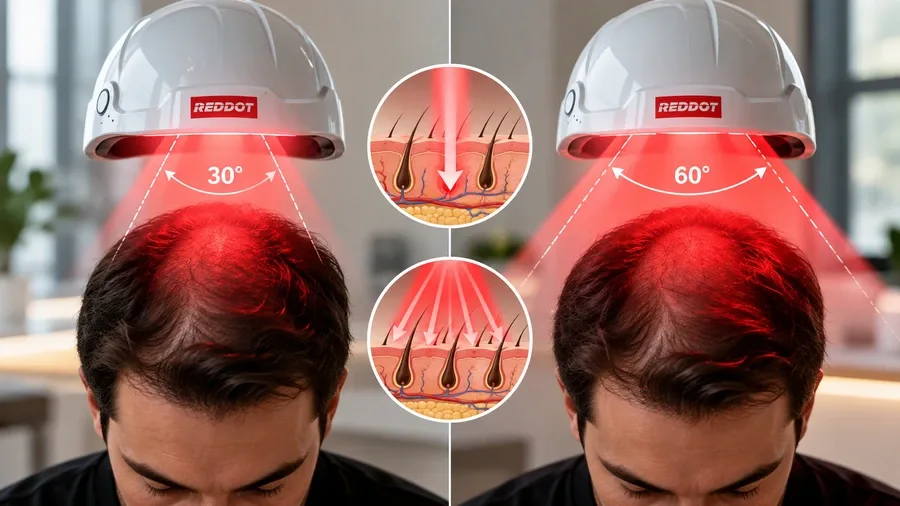
This ranking evaluates device classes based on optical engineering metrics. Specifically, it measures irradiance delivery at the scalp surface, lens beam angle, and wavelength ratio rather than marketing claims or aesthetic design. The assessment targets two audiences: individuals experiencing early-stage hair thinning who want to understand why some devices fail while others succeed, and B2B brand owners evaluating manufacturing specifications for clinical-grade photobiomodulation products.
The baseline criteria used here include the ability to bypass hair shaft scattering, maintenance of therapeutic irradiance thresholds (typically 30–50 mW/cm² at the target distance), and proven synergistic wavelength combinations supported by peer-reviewed literature in journals like Lasers in Surgery and Medicine. As a CTO with over 15 years of experience in optical engineering and non-invasive therapeutics, my perspective is straightforward: reversing hair thinning depends entirely on delivering precise photon density to the dermal papilla cells, not just turning on red LEDs.
High-output panels with focused optics rank first for reversing thinning
High-output desktop panels equipped with narrow-angle lenses, such as 30 degrees, represent the most effective configuration for addressing whether can red light therapy reverse hair thinning. They concentrate photons into a tight beam capable of penetrating dense hair canopies without excessive scattering. These devices typically deliver irradiance levels exceeding 30 mW/cm² at practical treatment distances around 15 cm, which is the minimum threshold required to stimulate mitochondrial ATP production in dormant hair follicles. Focused-lens configurations are often engineered specifically for targeted scalp protocols, contrasting sharply with broader body panels where light disperses too widely to be effective for hair restoration.
Wearable laser caps and LED helmets rank second for convenience but face thermal limits
Wearable caps rank highly for user compliance due to their hands-free nature and direct scalp contact, which eliminates distance-related irradiance drop-off. The primary limitation is thermal management. Packing hundreds of diodes into an enclosed, unventilated space creates heat buildup that degrades LED output over time and can trigger protective shutdowns, reducing actual therapeutic dosage. Many consumer-grade helmets use wider wavelength bands that lack the precision required for optimal follicular stimulation compared to dedicated medical-grade panel architectures.
Handheld wands rank third due to inconsistent dosage delivery
Handheld devices rank lowest for treating widespread hair thinning because manual movement makes it nearly impossible to maintain consistent distance, angle, and dwell time across the entire scalp. While useful for spot-treating small areas, the variability in user technique often results in under-dosing certain regions and over-dosing others, leading to uneven regrowth patterns. From an engineering standpoint, relying on human motor control introduces too many variables to guarantee the standardized irradiance necessary for clinical efficacy. A compact 9W therapy flashlight with three 3W chips emitting at 630 nm, 660 nm, and 850 nm illustrates this form factor; its 76g aluminum alloy body suits localized care, but covering an entire scalp demands sustained consistency that manual operation rarely achieves.
Use these criteria when evaluating any device intended for hair restoration.
- Verify the lens beam angle is narrow enough to penetrate hair without scattering.
- Confirm the device delivers at least 30 mW/cm² at your planned treatment distance.
- Check that the wavelength ratio matches established trichology research.
- Assess thermal management to ensure output remains stable throughout the session.
- Avoid relying on manual positioning for large treatment areas.
Understanding these optical differences explains why identical-looking devices produce vastly different biological outcomes.
The biophysics behind why specific wavelengths reverse hair thinning
>200 mW/cm² at 6 inches is the irradiance delivered by the EST-X2 Therapy Lamp using selectable 30-degree and 60-degree lenses. This number matters because raw power means nothing if the photons scatter before reaching the target tissue. In practice, high-irradiance, focused-lens configurations are engineered for targeted protocols rather than general ambient exposure.
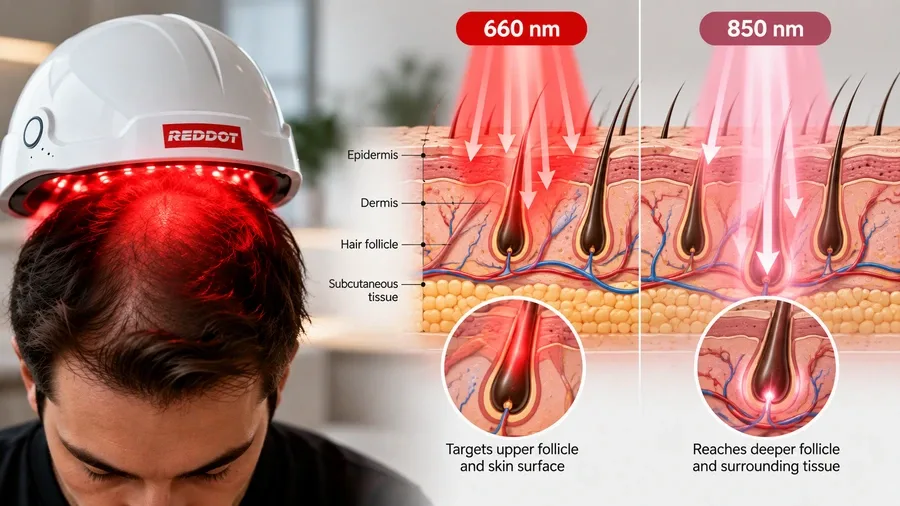
In trichology, red light therapy applies specific visible red and near-infrared wavelengths to stimulate cellular respiration in hair follicle stem cells and dermal papilla cells. This shifts them from the resting telogen phase back into the growth anagen phase. The two primary wavelengths perform distinct jobs. 660 nm red light targets superficial cellular activity and microcirculation around the follicle bulb. 850 nm near-infrared light penetrates deeper to directly enhance mitochondrial function in the dermal papilla, as documented in foundational research published in Photobiomodulation, Photomedicine, and Laser Surgery.
These two wavelengths may complement each other. The best wavelength for red light therapy generally depends on the target tissue and its depth. For hair thinning, their combined use may reach scalp tissues at different depths, a combined approach ensures both the vascular supply and the root structure receive adequate photonic energy. Chronic stress raises cortisol, which prematurely pushes hair follicles into the telogen phase. While red light therapy for sleep helps regulate circadian rhythms and lower systemic stress, applying light directly to the scalp tackles the localized cellular dysfunction causing the thinning itself.
How 660 nm and 850 nm ratios dictate clinical outcomes
A balanced 1:1 ratio of 660 nm to 850 nm is often considered optimal for scalp treatments. It ensures equal photon distribution between superficial blood flow enhancement and deep cellular energy production. Contrast this with belts designed for muscle recovery that might use a 1:2 ratio favoring deeper near-infrared penetration. Those deeper ratios are less ideal for the relatively shallow depth of hair follicles. The T1 Desktop Panel illustrates the exact optical configuration needed for close-range scalp therapy where hair blocks wider light dispersion, using 120pcs x 1W LEDs with a strict 660nm:850nm 1:1 wavelength ratio to deliver 35 mW/cm² at 15 cm.
Why optical engineering matters more than raw wattage
Higher total wattage does not automatically equal better hair growth results. Total power means nothing if the beam angle scatters the light before it reaches the scalp. Irradiance, measured in mW/cm², is the true metric of efficacy. Lens geometry dictates this value at any given distance. For broader applications, a full-body mat containing 945 LEDs operates at a 4:1 ratio of 660 nm to 850 nm, prioritizing superficial coverage over the deep focal intensity required for hair restoration. Scalp devices must prioritize tight optical control over sheer LED counts.
Precise wavelength ratios determine whether photons reach the cells that govern hair growth.
Are there any risks or side effects when treating thinning hair?
Low-level light therapy for hair loss is broadly recognized as safe and non-invasive. Clinical trials and reviews featured in the Journal of Cosmetic and Laser Therapy establish evidence-based benchmarks for treatment duration and frequency without severe adverse events. Genuine physiological risks are minimal. Device-induced issues caused by poor engineering present the real danger, including thermal burns from inadequate heat sinking or eye strain from unshielded high-intensity emitters.
People frequently ask if the same devices used for hair can address other concerns, such as whether can red light therapy tighten saggy skin. While the same wavelengths stimulate collagen production in facial tissues, applying a skin-tightening protocol directly to the scalp will not yield hair regrowth results. Skin tightening often uses different distances or pulsing frequencies. Specificity in protocol matters. There is also a risk of false expectations and delayed medical intervention. Low-level light therapy can reverse early-to-moderate androgenetic alopecia, but completely scarred or dead follicles cannot be resurrected by light alone.
Thermal management and long-term device safety
Continuous operation of high-density LED arrays generates significant heat. If a device lacks proper thermal dissipation engineering, the internal temperature rise causes wavelength drift and irradiance degradation over a 15-minute session. International safety standards prevent this. IEC 60601-1 compliance provides essential performance requirements for medical electrical equipment and validates why hair-growth light therapy devices must meet rigorous electrical and thermal safety benchmarks.
Beyond thermal issues, physical reliability is critical. During production and customer use, product defects have repeatedly occurred due to loose ribbon cables and detached terminals. This represents a significant quality hazard affecting product reliability. To solve this, manufacturers implement a two-pronged approach: applying glue to all ribbon cables in inventory to reinforce the terminals, and requiring suppliers to secure all subsequent purchases of ribbon cables to their terminals with glue before shipment. Although the cost per light fixture increases, this fundamentally eliminates failures caused by loose connections, avoiding expensive after-sales repair costs and preventing unpredictable dosage delivery.
Can low-level light therapy damage existing healthy hair? No. The irradiance levels used for follicular stimulation operate well below the threshold that causes thermal or photochemical damage to healthy tissue. Problems arise exclusively from poorly manufactured devices that fail to regulate heat or deliver erratic power output.
Safety ultimately depends on the engineering inside the chassis rather than the light outside it.
Evaluating device quality through an engineering lens
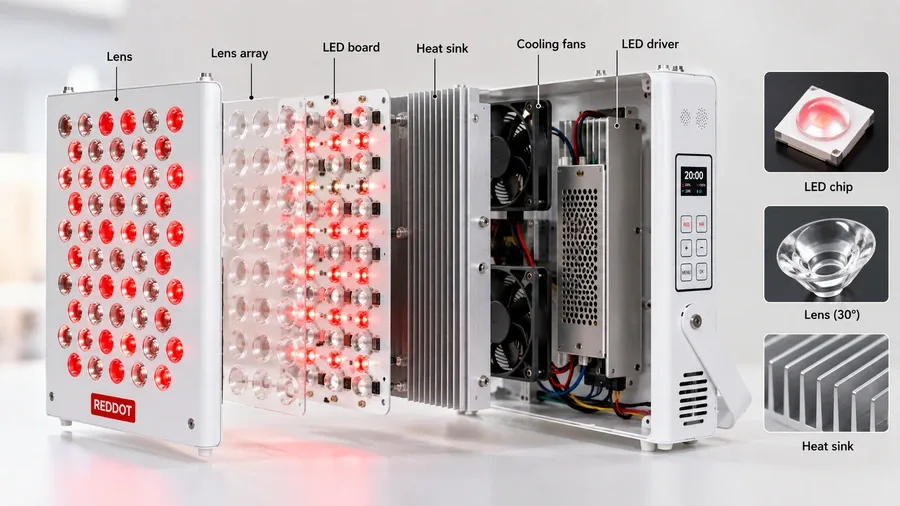
The ability of photobiomodulation to actually reverse hair thinning depends entirely on whether the device delivers the promised specifications consistently over thousands of hours of use. Consumers and B2B buyers alike must look past marketing copy and evaluate devices based on verifiable engineering data. Authentic LED bead sourcing, precise optical alignment, and certified quality management systems separate functional medical tools from decorative lights.
ISO 13485 certification establishes that effective hair thinning devices require medical-grade multi-stage inspection and performance testing to ensure consistent irradiance output. This directly addresses industry pain points regarding power output accuracy. Achieving these standards requires substantial R&D infrastructure. REDDOT LED maintains a 17-member R&D team with in-house expertise in optics, electronics, firmware, and photobiomodulation technologies backed by over 70 granted patents. This level of investment is necessary to solve complex challenges like preventing thermal degradation during extended scalp sessions.
What separates medical-grade manufacturing from generic assembly
OEM and ODM partners who engineer custom optical solutions build products tailored to specific biological targets. Suppliers who merely apply private labels to off-the-shelf, unverified components do not. Multi-stage quality inspections verify that every single LED emits within the correct nanometer tolerance. Even a 5 nm deviation can shift the light out of the optimal absorption peak for cytochrome c oxidase in hair follicles. Manufacturing capabilities spanning optical engineering, industrial design, and firmware development allow brands to create differentiated, clinically valid products rather than commoditized gadgets that fail to deliver results.
Matching device architecture to specific treatment needs
Selecting the right form factor depends on the specific pattern of hair thinning. Diffuse thinning across the crown requires broad, uniform panel coverage. Receding hairlines benefit from targeted, high-density emitter zones. B2B brand owners must consider the end-user’s environment. A clinic requires heavy-duty thermal management for back-to-back patient use, whereas a home-use device prioritizes compact form factors without sacrificing irradiance. Verifying a manufacturer’s adherence to standards like CE, RoHS, FCC, and MDSAP ensures the device is legally compliant and safe for global distribution.
Use this checklist to evaluate any potential manufacturing partner or retail device.
- Confirm ISO 13485 certification to verify medical-grade quality management.
- Request spectral test reports proving exact wavelength emission tolerances.
- Verify thermal dissipation designs match the intended session length.
- Ensure international compliance marks align with your target market regulations.
- Evaluate the manufacturer’s R&D capacity for ongoing technical support.
Engineering rigor determines whether a light therapy device functions as a reliable clinical tool or a temporary novelty.
Key Takeaways
Red light therapy at 660 nm and 850 nm wavelengths can support hair follicle activity by stimulating mitochondrial ATP production, though clinical outcomes depend heavily on delivering adequate irradiance directly to the scalp rather than just the hair shaft. Choosing a device with appropriate lens angles and verified power output is the most practical step for anyone evaluating photobiomodulation for thinning hair.
Frequently Asked Questions
Does red light therapy regrow thinning hair?
Red light therapy can stimulate dormant hair follicles and improve hair density in cases of early-stage thinning, but it does not typically regrow hair on completely bald scalps. Photobiomodulation works by delivering specific wavelengths, commonly 660 nm and 850 nm, which increase cellular energy production in the follicle. Peer-reviewed research published in journals indexed on PubMed indicates that consistent application over several months yields measurable improvements in hair count per square centimeter.
What did Jennifer Lopez use for hair loss?
There is no verified public record or medical source confirming that Jennifer Lopez used red light therapy specifically for hair loss. Celebrity endorsements often circulate without clinical backing, making them unreliable guides for treatment decisions. Anyone researching phototherapy should rely on peer-reviewed data from sources like PubMed rather than entertainment media claims.
What are the big 3 for thinning hair?
The “big three” treatments widely recognized by dermatologists for thinning hair are minoxidil (topical), finasteride (oral), and ketoconazole shampoo. These pharmacological approaches target different mechanisms of androgenetic alopecia, from blocking DHT conversion to reducing scalp inflammation. Red light therapy is increasingly studied as a non-pharmacological complement to these standard protocols, with devices operating under IEC 60601-1 safety standards offering a regulated approach to light-based treatment.
What is the no. 1 treatment for hair loss?
Minoxidil remains the most widely recommended first-line topical treatment for pattern hair loss, approved by the FDA for both men and women. It works by prolonging the anagen (growth) phase of the hair cycle and increasing blood flow to the follicle. While minoxidil holds the primary position in clinical guidelines, photobiomodulation using 660 nm and 850 nm wavelengths is gaining traction as an adjunct therapy supported by ongoing research documented in medical literature.
References & Sources
- U.S. Food and Drug Administration (FDA). “Medical Devices.” https://www.fda.gov
- International Electrotechnical Commission (IEC). “IEC 60601-1 Medical Electrical Equipment Standards.” https://www.iec.ch
- National Institutes of Health (NIH). “PubMed Database: Photobiomodulation and Alopecia Research.” https://pubmed.ncbi.nlm.nih.gov
- Wikipedia. “Low-level laser therapy.” https://en.wikipedia.org