
Most buyers assume any red light works the same. This misconception quietly costs clinics and brands their credibility when devices fail to deliver measurable results.
660 nm and 850 nm are two of the most commonly used wavelengths in red and near-infrared light therapy devices. Combining visible red and near-infrared wavelengths can provide a broader spectral configuration, while the optimal wavelength selection and ratio depend on the intended application, device design, and treatment protocol.
Understanding how these specific nanometers interact with biology changes how you evaluate hardware. The sections ahead break down the therapeutic window so you can match optical specifications to real clinical applications.
The therapeutic window: ranking wavelengths by biological evidence and engineering feasibility
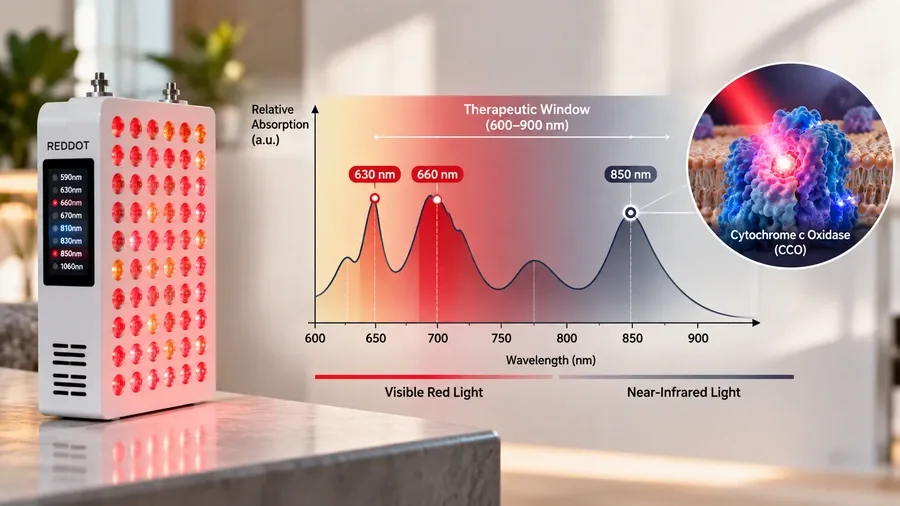
Determining which wavelength is best for red light therapy depends on two intersecting factors: the biological absorption spectrum of cellular chromophores (primarily cytochrome c oxidase in mitochondria) and the optical engineering limits of manufacturing stable, high-output LEDs. A wavelength might trigger a strong cellular response in a petri dish but prove impossible to manufacture reliably at scale. This ranking evaluates product classes rather than off-the-shelf consumer brands, helping brand owners, clinicians, and distributors understand how form factor dictates wavelength selection.
The Therapeutic Window: Comparing Wavelengths by Biological Evidence and Engineering Feasibility:
- 630 nm: Commonly used in skin-focused and other PBM applications.
- 650 nm: Used in some targeted and localized light-delivery devices.
- 660 nm: A widely used visible-red wavelength in PBM research and commercial devices.
- 810 nm: A commonly studied NIR wavelength, including in transcranial PBM research.
- 850 nm: A widely used NIR wavelength in commercial LED systems, supported by broad diode availability and established manufacturing architectures.
Optical wavelength, measured in nanometers, dictates tissue depth. Red light therapy frequency Hz refers to pulsing rates. While pulsing can influence cellular response, the foundational biological trigger is always the nanometer wavelength itself.
When evaluating device specifications, buyers should verify these core parameters:
- Confirm the target tissue depth matches the chosen nanometer range.
- Verify that the manufacturer can maintain strict wavelength tolerances across production batches.
- Match the wavelength to the intended product class, whether a targeted intranasal device or a broad-spectrum desktop panel.
- Distinguish between optical wavelength and pulsing frequency before comparing clinical claims.
Understanding this biological and engineering intersection prevents costly specification errors during product development.
Why 660 nm and 850 nm dominate professional device configurations
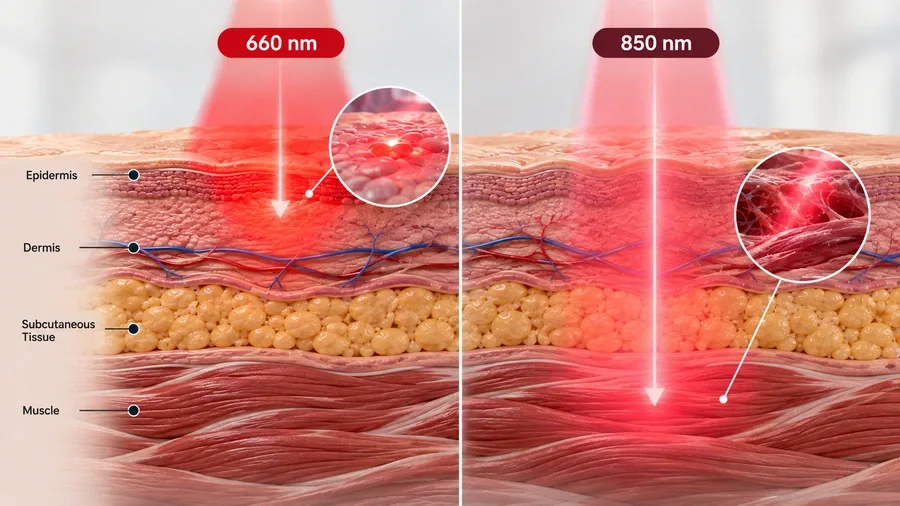
Research published in the journal Photobiomodulation, Photomedicine, and Laser Surgery details how 660 nm and 850 nm stimulate ATP production without causing thermal damage. These two wavelengths form the backbone of almost all clinical-grade devices because they cover both ends of the penetration spectrum efficiently. Combining 660 nm for superficial absorption and 850 nm for deep tissue creates a treatment profile that addresses multiple anatomical layers simultaneously.
Dual-wavelength engineering requires exact ratios. The REDDOT LED T1 Desktop Panel uses 120pcs x 1W LEDs in an exact 660nm:850nm = 1:1 wavelength ratio to deliver balanced coverage, achieving 35mW/cm² irradiance at a 15cm distance. Wavelength must also be matched with optical beam angles to prevent photon scattering. The EST-X2 Therapy Lamp configuration pairs 60 X5W LEDs at a 660nm:850nm = 1:1 ratio with interchangeable 30-degree and 60-degree lenses, demonstrating how precise optics allow targeted light delivery exceeding 200mW/cm² at 6 inches.
Single-wavelength handheld units serve highly localized tools, whereas professionals prefer the 1:1 ratio for full-body or large-area treatments. When selecting the best wavelength for red light therapy, dual-band panels provide the most predictable dosimetry for general use.
Dual-wavelength systems are common in large-area PBM panels, while single- and multi-wavelength configurations may also be appropriate depending on the intended application:
- Define the wavelength configuration according to the intended application.
- Pair the wavelength configuration with appropriate optical geometry.
- Verify irradiance at the stated working distance.
- Evaluate treatment-area uniformity and spectral output rather than wavelength count alone.
This optical precision separates medical-grade hardware from generic consumer electronics.
Application-specific wavelengths and why one size does not fit all
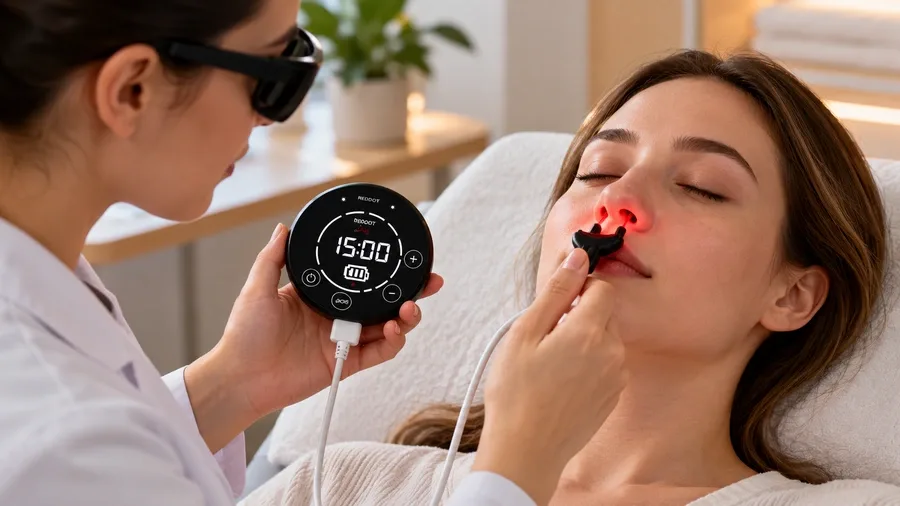
While 660 nm and 850 nm answer the general question of which wavelength is best for red light therapy, specific use cases demand different configurations. Evaluating what red light wavelength is best for hair growth, joint recovery, or mucosal health requires independent judgment based on tissue sensitivity and depth.
Specialized configurations exist for delicate anatomy. The REDDOT LED Rhinitis Lamp employs a highly specific 650 nm wavelength with 12x3W LEDs and a controlled 10mW/cm² irradiance. This lower irradiance and specific wavelength are engineered to safely support targeted, localized application for sensitive nasal mucosa without overwhelming the tissue. High power would cause discomfort here; precision matters more than raw output.
Portable formats handle spot treatments differently. Devices integrating multi-chip designs spanning 630, 660, and 850 nm in compact aluminum alloy bodies serve users needing daily hand care or post-workout muscle relief. Wearable belts introduce another variable: ratio tuning. A belt using 120pcs LEDs at a 660:850 1:2 ratio, such as the YD002 Red Light Therapy Belt operating at 25W, prioritizes deeper near-infrared penetration for muscle recovery. Alternatively, a 4:1 ratio favors superficial skin and subcutaneous fat layers. A 3:2 ratio might be chosen for waist and abdomen care, balancing skin-level benefits with deeper delivery.
Form factor dictates the physics. A massive panel cannot treat a nasal cavity, and a tiny intranasal probe cannot recover a strained hamstring. Matching the biophysics of light penetration to the physical constraints of the device determines clinical success.
How optical engineering and manufacturing standards dictate wavelength accuracy
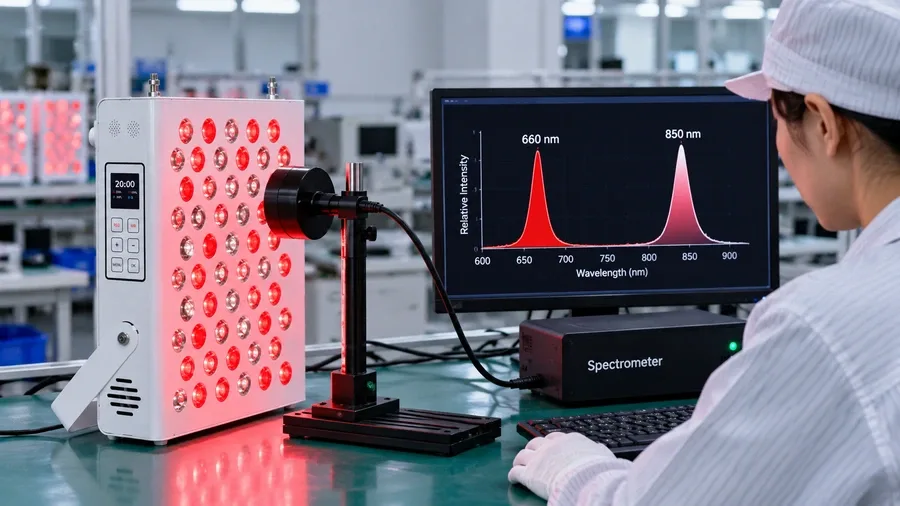
The stated wavelength on a box often differs from the actual light emitted by cheaply manufactured devices. Kevin Zhang, Chief Technology Officer at REDDOT LED with over 15 years of experience, notes that maintaining wavelength accuracy is fundamentally a supply chain and engineering challenge. “Binning” in LED manufacturing refers to sorting diodes by their exact spectral output. Maintaining a strict wavelength tolerance of ±5 nm requires advanced supply chain control. REDDOT LED’s ISO 13485-certified quality management system ensures that the stated wavelength output of every manufactured device remains consistent and accurate over its lifespan, a requirement for medical-grade compliance.
Housing high-power LEDs without altering their optical output presents physical engineering challenges. When assembling the RDPRO-6000 single-core seven-channel product, the original 70cm terminal wire length proved insufficient due to the excessive distance between the lamp board solder joints and the constant current board. Cutting terminals to add extension wires increased labor time and wasted materials, while simply replacing the wire with a longer one caused voltage drop and uneven brightness. The solution required no wiring changes: adjusting the layout of the constant current board on the housing shortened its distance from the lamp board.
Adding eight rivets accommodated different mounting hole positions for red and infrared constant current boards, achieving universal housing compatibility for single-chip, dual-chip, and seven-channel products. This spatial adjustment directly impacts wavelength mixing and uniform irradiance delivery.
International frameworks govern wavelength verification. IEC 60601-1 sets safety standards for medical electrical equipment, while the World Association for Photobiomodulation Therapy (WALT) publishes guidelines for recommended dosage parameters. B2B buyers and distributors must verify these certifications rather than relying solely on marketing claims.
| Engineering Parameter | Unverified Manufacturing | ISO 13485 Certified Production |
|---|---|---|
| Wavelength Tolerance | Often exceeds ±10 nm | Strictly maintained within ±5 nm |
| LED Binning | Mixed bins used to reduce cost | Sorted bins matched to specifications |
| Thermal Management | Inconsistent heat dissipation alters output | Engineered housings prevent spectral drift |
Manufacturing consistency transforms theoretical biology into reliable clinical outcomes.
Choosing the right wavelength configuration for your target audience
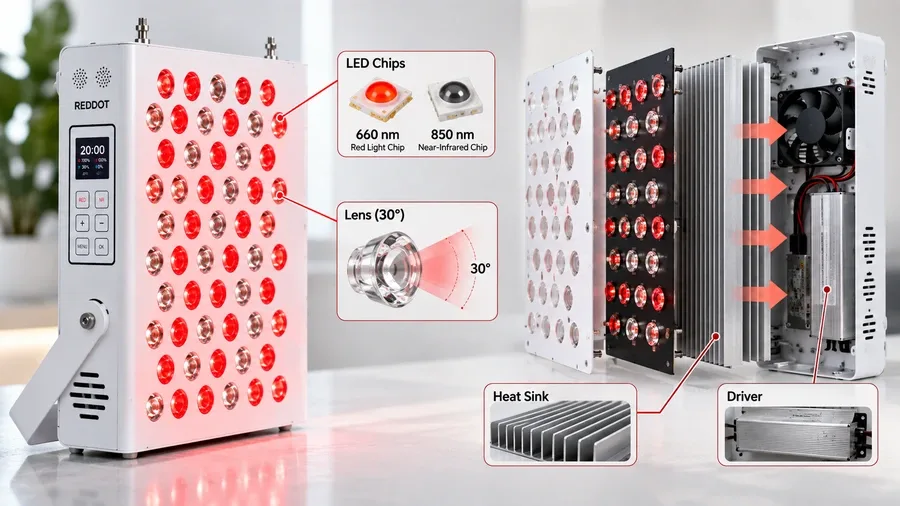
Selecting a device requires matching the biophysics of light penetration with an end-user’s specific needs. Brand owners, clinic procurement teams, and distributors face a clear choice between OEM custom-engineered solutions and generic off-the-shelf private-label devices. Custom engineering allows wavelength ratios like 660:850 or 660:880 to be tailored to a specific clinical protocol. Generic devices often rely on unverified, mixed-bin LEDs that fail to deliver consistent dosimetry.
Common belief: Finding the single best wavelength guarantees a successful product. What is actually true: Optical specifications mean nothing if the patient cannot comfortably operate the machine. During the development of the RD6000 model, customers reported a significant usability issue. When mounted on a wall, the unit sat too close to the surface, leaving insufficient space to reach the power switch. Users were forced to unplug the device entirely to turn it off. While taller feet were suggested initially, the final solution involved redesigning the product to relocate the power switch to a more accessible position. This ensured users could easily operate the switch even when the unit was mounted flush against a wall. Ergonomic engineering must accompany optical specs.
Identifying the optimal wavelength for photobiomodulation requires understanding the intersection of cellular absorption, optical lens design, and rigorous manufacturing quality control. Buyers exploring OEM partnerships should evaluate potential manufacturers based on their R&D capabilities, patent portfolios like REDDOT LED’s 70+ patented technologies, and adherence to global compliance standards including MDSAP and CE. Hardware that balances verified spectral output with practical usability wins in regulated markets.
Key Takeaways
The 660 nm and 850 nm wavelengths align with the peak absorption bands of cytochrome c oxidase, making a 1:1 ratio of these two wavelengths the standard configuration for photobiomodulation devices. Selecting the correct wavelength matters less than verifying that the device delivers stable irradiance at the target distance, since even an ideal spectrum produces no biological effect if the optical output is too low to reach the tissue. Understanding this relationship between wavelength selection and actual light delivery helps buyers evaluate devices beyond marketing claims.
Frequently Asked Questions
Which red light wavelength is best for anti-aging?
The 660 nm wavelength is generally applied for anti-aging because it absorbs efficiently in superficial skin layers where collagen synthesis occurs. Research on photobiomodulation indicates that red light in the 630 nm to 670 nm range stimulates fibroblast activity. Many clinical-grade facial devices use this specific band, sometimes combined with 850 nm near-infrared light, to address both surface texture and deeper tissue support.
Do and don’ts of red light therapy?
Do verify that your device complies with recognized safety standards such as IEC 60601-1, which governs the electrical safety of medical equipment. Don’t assume that a higher LED count automatically means better results; optical lens design and thermal management determine how much usable light actually reaches the target area. Do maintain a consistent treatment distance specified by the manufacturer, as irradiance drops significantly when you move further from the panel. Don’t stare directly into high-output LEDs without appropriate eye protection, particularly with devices emitting near-infrared light that remains invisible to the human eye.
What color light for lymphatic drainage?
Near-infrared light at 850 nm is typically used for lymphatic drainage because its longer wavelength penetrates deeper into subcutaneous tissue than visible red light. While visible red light around 660 nm absorbs primarily within the first few millimeters of skin, 850 nm photons can reach underlying vascular and lymphatic structures. Devices targeting deeper physiological processes often rely on this near-infrared band or pair it with red wavelengths to cover multiple tissue depths simultaneously.
Can you overdo red light therapy on your face?
Yes, exceeding recommended exposure times can push cells past the optimal dose defined by the Arndt-Schulz curve, where additional light stops providing benefits and may inhibit cellular function. Most home-use facial panels operate at lower irradiance levels compared to professional clinic systems, but session length still needs to follow established protocols. Manufacturers typically specify treatment durations based on their device’s measured output, such as delivering a target dose at a fixed distance like 15 cm. Sticking to these parameters prevents overdosing the tissue while maintaining consistent results.
References & Sources
- International Electrotechnical Commission (IEC). “IEC 60601-1: Medical electrical equipment – General requirements for basic safety and essential performance.”
- U.S. Food and Drug Administration (FDA). “Product Classification and Regulation of Light-Based Medical Devices.”
- International Organization for Standardization (ISO). “ISO 13485: Medical devices — Quality management systems.”
- Hamblin, M.R. “Mechanisms and applications of the anti-inflammatory effects of photobiomodulation.” AIMS Biophysics, 2017.
- Wikipedia. “Low-level laser therapy.” Peer-reviewed overview of photobiomodulation mechanisms and wavelengths. https://en.wikipedia.org
Related Guides
This distinction shapes how manufacturers configure wearable devices. The YD002 Red Light Therapy Belt uses 120 LEDs in a 660:850 1:2 ratio at 25W input power, directing more near-infrared energy toward deeper muscle recovery during post-workout use. A different configuration like the YD004 shifts that balance with 210 LEDs in a 4:1 ratio at 36W, favoring surface-level coverage for localized skin applications. Both designs run on stable 12V/3A inputs, because consistent current delivery prevents wavelength drift during operation.