
A higher-irradiance device can deliver a given nominal surface energy density in less time than a lower-irradiance device. However, equal J/cm² values do not necessarily produce identical biological effects because wavelength, exposure time, beam geometry, tissue properties, and other treatment parameters can differ. That time difference changes everything about your treatment plan.
What irradiance level is best for red light therapy depends on depth: There is no single irradiance level that is best for every red light therapy application. Appropriate irradiance depends on wavelength, treatment distance, exposure time, total energy dose, beam geometry, target tissue, and the protocol being used.Commercial devices may report irradiance values ranging from tens to hundreds of mW/cm², but these values should be treated as device specifications rather than universal treatment thresholds. Cells respond to total energy delivered per square centimeter, not raw power alone. Exceeding the biological threshold reverses the benefit entirely.
Understanding this relationship between power density and cellular response lets you match any device — from a targeted wearable belt to a full-body mat — to a specific clinical goal. The sections ahead break down how optics, distance, and biology determine the exact output your application demands.
What is irradiance in red light therapy and why does it matter?
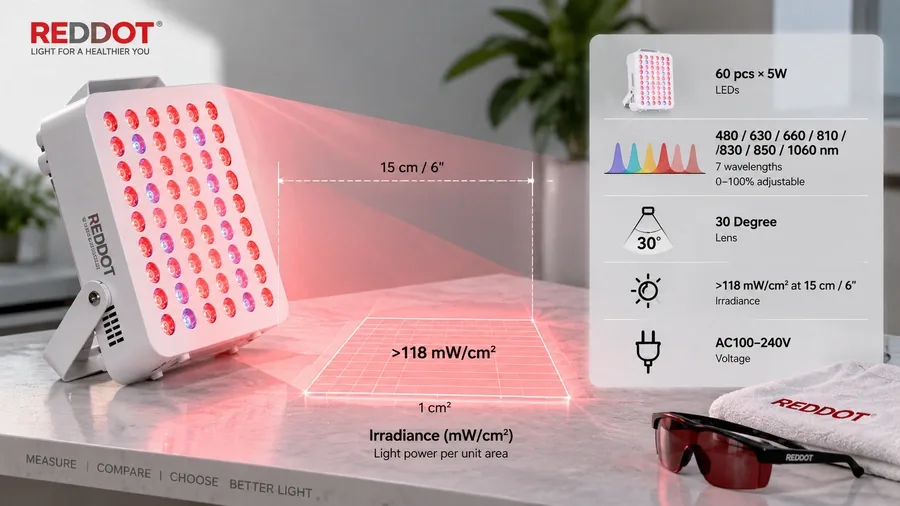
Irradiance measures optical power delivered per unit area. Expressed in milliwatts per square centimeter (mW/cm²), it tells you exactly how much photon energy reaches biological tissue. Total device wattage or raw LED count often misleads buyers who assume higher electrical draw guarantees better clinical results. Irradiance is the metric that actually determines therapeutic delivery. Kevin Zhang, Chief Technology Officer at REDDOT LED, has spent over 15 years working in optical engineering and photobiomodulation. Developing patented light therapy products compliant with IEC 60601 safety standards requires understanding that true irradiance must be physically measured and validated, never simply calculated from marketing claims.
A common misconception dominates online discussions about what irradiance level is best for red light therapy. Superficial blog comments and generic reviews routinely push the highest irradiance red light therapy devices without acknowledging biological limits. Excessive power can inhibit cellular function depending on the application. More light does not automatically mean better outcomes.
B2B buyers, medical device manufacturers, wellness brands, and distributors sourcing photobiomodulation equipment need to grasp this distinction. When learning how to compare red light therapy devices across different engineering criteria, isolating the optical physics of irradiance is the first step toward specifying a safe product. Generic wellness gadgets rarely publish verified optical data, leaving procurement teams guessing. Understanding the measurement separates professional equipment from consumer novelties.
The biphasic dose response: why optimal irradiance is a biological threshold
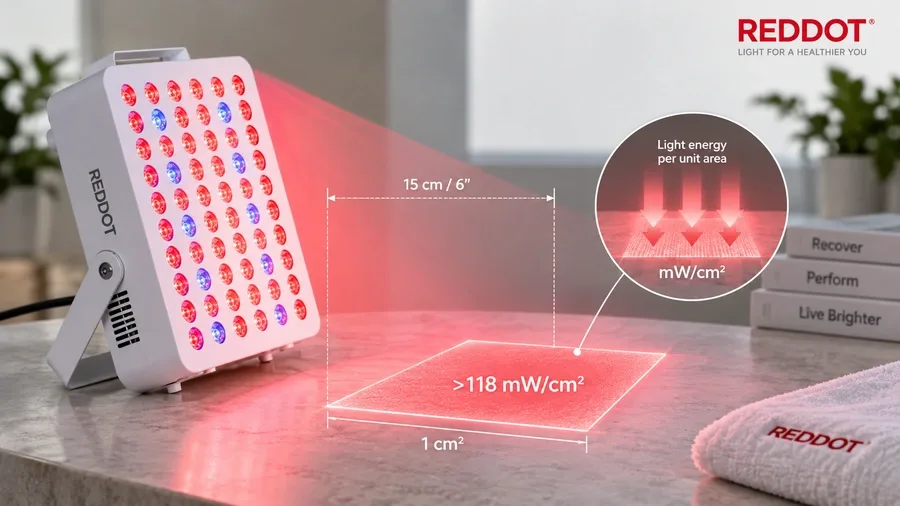
Why doesn’t maximum power always produce the best clinical results? Peer-reviewed research published in journals like Photobiomodulation, Photomedicine, and Laser Surgery explains this through the Arndt-Schulz biphasic dose response curve. Low-to-moderate irradiance stimulates mitochondrial activity via cytochrome c oxidase absorption. Crossing a specific biological threshold triggers an inhibitory response where cellular benefits plateau or reverse entirely. Light acts as a drug. The dose dictates whether the effect heals or hinders.
The Rhinitis Lamp illustrates this mechanism in practice. Its 12x3W LEDs operating at 650nm are intentionally calibrated to deliver a controlled 10mW/cm² irradiance. Localized mucosal tissues are highly sensitive. Applying intense power here would push the tissue past the stimulatory peak into the inhibitory zone of the biphasic curve. Matching irradiance to specific tissue depths is an engineering necessity. WALT (World Association for Photobiomodulation Therapy) standardized dosimetry guidelines publish recommended irradiance ranges tailored to different clinical targets, proving no single universal output exists.
How do manufacturers guarantee these precise thresholds remain stable across thousands of units? Consistent irradiance output requires rigorous multi-stage inspection and manufacturing controls. Facilities operating under ISO 13485 quality management systems maintain the strict process controls necessary for producing reliable medical-grade phototherapy devices. Component variation between production batches can shift optical output enough to alter clinical efficacy. Precision manufacturing prevents biological guesswork.
How lens optics and distance dictate the irradiance you actually receive
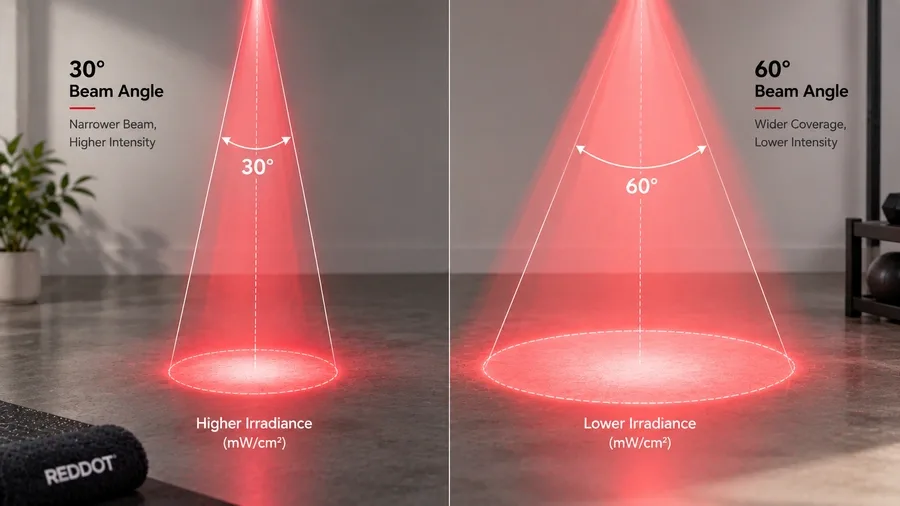
Optical physics governs how LED wavelength, distance, and lens beam angles interact to determine actual irradiance delivery at the tissue surface, as documented in publications like the Journal of Biophotonics. A device’s stated irradiance is meaningless without knowing the exact measurement distance and the lens configuration used during testing. Numbers isolated from their geometric context describe nothing.
Two distinct engineering approaches demonstrate how optics manipulate power density. The EST-X2 Therapy Lamp achieves >200mW/cm² irradiance at 6 inches by using interchangeable 30-degree and 60-degree lens options designed specifically for targeted deep-tissue clinical use. By contrast, the T1 Desktop Panel delivers 35mW/cm² at 15cm using 120pcs x1W LEDs paired with a 30-degree lens. This lower-irradiance architecture ensures safe, close-range facial phototherapy without thermal risk. Wearable configurations fix the distance at zero. Devices like the YD004 Red Light Therapy Belt use 210pcs LEDs at 36W with a 660:850nm 4:1 ratio to deliver consistent irradiance directly to the skin. Direct-contact wearables require carefully balanced LED ratios and moderate power inputs to prevent thermal buildup during home or gym recovery sessions.
Physical assembly constraints impact optical consistency just as much as lens selection. During the development of earlier panel models, the original circuit board design for the RD50 placed solder pads on the outer edge. Workers had to route four wires through the narrow space between the heat sink and the fan bracket. This mechanical stress could subtly shift LED alignment over time, altering the intended beam angle and causing uneven irradiance distribution across the panel. Basic electrical testing misses this failure mode completely. Relocating the solder pads to the center of the board eliminated wire pinching and preserved the precise optical geometry required for uniform light delivery.
Ranking irradiance levels by treatment depth and application
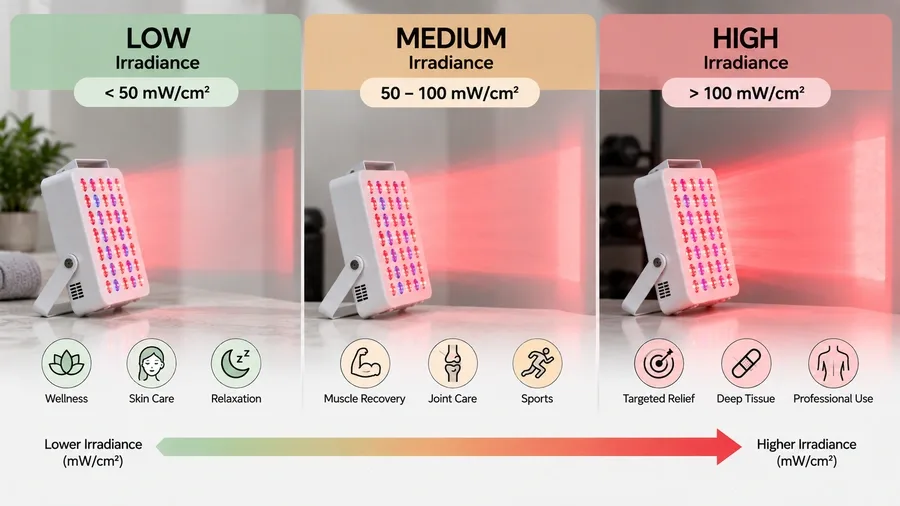
Near-infrared wavelengths targeting muscles and bones must overcome significant scattering and absorption in upper tissue layers, requiring outputs exceeding 100 mW/cm² to ensure therapeutic photons reach the intended depth. IEC 60601-2-57 international standards for non-laser light source equipment establish the framework for categorizing these outputs safely. This ranking guides device developers, OEM/ODM partners, and clinical procurement teams specifying new photobiomodulation products.
Superficial and mucosal applications operate in the 5–20 mW/cm² range. Delicate tissues like nasal mucosa or open wounds cross the inhibitory threshold of the biphasic curve rapidly. They require gentle, sustained photon delivery rather than intense bursts. Strict current regulation prevents micro-fluctuations in output that could irritate sensitive membranes.
Cosmetic and skin-level applications fall in the middle tier at 20–50 mW/cm². Facial skin and shallow dermal layers benefit from moderate stimulation for collagen production without thermal discomfort. Engineering this tier demands balancing LED count with diffusion to avoid hot spots. Large-format devices like the YD007 Red Light Therapy Mat use 945pcs LEDs across a 160×60 cm surface with adjustable gears to maintain this moderate, even coverage for full-body skin and relaxation protocols.
Deep tissue and musculoskeletal applications demand the highest category, ranging from 100–200+ mW/cm². High-density arrays and narrow beam lenses concentrate power to drive photons through dense tissue. Determining what irradiance level is best for red light therapy depends entirely on which of these anatomical targets the device addresses. Specifying the wrong tier renders the hardware either ineffective or biologically counterproductive.
Selecting the right irradiance specification for your device or clinic
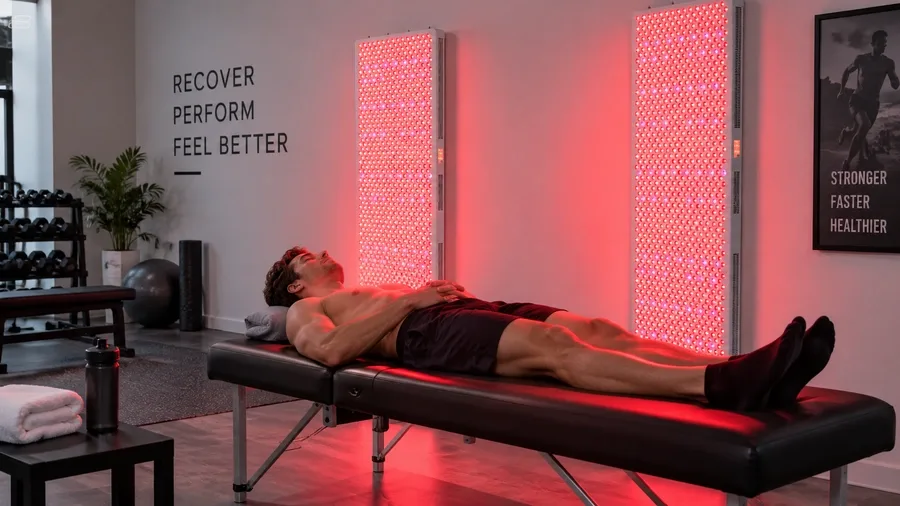
Choosing an irradiance level means matching optical output to the end-user’s primary treatment protocol and environment. B2B buyers and wellness brands must look past raw power specifications. A California sports recovery studio reduced client treatment times by 50% after switching to customized high-irradiance panels supplied by REDDOT LED. By correctly specifying >100 mW/cm² for deep muscle recovery, the studio increased daily throughput and client satisfaction. Intentional irradiance optimization translates directly into commercial value.
Regional regulations complicate this selection process. The country where a device will be sold dictates which safety standards apply, including CE, UKCA, FCC, ETL, or MDSAP. Manufacturers exporting to over 50 countries must ensure their chosen irradiance levels comply with local medical or consumer electronics regulations. Some jurisdictions classify high-irradiance devices differently than low-power wellness tools, affecting import documentation and market access.
Spec sheets provided by off-the-shelf suppliers rarely account for these variables. Device developers should partner with OEM/ODM manufacturers capable of customizing lens angles, LED spacing, and drive currents to hit exact irradiance targets. Follow this sequence when evaluating a potential manufacturing partner:
- Define the clinical target tissue depth before reviewing any hardware catalog.
- Request third-party verified irradiance maps measured at the specific distance your users will maintain.
- Confirm the manufacturer holds relevant regional certifications for the intended output class.
- Validate that the factory operates under a recognized quality management system to guarantee batch-to-batch optical consistency.
Engineering capability determines whether a product performs safely in real-world conditions. This is why understanding irradiance specifications matters before placing a production order.
Key Takeaways
For most red light therapy applications, an irradiance between 30 mW/cm² and 100 mW/cm² at the treatment distance delivers enough photons to stimulate cellular activity without exceeding the biological response window. Matching this output to your specific treatment depth—whether targeting superficial skin or deeper muscle tissue—determines whether a session produces measurable results or simply generates heat.
Frequently Asked Questions
What is the ideal irradiance range for red light therapy?
The ideal irradiance range for general red light therapy falls between 30 mW/cm² and 100 mW/cm² measured at the target treatment distance. Devices operating within this window deliver sufficient photon density to stimulate mitochondrial cytochrome c oxidase, which drives cellular energy production according to established photobiomodulation research. Manufacturers like REDDOT LED design panels to maintain stable output across this range, ensuring users receive consistent dosing session after session.
Can you overdo red light therapy?
Yes, exceeding the optimal irradiance level or extending exposure time too long can trigger a biphasic dose response where therapeutic benefits diminish or reverse entirely. Research in photobiology demonstrates that cells respond to light in an inverted U-shaped curve, meaning doses far above the recommended 30–100 mW/cm² threshold may inhibit rather than stimulate cellular function. Sticking to manufacturer guidelines and clinical protocols prevents tissue from receiving excessive energy that offers no added benefit.
Can red light therapy reverse hair thinning?
Red light therapy can improve hair density in cases of androgenetic alopecia when applied at specific wavelengths, typically 650 nm to 670 nm, with controlled irradiance. Clinical studies indexed on PubMed show that low-level light therapy stimulates dormant hair follicles by increasing local blood flow and ATP production. The treatment works best as an early intervention, as completely scarred or inactive follicles do not respond to photobiomodulation regardless of the irradiance level applied.
What’s the best level for red light therapy?
The best level for red light therapy depends entirely on the target tissue depth and the specific condition being addressed. Superficial skin treatments generally perform well at 30 mW/cm² to 50 mW/cm², while deeper muscle or joint recovery often requires outputs closer to 100 mW/cm² to ensure adequate photon penetration. Standards bodies like the IEC evaluate device safety and performance to ensure these output levels remain within biologically effective and electrically safe boundaries.
References & Sources
- International Electrotechnical Commission (IEC). “Safety Standards for Medical Electrical Equipment.”
- U.S. Food and Drug Administration (FDA). “Regulation of Light-Based Medical Devices.”
- National Institutes of Health (NIH). “Photobiomodulation and Low-Level Light Therapy Research.”
- International Organization for Standardization (ISO). “Quality Management Systems for Medical Devices (ISO 13485).” 2016.
- Wikipedia. “Low-Level Laser Therapy.” 2024. https://en.wikipedia.org