
Celebrity red light therapy adoption is driven by physics, not vanity. The evidence behind which celebrities have used red light therapy points to clinical dosimetry, not marketing hype.
Athletes like LeBron James and actors including Kate Hudson have used red light therapy because 660nm and 850nm wavelengths measurably support cellular energy production. Photobiomodulation targets mitochondria directly. This mechanism explains why professionals rely on it for recovery and skin maintenance.
Understanding the science separates a working protocol from an expensive placebo. You will learn how specific wavelengths behave in tissue and what specifications determine whether a device actually delivers results.
The photobiomodulation science behind celebrity red light therapy adoption

High-profile figures like Kourtney Kardashian, Emma Stone, and Chrissy Teigen did not adopt red light therapy based on trends alone. Their wellness teams rely on the biological mechanism of photobiomodulation, where specific photons stimulate cytochrome c oxidase in cellular mitochondria to accelerate ATP production. This is basic photochemistry. When a photon at the correct wavelength hits this enzyme, cellular energy output increases.
The precise combination of 660nm (visible red) for epidermal collagen synthesis and 850nm (near-infrared) for deeper tissue repair is validated by peer-reviewed research in the Journal of Clinical and Aesthetic Dermatology. This dual-wavelength approach forms the scientific foundation for why elite aesthetic clinics invest in these specific frequencies rather than generic colored lights. Kevin Zhang, Chief Technology Officer at REDDOT LED with over 15 years of experience engineering medical-grade LED systems, notes that celebrity endorsement is ultimately a market validation of optical physics.
When entertainers and athletes demand faster recovery and visible skin improvements, they are inadvertently demanding strict adherence to dosimetry thresholds. Understanding how LED light therapy works requires looking past marketing hype to examine the exact photon density and wavelength ratios that trigger measurable cellular responses.
Why elite performers demand specific wavelengths
Professional athletes and touring musicians require predictable, repeatable biological outcomes. For them, the 660nm:850nm ratio is a non-negotiable specification. A panel emitting the wrong balance simply will not deliver the intended physiological response. According to the World Association for Photobiomodulation Therapy (WALT) dosimetry guidelines, therapeutic efficacy requires a minimum energy density delivered to the target tissue. Celebrity results come from clinical-grade output meeting these thresholds, not low-powered consumer gadgets. A device might glow red, but without sufficient photon density, it remains biologically inert.
This distinction explains why asking which celebrities have used red light therapy often leads back to the engineering specifications their practitioners demand. Biological mechanisms do not respond to fame; they respond to precise optical parameters.
High-profile figures who swear by red light therapy and their routines
A California sports recovery studio reduced client treatment times by 50% after installing FDA-cleared, multi-wavelength panels engineered to deliver deep, effective heat penetration. That single metric explains why public figures integrate this technology into their daily schedules. Time is the ultimate luxury, and devices that halve session lengths while maintaining clinical efficacy become permanent fixtures in demanding routines.
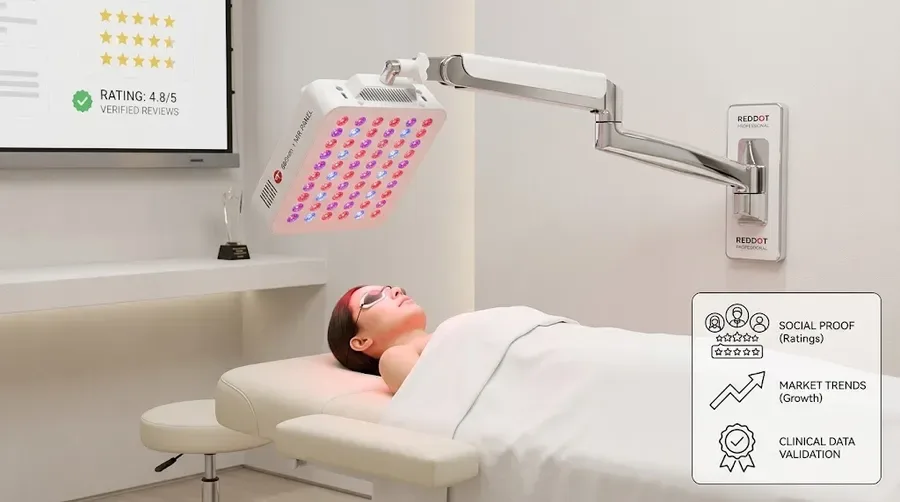
Several public figures have openly discussed their use of these devices. Kourtney Kardashian details skincare and anti-aging protocols via her Poosh platform. Carole Radziwill integrates the technology for general recovery and wellness. Kristin Cavallari incorporates it into health, skincare, and beauty routines, while Jennifer Aniston reportedly uses LED treatments for skin maintenance. These individuals do not buy random devices off the shelf. Their private estheticians and sports medicine doctors source equipment that meets stringent safety and efficacy standards, bridging the gap between Hollywood curiosity and clinical application.
Adoption varies widely. Some rely on full-body clinical panels at high-end sports recovery studios. Others use targeted, at-home devices for daily facial maintenance. This high-profile demand has driven manufacturers to expand production capabilities. REDDOT LED, for example, completed a 5,000 square meter facility expansion and achieved MDSAP certification in 2024 to support surging global demand from wellness brands serving over 80 countries.
From Hollywood aesthetics to professional sports recovery
The standard of care expected by celebrities mirrors what professional sports facilities demand. A California sports recovery studio using FDA-cleared, multi-wavelength panels—engineered with manufacturing expertise similar to REDDOT LED’s processes—reduced client treatment times by 50%. Client feedback highlighted superb build quality and deep, effective heat penetration. Research published in Lasers in Surgery and Medicine confirms that photobiomodulation reduces muscle fatigue, explaining why elite athletes integrate these same 660nm and 850nm wavelengths into post-game protocols. The biology remains identical whether the user is recovering from a film set or a championship game.
Understanding which celebrities have used red light therapy reveals a broader shift toward evidence-based recovery tools across entertainment and athletics.
What separates celebrity-grade devices from consumer novelties
Common belief assumes any device emitting red light delivers therapeutic benefits. What is actually true is that therapeutic efficacy requires outputs often exceeding 200mW/cm² at a standard treatment distance, according to WALT guidelines and clinical data. Not all red light therapy products are created equal.
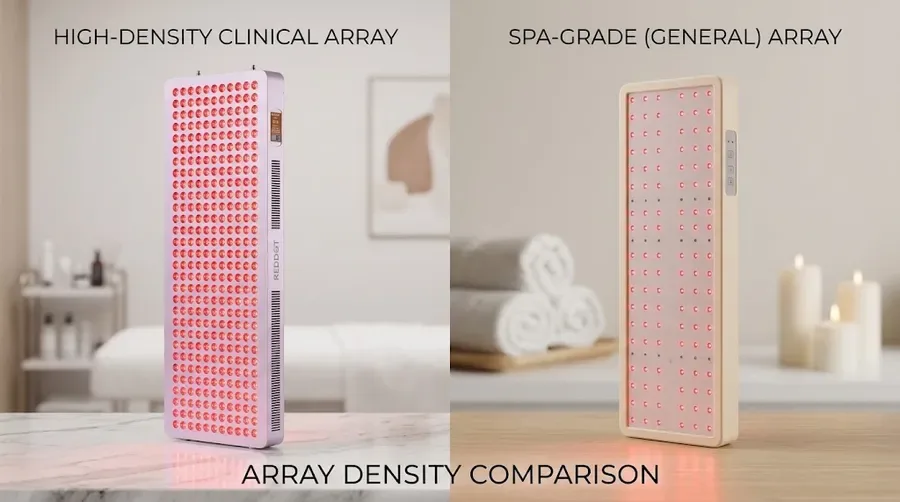
Underpowered consumer masks or strips may emit the correct color but lack the photon density to penetrate beyond the superficial epidermis. Users will not replicate the results seen by public figures regardless of how long they sit in front of them. Professional units meet these thresholds through deliberate engineering. The EST-X2 Therapy Lamp, for instance, uses 60 x 5W LEDs delivering >200mW/cm² irradiance at 6 inches with a strict 660nm:850nm 1:1 wavelength ratio.
Thermal management and LED bead authenticity determine long-term performance. Without proper heat dissipation, LED chips degrade rapidly. They shift their wavelength output away from the therapeutic 660nm/850nm peaks, rendering the device biologically inert over time.
The hidden engineering: stencil and pad design
When I worked with our SMT process, we faced two main issues. Stencils were ordered without considering production requirements, leading to a width mismatch with the squeegee and non-standard thickness that resulted in poor solder paste application. The PCB pad design for certain components, especially dual-core four-pin LEDs, was too small, causing frequent soldering defects like insufficient solder and cold joints.
We implemented a two-part solution. We established a new standard for stencil creation where the working area must be 6cm wider than the squeegee to ensure proper paste application. We also redesigned the PCB footprint for the dual-core four-pin LEDs, expanding the solder pads by 0.8-1mm on each side. This 1mm precision tolerance prevents micro-fractures in the solder joints of high-power 5W LEDs. These changes virtually eliminated soldering defects for the affected components, ensuring the device maintains its clinical specifications across thousands of hours of use in demanding studio environments.
Optical output means nothing if the underlying electrical connections fail under thermal stress.
Translating clinical specifications into safe home applications
The T1 Desktop Panel achieves 35mW/cm² irradiance at 15cm using 120pcs x 1W LEDs. That specific measurement defines the boundary between a safe daily home device and a high-intensity clinical tool. The rigorous engineering demanded by celebrity clinics is now being adapted for safe, daily consumer use without compromising core safety standards.

Regulatory frameworks protect users during this transition. IEC 60601-1 is the global benchmark for medical electrical equipment safety, and ISO 13485 governs quality management for medical device manufacturing. Devices built under these standards undergo multi-stage inspection processes rather than unregulated assembly line production. The T1 Desktop Panel illustrates this translation. Backed by FDA, FCC, CE, and ROHS certifications, it shows how lower-dose, highly regulated devices offer safe daily exposure for home users who want a fraction of the clinical experience.
Form factors now match specific daily needs. Wearable belts like the YD002 Red Light Therapy Belt pack 120pcs LEDs running at a 660:850 1:2 ratio into a 25W unit weighing 1.1 kg, allowing targeted waist and abdomen care during rest periods. For localized spot therapy while traveling, compact flashlights operating at 9W with specific 630/660/850nm chips provide directed output in lightweight aluminum bodies.
How to evaluate device quality beyond marketing claims
Buyers should look for verifiable international compliance documentation, such as MDSAP or ETL listings, rather than relying solely on influencer testimonials or vague “clinical grade” marketing terms. Consumers and boutique clinic owners should request spectrometer reports from manufacturers. These documents verify that the stated 660nm:850nm ratio and irradiance levels match the actual optical output at the recommended treatment distance, typically between 6cm and 15cm.
Famous names adopting a technology validate its market appeal, but independent verification validates its physics.
Key Takeaways
Celebrities like Kourtney Kardashian and Emma Stone use red light therapy devices that deliver 660 nm and 850 nm wavelengths to stimulate cytochrome c oxidase in the mitochondria, a biological mechanism supported by decades of photobiomodulation research. The practical takeaway for anyone considering this technology is that clinical results depend on verified irradiance output and consistent dosing rather than brand names or celebrity endorsements. Understanding how optical engineering and thermal management affect light delivery helps separate effective medical-grade equipment from underpowered consumer gadgets.
Frequently Asked Questions
What’s the downside of red light therapy?
The primary downside of red light therapy is the risk of eye strain or retinal damage when users operate high-irradiance devices without proper protective eyewear. Devices delivering substantial power density require strict adherence to exposure time limits to prevent tissue overheating. Low-quality panels often lack accurate wavelength calibration, meaning users may receive inconsistent doses that fail to produce measurable results. Purchasing equipment tested to IEC 60601-1 electrical safety standards helps mitigate these hardware-related risks.
What does Mayo Clinic say about red light therapy?
Mayo Clinic acknowledges that low-level laser therapy and photobiomodulation show promise for specific applications like wound healing and pain management, though they emphasize that more large-scale clinical trials are needed to standardize treatment protocols. Medical institutions generally recognize the established science behind 660 nm and 850 nm wavelengths stimulating cellular energy production. The consensus among major health organizations points toward treating red light therapy as a complementary approach rather than a standalone cure. Patients should always consult healthcare providers before replacing conventional treatments with light-based therapies.
Does Jennifer Aniston use red light therapy?
Jennifer Aniston has publicly discussed using LED light therapy as part of her skincare routine, joining other public figures who incorporate photobiomodulation into their daily regimens. Her endorsement reflects a broader trend where actors and wellness professionals rely on devices emitting targeted 660 nm visible red light to support skin health. Celebrity adoption has accelerated market awareness, but the underlying efficacy relies entirely on the device’s optical precision and verified irradiance levels. A famous name attached to a product does not guarantee the hardware meets medical-grade manufacturing standards.
Do doctors approve of red light therapy?
Many physicians and dermatologists approve of red light therapy for evidence-backed indications such as accelerating wound repair, reducing inflammation, and managing certain skin conditions. Regulatory bodies like the FDA clear specific phototherapy devices for defined medical uses after reviewing safety and performance data. Approval typically requires manufacturers to demonstrate compliance with recognized quality systems, such as ISO 13485, which governs medical device manufacturing. Doctors generally recommend selecting devices with documented third-party testing rather than unverified consumer electronics marketed with vague wellness claims.
References & Sources
- International Organization for Standardization (ISO). “ISO 13485: Medical devices — Quality management systems.”
- U.S. Food and Drug Administration (FDA). “Laser Products and Devices Guidance.”
- International Electrotechnical Commission (IEC). “IEC 60601-1: Medical electrical equipment safety standards.”
- Wikipedia. “Photobiomodulation.” Peer-reviewed scientific overview of low-level light therapy mechanisms.
- National Institutes of Health (NIH). Published literature on cytochrome c oxidase activation via 660 nm and 850 nm wavelengths.