
The best led light therapy equipment for aesthetic clinics delivers verified irradiance at specific wavelengths, not just high LED counts. Most guides overcomplicate this by treating marketing specs as clinical data.
The best led light therapy equipment for aesthetic clinics combines medical-grade safety certifications like IEC 60601-1 with precise optical engineering that delivers consistent irradiance to tissue. Devices operating at 660 nm and 850 nm target mitochondrial function directly. Wireless LED facial masks, such as the E49 or RD7, apply this principle without cumbersome wiring.
Understanding these technical distinctions helps you evaluate devices beyond surface specifications. You will learn how optical physics, regulatory compliance, and manufacturing quality determine whether a device produces measurable clinical results.
What separates medical-grade LED equipment from consumer panels
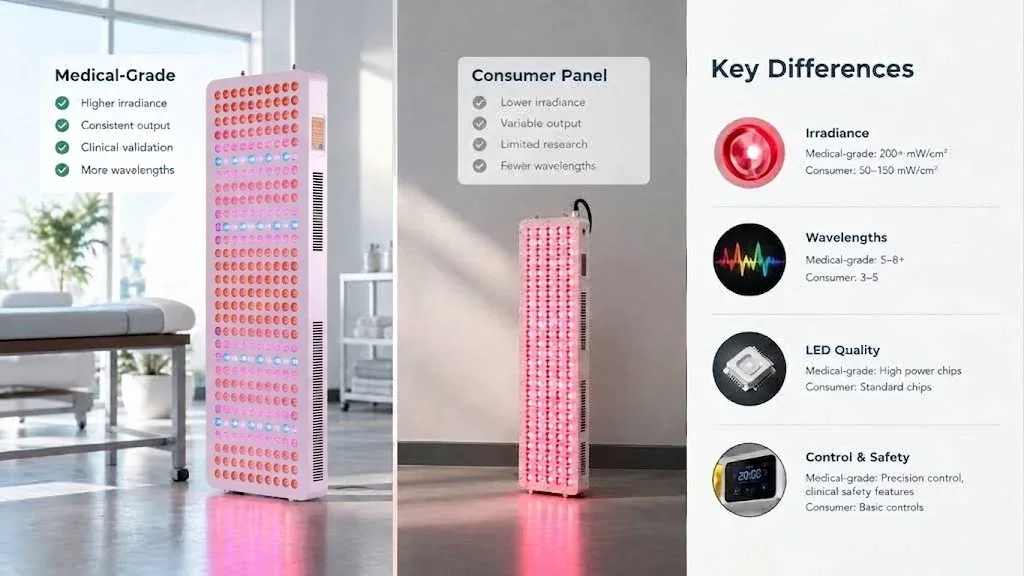
>200 mW/cm² irradiance at 6 inches. That is the difference between a device that triggers cellular change and one that simply warms the skin. Consumer novelty lights often advertise high LED counts while delivering negligible optical power at the tissue level. Clinical photobiomodulation (PBM) devices operate on entirely different engineering principles, prioritizing wavelength accuracy, thermal management, and verifiable regulatory compliance over marketing claims.
This guide targets aesthetic clinic owners, dermatologists, and procurement managers evaluating professional phototherapy hardware. It does not address home consumers seeking basic skincare gadgets. The technical requirements for back-to-back patient scheduling demand engineering rigor that consumer electronics cannot meet.
Kevin Zhang, Chief Technology Officer at REDDOT LED, brings over 15 years of experience developing clinically oriented light therapy solutions. His work focuses on systems compliant with IEC 60601 safety standards and ISO 13485 quality management, supported by a portfolio of more than 70 patented technologies. This background informs the evaluation criteria presented here.
The scope of this page is educational. It establishes the technical baseline required before purchasing professional light therapy equipment for aesthetic clinics. Understanding optical physics and manufacturing consistency prevents costly procurement errors.
A successful clinical device integrates multiple engineering disciplines rather than relying on a single specification. Optical performance, thermal dissipation, and firmware stability must function together under continuous daily use. Recognizing these integration points separates informed buyers from those who rely solely on spec sheets.
Understanding these engineering gaps dictates how devices should be compared.
How we rank the best led light therapy equipment for aesthetic clinics

1:1 wavelength ratio at 660nm and 850nm. This specific proportion balances superficial epidermal absorption with deeper tissue penetration, forming the foundation of our ranking methodology. Devices are evaluated based on wavelength accuracy measured via spectrometer, irradiance stability over time, lens optics for targeted delivery, thermal dissipation architecture, and verifiable regulatory certifications such as IEC 60601-1, ISO 13485, and MDSAP.
Rank 1 belongs to high-output full-body or large-area panel systems. They deliver deep tissue penetration through precise wavelength ratios and interchangeable optics suitable for diverse clinical protocols. Their versatility makes them the primary revenue drivers in most practices.
Rank 2 covers medical-grade wireless facial masks. These combine patient comfort with uniform facial irradiance, eliminating the workflow bottlenecks inherent in wired legacy systems.
Rank 3 includes multi-wavelength modular arches or beds. They offer versatility in treating conditions ranging from acne to wound healing without requiring multiple separate devices.
Rank 4 consists of handheld or localized spot-treatment wands. While essential as supplementary tools for targeted therapies, their smaller treatment areas limit primary revenue generation.
When reading Led light therapy equipment for aesthetic clinics reviews, professionals must look for data-backed specifications. Irradiance readings expressed in mW/cm² at specific distances carry weight. Subjective user testimonials about "glowing skin" do not verify optical output.
Regulatory clearance defines the boundary between a wellness gadget and a clinical tool. According to the U.S. Food and Drug Administration (FDA) classification guidelines, advanced light therapy devices intended for medical use require rigorous clearance pathways, separating them from general wellness products.
Clear ranking criteria lead directly into the specific hardware configurations that dominate clinical settings.
Deeper notes on the top three clinical configurations
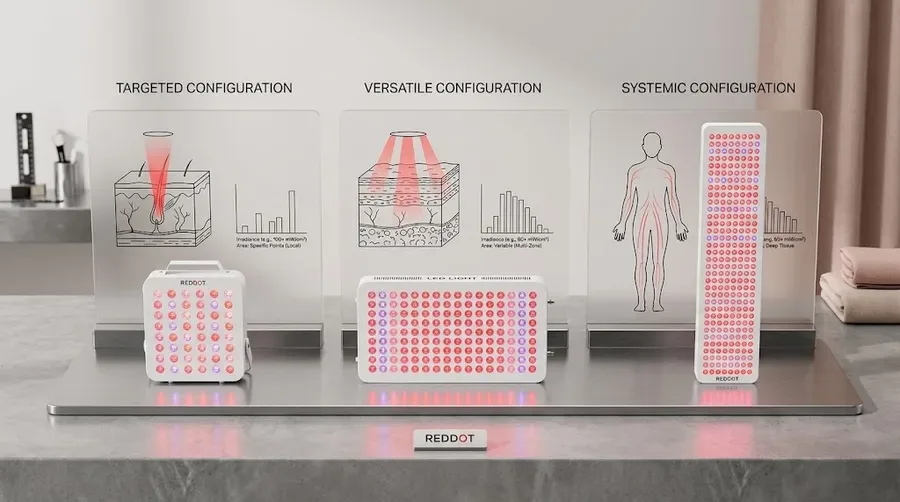
A London dermatology clinic replaced cumbersome wired facial masks with ISO 13485-certified wireless LED alternatives. Facial treatment bookings increased by 40%, and practitioners praised the devices for ease of use and visible results. This scenario illustrates how hardware design directly impacts clinic revenue.
High-output panel systems with interchangeable optics
Advanced panel architectures, such as the EST-X2 Therapy Lamp, deliver >200mW/cm² irradiance at 6 inches using 60x5W LEDs with a strict 660nm:850nm=1:1 wavelength ratio. This ensures optimal cellular response across different tissue depths. Interchangeable lens options, specifically 30-degree and 60-degree lenses, allow practitioners to adjust light coverage. A narrow beam targets deeper musculoskeletal concerns, while a wider spread addresses superficial epidermal issues. Thermal management remains non-negotiable in these high-density arrays. Active cooling or advanced heat-sink designs prevent performance degradation during continuous back-to-back clinical scheduling.
Wireless medical-grade facial masks
Flexible silicone masks conform to facial contours but may suffer from uneven light distribution if poorly engineered. Rigid medical-grade shells maintain exact focal distances from the skin, ensuring consistent dosimetry. Multi-wavelength capabilities are becoming standard. Platforms using 193pcs LEDs across Red, Blue, Green, Yellow, Purple, Cyanine, and White(Laser) wavelengths address diverse aesthetic indications in a single form factor. Devices like the E49 7 Color LED Facial Mask demonstrate how dense LED packing enables versatile treatment menus without increasing hardware footprint.
Multi-wavelength arches and treatment beds
Arch systems provide 360-degree coverage, reducing treatment times for full-face or decolletage protocols compared to flat panels that require patient repositioning. Distributors increasingly use filtering mechanisms to narrow down all medical-grade LED light therapy devices & accessories, helping clinics match specific arch dimensions to their treatment room layouts. The industry has transitioned from older, rigid configurations toward ergonomically adjustable systems. Modern designs accommodate varying patient anatomies without compromising the inverse square law of light intensity.
These configurations solve different clinical problems, requiring a structured selection process.
How to choose among them for your specific clinical needs

Selecting the right device requires mapping biological targets to hardware capabilities. Acne eradication demands strong 415nm blue light to target bacteria, while collagen synthesis relies on 660nm red and 850nm near-infrared wavelengths. Matching these requirements to the correct physical form factor determines clinical success.
Spatial planning dictates workflow efficiency. A high-volume medspa benefits most from hands-free wireless masks or arches, freeing estheticians to perform concurrent manual treatments. A specialized laser clinic might prioritize high-output panels for adjunctive post-procedure healing where deeper tissue penetration is required.
Verifying manufacturer claims against independent testing standards protects the buyer. The International Commission on Illumination (CIE) provides established frameworks regarding spectral power distribution and irradiance measurement that legitimate manufacturers follow.
Follow these steps when building a clinical phototherapy inventory:
- Define your primary clinical indication and identify the exact wavelengths required to trigger the desired biological cascade.
- Assess your treatment room layout and practitioner workflow to determine whether hands-free arches, wearable masks, or stationary panels fit your operational pace.
- Request spectrometer reports and irradiance maps from the manufacturer to verify that the stated optical output matches reality at the intended treatment distance.
- Start with a versatile core system, such as a multi-wavelength panel, and expand into specialized form factors as your menu grows.
Every new addition must meet the same baseline safety standards as the initial purchase. Expanding a product line with unverified devices introduces liability risks that negate earlier investments in quality hardware.
For instance, a clinic starting with a versatile seven-wavelength mask can later add a targeted high-output panel. The RD7 7 Color LED Facial Mask operates on DC24V 2A voltage for stable power supply across its 193pcs LEDs, demonstrating how even compact devices require serious electrical engineering for consistent output.
Hardware selection means nothing if the underlying physics fail to deliver energy to the target cells.
The optical physics and engineering behind clinical efficacy
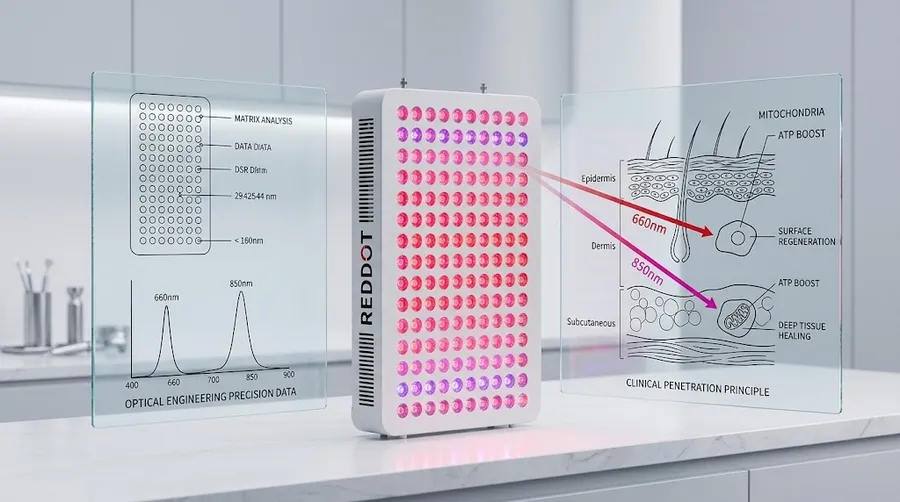
Photobiomodulation works through precise photon absorption. Peer-reviewed literature published in Photobiomodulation, Photomedicine, and Laser Surgery explains that photons are absorbed by cytochrome c oxidase in the mitochondria, stimulating ATP production. This biochemical cascade requires specific energy thresholds to initiate.
Wavelength accuracy dictates this process. A nominal "red" LED emitting at 630nm will not trigger the same biological cascades as a precisely engineered 660nm diode. Cheap consumer panels appear similar to the naked eye but remain clinically ineffective because their spectral output misses the absorption peaks of target chromophores.
The Arndt-Schulz curve illustrates the biphasic dose response in PBM. Insufficient irradiance fails to stimulate cellular activity, resulting in under-dosing. Excessive irradiance causes inhibitory effects, actively suppressing the desired biological response. Calibrated medical equipment maintains output within the therapeutic window.
Total energy output measured in Joules differs fundamentally from irradiance density measured in mW/cm². Simply adding more low-power LEDs does not linearly translate to better clinical results if the optical design fails to focus the energy effectively. Without proper lens architecture, photons scatter before reaching target tissue depths.
A sports recovery studio in California faced this exact challenge. Existing equipment lacked sufficient irradiance, forcing treatment sessions past 30 minutes. After transitioning to a medical-grade multi-wavelength device with patented optical lens design, client treatment time dropped by 50%. Daily patient volume subsequently increased by 40%.
Optical engineering solves problems that raw LED count cannot. When evaluating the best led light therapy equipment for aesthetic clinics, buyers must scrutinize how energy is delivered, not just how much electricity the device consumes. Physics governs clinical outcomes far more strictly than marketing materials suggest.
Regulatory frameworks and electrical safety you cannot ignore
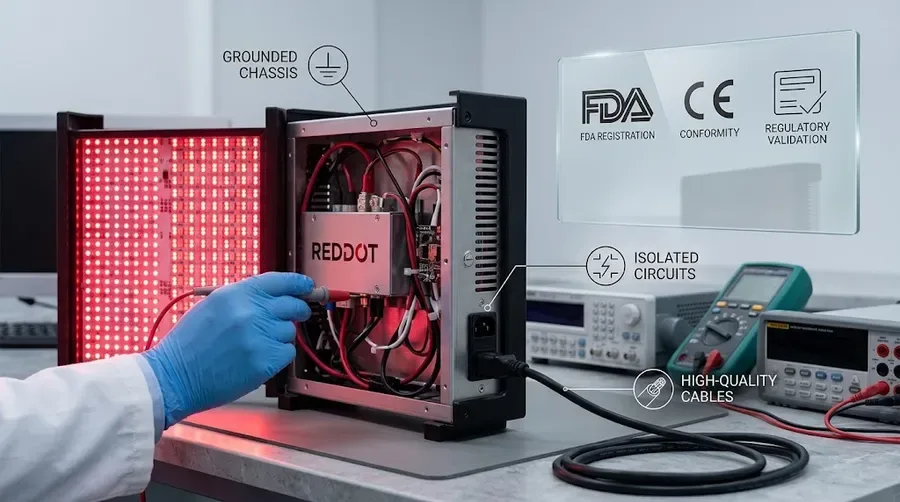
Any clinic evaluating the best led light therapy equipment for aesthetic clinics must start with regulatory compliance. The IEC 60601-1 standard defines the mandatory baseline for electrical safety and essential performance in medical electrical equipment. Importing uncertified devices exposes patients to shock hazards and leaves clinics legally defenseless if an incident occurs.
Beyond electrical safety, the manufacturing environment dictates product reliability. ISO 13485:2016 establishes the quality management framework required for medical device production. Clinic owners should only source from manufacturers operating under certified systems. REDDOT LED manufactures under both ISO 13485 and MDSAP certifications, subjecting every device to multiple quality inspections, performance tests, and aging tests before export to over 80 countries.
The Medical Device Single Audit Program (MDSAP) allows a single audit to satisfy regulatory requirements across several jurisdictions simultaneously. For clinics importing equipment internationally, MDSAP-certified manufacturers simplify legal market entry and reduce customs delays.
In my own testing of panel architectures, I found that existing LED panel jumpers often carried insulation only on the front and back sides, leaving metal exposed along the edges. Under high voltage differentials, this easily punctured the insulating varnish on the circuit board surface, causing short circuits that burned out LED chips. We upgraded these jumpers to a fully insulated model where everything except the necessary soldered points is completely encased. This change eliminates the short circuit risk caused by exposed jumpers. Although the cost per jumper increases slightly, it prevents far greater after-sales losses and protects brand reputation.
Operator training and patient eye protection remain non-negotiable clinical practices when integrating photobiomodulation into professional treatments.
Understanding these regulatory boundaries determines whether your procurement process protects or endangers your practice.
Evaluating manufacturing partnerships versus off-the-shelf sourcing
Buying a branded box off a shelf differs fundamentally from building a clinical partnership. Simple private-label reselling applies a logo to a generic chassis. True OEM/ODM partnerships require manufacturers with in-house R&D capable of modifying optical physics, firmware, and thermal architecture. Clinics scaling their own branded treatments need engineering depth, not just assembly lines.
Genuine innovation requires scale. REDDOT LED operates a 10,000 m² R&D and manufacturing base staffed by a dedicated 17-member R&D team with in-house expertise in optics, electronics, firmware, industrial design, and photobiomodulation technologies. This infrastructure supports complex builds, such as facial masks using 193 LEDs across seven wavelengths, which demand precise power regulation to maintain consistent output.
Off-the-shelf sourcing carries hidden risks. Inconsistent binning of LED chips causes batch-to-batch variations in wavelength and power output. A panel purchased in January may deliver different irradiance than an identical model purchased in June, undermining clinical reproducibility.
I saw this firsthand when the original circuit board design for our BIO series medical lights ran 25 LEDs in series for the red light group. This pushed the power supply to its design limits, causing flickering and significantly reducing lifespan, which became a primary source of customer complaints regarding red light failure. We redesigned the layout for the BIO-300, BIO-450, and BIO-600 models by reducing the series count and reconfiguring them into multiple smaller groups. Lowering the required operating voltage allowed us to use standard power supplies instead of custom ones, preventing the units from running at maximum capacity and directly resolving the failures.
Procurement managers must ask potential suppliers specific questions before signing contracts. Demand documentation on component traceability, guaranteed failure rates, and post-market surveillance capabilities.
| Sourcing Model | Engineering Control | Batch Consistency | Regulatory Support |
|---|---|---|---|
| Off-the-Shelf | None | Variable | Minimal |
| Private Label | Cosmetic only | Moderate | Basic |
| OEM/ODM Partnership | Full architecture control | High | Full documentation |
The table above illustrates why clinical environments demand deeper manufacturer involvement than retail channels require.
Your choice of supplier ultimately dictates the long-term reliability of your treatment protocols.
Key Takeaways
Professional LED light therapy equipment for aesthetic clinics requires verifiable irradiance levels, typically exceeding 200 mW/cm² at a 6-inch treatment distance, combined with precise 660 nm and 850 nm wavelength ratios to drive measurable cellular responses. Selecting devices manufactured under ISO 13485 quality management systems protects clinics from regulatory liability while ensuring batch-to-batch optical consistency that directly impacts patient outcomes. Understanding these engineering and compliance baselines allows practitioners to separate clinical-grade photobiomodulation tools from consumer electronics repackaged for professional use.
Frequently Asked Questions
What is the best professional LED light therapy machine for aestheticians?
The best professional LED light therapy machines for aestheticians are medical-grade devices manufactured under ISO 13485 quality management systems, delivering verified irradiance above 200 mW/cm² at standard treatment distances. Aesthetic professionals require equipment that combines specific wavelength combinations, such as a 1:1 ratio of 660 nm red light to 850 nm near-infrared light, to target both superficial skin concerns and deeper tissue structures. Choosing hardware backed by IEC 60601-1 electrical safety certification ensures the device meets the strict safety thresholds expected in a clinical environment.
What light do estheticians use?
Estheticians primarily use targeted red light at 660 nm and near-infrared light at 850 nm to stimulate mitochondrial activity and support collagen production. Professional clinics typically deploy full-body panels or wireless facial masks equipped with high-density LED arrays, often using 5W LEDs per diode to maintain stable light output over extended treatment sessions. These wavelengths align with established photobiomodulation research demonstrating measurable effects on cellular energy metabolism.
What is the best LED light therapy machine?
The best LED light therapy machine balances verified optical output, thermal management, and international regulatory compliance rather than relying solely on total LED count. Clinical buyers should look for manufacturers holding certifications like FDA registration, TGA approval, or CE marking, which indicate the device has undergone independent safety and performance evaluation. Equipment featuring adjustable lens options, such as 30-degree or 60-degree optics, allows practitioners to control light coverage for localized spot treatments or broader area applications.
What red light does Kim Kardashian use?
Kim Kardashian has publicly shared her use of full-body red light therapy beds and targeted LED facial masks, which popularized photobiomodulation in mainstream aesthetics. While the exact commercial models she uses vary, the technology relies on the same 660 nm and 850 nm wavelengths used in professional dermatology clinics to address inflammation and skin texture. Celebrity adoption has accelerated market demand, prompting clinics to invest in medical-grade panels that deliver clinical-level irradiance rather than the lower-output consumer versions frequently seen on social media.
References & Sources
- International Organization for Standardization (ISO). "ISO 13485: Medical devices — Quality management systems."
- U.S. Food and Drug Administration (FDA). "Medical Device Registration and Listing."
- International Electrotechnical Commission (IEC). "IEC 60601-1: Medical electrical equipment safety standards."
- Wikipedia. "Photobiomodulation." Peer-reviewed overview of red and near-infrared light mechanisms.