
Assuming red and near-infrared light works identically at any hour quietly costs people better sleep and slower recovery. Is it better to do red light therapy in the morning or at night?
Morning sessions generally produce better results for most goals. Red wavelengths around 660 nm stimulate mitochondrial ATP production without suppressing melatonin, supporting daytime cellular energy. Evening use with 850 nm near-infrared light can aid muscle recovery, but bright visible light exposure close to bedtime may delay sleep onset.
The difference comes down to how specific wavelengths interact with your circadian biology and tissue repair cycles. The sections ahead break down the photobiology behind timing, what peer-reviewed research shows about morning versus evening protocols, and how to match a session window to your actual goal.
Why timing matters: the photobiology behind morning versus evening light

Red and near-infrared photons interact directly with cytochrome c oxidase, an enzyme inside mitochondria that drives cellular energy production. Peer-reviewed findings published in the Journal of Biophotonics demonstrate that this photochemical interaction varies depending on the body’s circadian phase. Mitochondria are not static engines. Research in Chronobiology International indicates that cellular ATP production cycles fluctuate throughout the day, meaning mitochondria respond differently to photobiomodulation (PBM) when the body is in an active state compared to a restorative one.
Kevin Zhang, Chief Technology Officer at REDDOT LED with over 15 years of optical engineering experience, emphasizes that understanding these underlying mechanisms is essential before choosing a treatment window. Generic wellness advice rarely accounts for chronobiology. While broader applications exist, such as learning how to add red light therapy to a recovery center for clinical populations, this section focuses strictly on the individual science that dictates personal timing choices.
How specific wavelengths interact with circadian photoreceptors
Melanopsin-driven circadian responses are highly sensitive to blue light but react minimally to deep red. Mitochondrial photoacceptors, however, absorb 660nm and 850nm light regardless of the clock. Red light does not suppress melatonin the way broad-spectrum or blue-enriched room lighting does. This makes it fundamentally safer for evening use.
The role of irradiance in time-of-day dosing
Irradiance measures light intensity delivered to tissue, expressed in mW/cm² according to Illuminating Engineering Society (IES) measurement standards. The intensity must match the biological goal. Higher irradiance suits daytime cellular energizing. Lower irradiance supports evening recovery without overstimulating the nervous system.
Does red light disrupt sleep if used at night? No. Because 660nm and 850nm wavelengths bypass melanopsin receptors, they do not trigger the melatonin suppression associated with standard artificial lighting.
Should I change my device settings based on the time of day? Yes. Match higher irradiance levels to morning sessions for energy, and lower irradiance to evening sessions for relaxation.
Understanding the photobiology behind timing clarifies why morning protocols produce distinctly different physiological outcomes than evening ones.
What the research says about morning red light therapy protocols
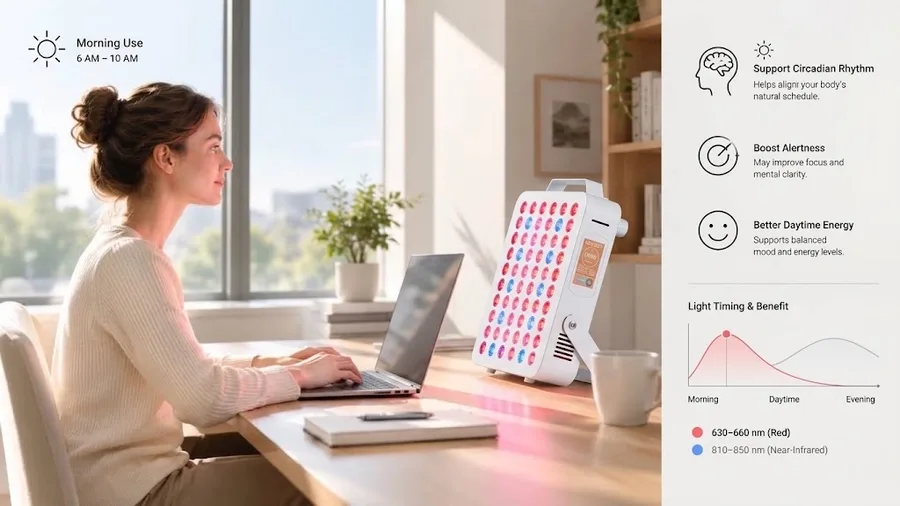
Clinical data published in Photobiomodulation, Photomedicine, and Laser Surgery indicates that morning PBM sessions enhance daytime alertness, support mitochondrial energy production, and prepare tissues for physical stress. Morning red light therapy is generally better for boosting cellular energy, enhancing alertness, and preparing tissues for daily activity, utilizing higher irradiance levels and balanced 660nm/850nm wavelength ratios. The World Association for Photobiomodulation Therapy (WALT) dosage guidelines recommend specific session lengths and Joules per square centimeter (J/cm²) that align well with morning energizing goals.
The T1 Desktop Panel illustrates morning-appropriate engineering. Its 120pcs x 1W LEDs with a balanced 660nm:850nm = 1:1 wavelength ratio deliver 35mW/cm² irradiance at 15cm. This provides precise close-range output for a morning desk routine. Morning protocols benefit from a 1:1 ratio because equal distribution of surface-level red and deeper-penetrating near-infrared light supports skin health and systemic energy simultaneously.
Wavelength ratios engineered for daytime activation
A 1:1 ratio differs functionally from other configurations early in the day by balancing epidermal stimulation with deeper tissue penetration. REDDOT LED’s 17-member R&D team relies on a proprietary IP portfolio of over 70 granted patents to develop lens options that alter light delivery density. For instance, 30-degree and 60-degree beam angles allow targeted morning treatments by concentrating or spreading photon delivery.
How many minutes should a morning session last? Following WALT dosage guidelines, most morning sessions require enough time to deliver the recommended J/cm² dose, which typically translates to several minutes at close range depending on the device’s irradiance.
Why is a 1:1 wavelength ratio preferred in the morning? Equal parts 660nm and 850nm stimulate both superficial skin layers and deeper muscle tissue simultaneously, matching the body’s need for whole-system activation after waking.
Morning protocols establish a baseline of cellular energy that carries through the first half of the day.
Benefits of evening red light therapy for recovery and sleep
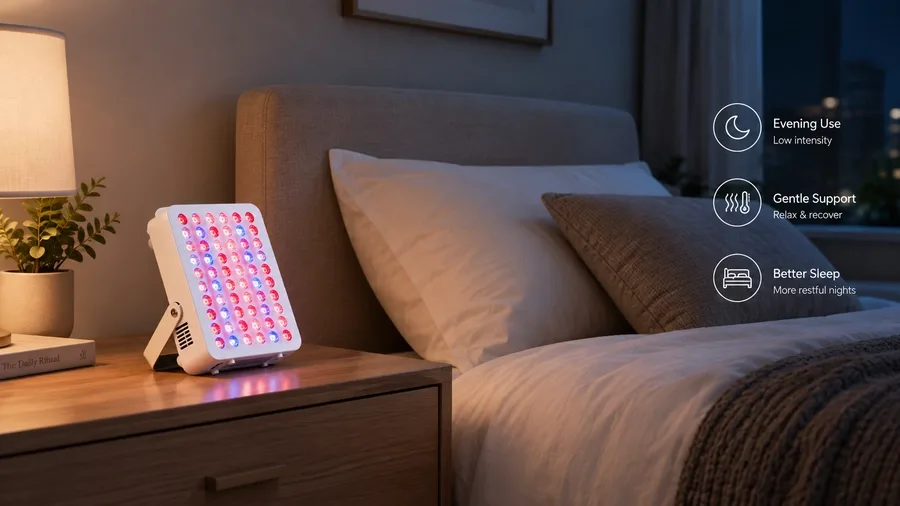
Evening application shifts the focus from energizing data to restorative biology. Research points toward muscle relaxation and sleep quality improvement when PBM is applied later in the day. The Rhinitis Lamp represents an ideal evening application. Its 650nm wavelength operates at a low 10mW/cm² irradiance. Housed in a compact 8x2cm, 0.78kg design, it suits localized, low-intensity bedside therapy right before sleep. Evening users should opt for devices with lower irradiance and targeted form factors. This avoids systemic overstimulation while delivering therapeutic photons to localized areas like joints or sinuses.
For broader coverage, the YD004 Red Light Therapy Belt uses 210pcs LEDs at 36W power with a 660:850 4:1 ratio. Its heavy emphasis on 660nm red light provides excellent superficial recovery for skin and shallow muscle tissue after a workout. It avoids driving near-infrared energy too deeply into large muscle groups late at night. Alternatively, a 9W therapy flashlight weighing just 76g offers another highly portable option for pinpoint bedtime muscle relief without complex setup.
Why low irradiance prevents sleep disruption
Excessive near-infrared exposure late at night could theoretically raise core body temperature or increase metabolic rate. This may interfere with the natural thermal drop required for sleep onset. Devices engineered for evening use prioritize localized, low-power delivery to support the body’s transition into parasympathetic dominance.
Form factors designed for nighttime routines
Physical design matters as much as optical output for evening compliance. Lightweight, quiet, and easily positioned devices prevent frustration in a dim bedroom environment.
- Choose a device under 1kg so you can position it comfortably on a nightstand without heavy mounting hardware.
- Select units with silent cooling or passive heat dissipation to maintain a quiet sleeping environment.
- Look for simple button or remote controls rather than bright touchscreens that emit disruptive blue light.
Evening protocols succeed when the hardware respects the biological requirement for calm.
Factors to consider when choosing your optimal treatment window
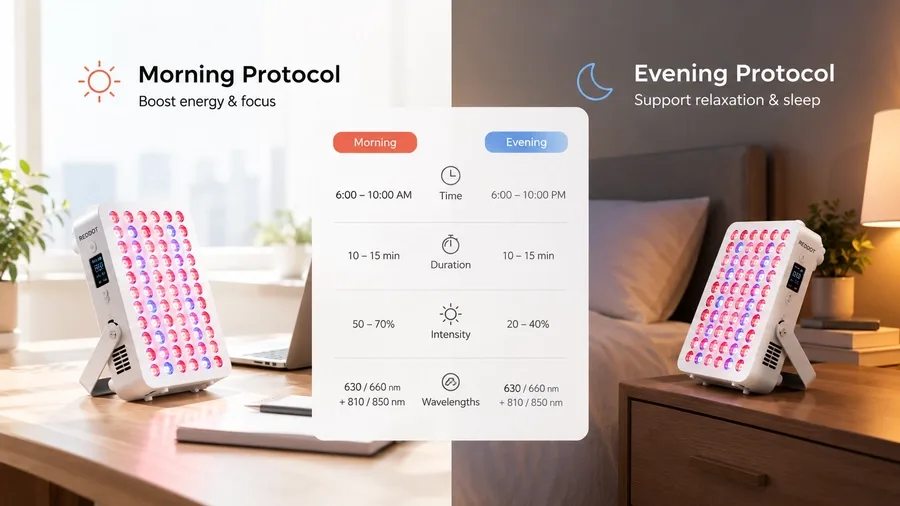
Deciding whether to schedule red light therapy in the morning or at night requires evaluating primary therapeutic goals, available time, and consistency. Energy seekers lean toward morning; recovery-focused users lean toward evening. Device consistency determines long-term success. REDDOT LED’s adherence to IEC 60601-1 safety standards and ISO 13485 quality management ensures stated irradiance and wavelength outputs remain stable over time. Fluctuating power output invalidates consistent circadian timing protocols. When working with custom medical lights, customers reported that parameter labels had insufficient adhesive quality, peeling up at the corners and losing stickiness.
Proposing a switch to a transparent sticker similar to the Biomax product line resolved this. This minor manufacturing detail reflects the broader commitment to precision required for devices used in strict daily timing protocols.
Comparing wearable belts illustrates how wavelength ratios dictate timing. The YD002 Red Light Therapy Belt contains 120pcs LEDs at 25W with a 660:850 1:2 ratio. Its higher proportion of 850nm near-infrared light makes it highly effective for deeper muscle recovery. This profile fits post-workout or early evening use rather than immediately before bed. By contrast, a wearable belt with 105pcs LEDs and an 18W power draw offers a gentler 660:880 3:2 ratio suitable for relaxed home living room care.
Matching your biological goal to the clock
Map specific needs to the biologically appropriate time of day. Chronic fatigue responds best to morning energizing protocols. Sports recovery often benefits from early evening application. Avoid the common mistake of using high-powered, full-body panels late at night simply because they are available. More power disrupts circadian biology when applied at the wrong hour.
The importance of optical engineering in timing efficacy
Marketing claims about “anytime use” ignore the physics of light delivery. Precise optical engineering, validated by international standards, allows a user to trust their chosen protocol.
- Define your primary goal as either daytime energy or nighttime recovery.
- Verify your device’s irradiance matches that specific biological goal.
- Confirm the manufacturer holds relevant safety certifications to guarantee output stability over months of daily use.
Timing a session correctly only works when the device delivers exactly what its specifications promise.
Key Takeaways
Morning sessions using 660 nm red light align with the body’s natural cortisol awakening response to support daytime cellular energy, while evening applications at 850 nm near-infrared wavelengths are better suited for muscle recovery without disrupting melatonin production. Matching your session timing to your specific goal determines whether the photobiomodulation supports alertness or tissue repair.
Frequently Asked Questions
Is it better to do red light therapy in the morning or at night?
The optimal timing depends on your primary goal, as morning exposure supports circadian alignment and daytime energy while evening use favors physical recovery. Research published in the Journal of Biophotonics indicates that red and near-infrared photons interact directly with cytochrome c oxidase inside mitochondria to drive cellular energy production. Scheduling your session around this mechanism means a morning routine generally benefits metabolic activation more than a late-night one.
Does red light therapy affect sleep if used at night?
Red light therapy does not suppress melatonin the way blue-enriched light does, making it safer for evening use than standard room lighting. Wavelengths at 660 nm and 850 nm lack the short-wavelength energy required to trigger the intrinsically photosensitive retinal ganglion cells responsible for circadian disruption. Keeping sessions moderate in duration helps ensure the treatment supports recovery without interfering with sleep onset.
Can I do red light therapy twice a day?
Yes, splitting sessions into a morning and evening routine is a common approach for individuals targeting both systemic energy and localized tissue repair. Photobiomodulation follows a biphasic dose response, meaning cells respond best to a specific range of total light energy rather than unlimited exposure. Spacing treatments allows mitochondria to process the photon absorption from each session independently.
How long should a morning red light therapy session last?
A typical morning session lasts between 10 and 20 minutes depending on the device irradiance and the treatment distance. Devices delivering an irradiance of at least 30 mW/cm² at the stated distance provide sufficient photon density within this window to stimulate cytochrome c oxidase effectively. Exceeding 20 minutes rarely provides additional benefit due to the saturation point of mitochondrial light absorption.
What is the best wavelength for morning red light therapy?
A wavelength of 660 nm is widely used for morning sessions because it penetrates superficial tissues efficiently to support skin health and general cellular metabolism. Many clinical devices pair 660 nm red light with 850 nm near-infrared light in a 1:1 ratio to cover both shallow and deeper tissue targets simultaneously. This combination addresses surface-level concerns while reaching underlying muscle structures.
Should I use red light therapy before or after a workout?
Using red light therapy before a workout can prime muscles by increasing local blood flow and preparing mitochondria for exertion, while post-workout application targets exercise-induced inflammation. Studies referenced by organizations like the World Association for Photobiomodulation Therapy indicate that near-infrared light at 850 nm reaches deeper muscle tissue to aid in recovery. The choice depends on whether the priority is performance preparation or accelerated repair.
References & Sources
- World Health Organization. “Radiation and Health.”
- International Electrotechnical Commission (IEC). “IEC 60601-1 Medical Electrical Equipment Safety Standards.”
- International Organization for Standardization (ISO). “ISO 13485 Medical Devices Quality Management.”
- Wikipedia. “Photobiomodulation.”
- Hamblin, M.R. “Mechanisms and applications of the anti-inflammatory effects of photobiomodulation.” AIMS Biophysics. 2017.
- de Freitas, L.F., Hamblin, M.R. “Proposed Mechanisms of Photobiomodulation or Low-Level Light Therapy.” IEEE Journal of Selected Topics in Quantum Electronics. 2016.
About the Author
Kevin Zhang is the Chief Technology Officer at REDDOT LED, where he directs research and engineering for medical-grade photobiomodulation devices. With over 15 years of experience in LED technology, his work focuses on optical design, thermal management, and international regulatory compliance across standards including ISO 13485, MDSAP, FDA, and IEC 60601-1. He oversees product development for global OEM and ODM partners requiring precise, clinically relevant light therapy hardware.